
A fluid bed dryer vs tray dryer comparison starts with the wet feed and the required product, not the equipment price. A dry-looking granule, cohesive wet cake and temperature-sensitive ingredient can demand different drying conditions. Before comparing quotations, identify whether “tray dryer” means a conventional hot-air cabinet or a vacuum tray system.
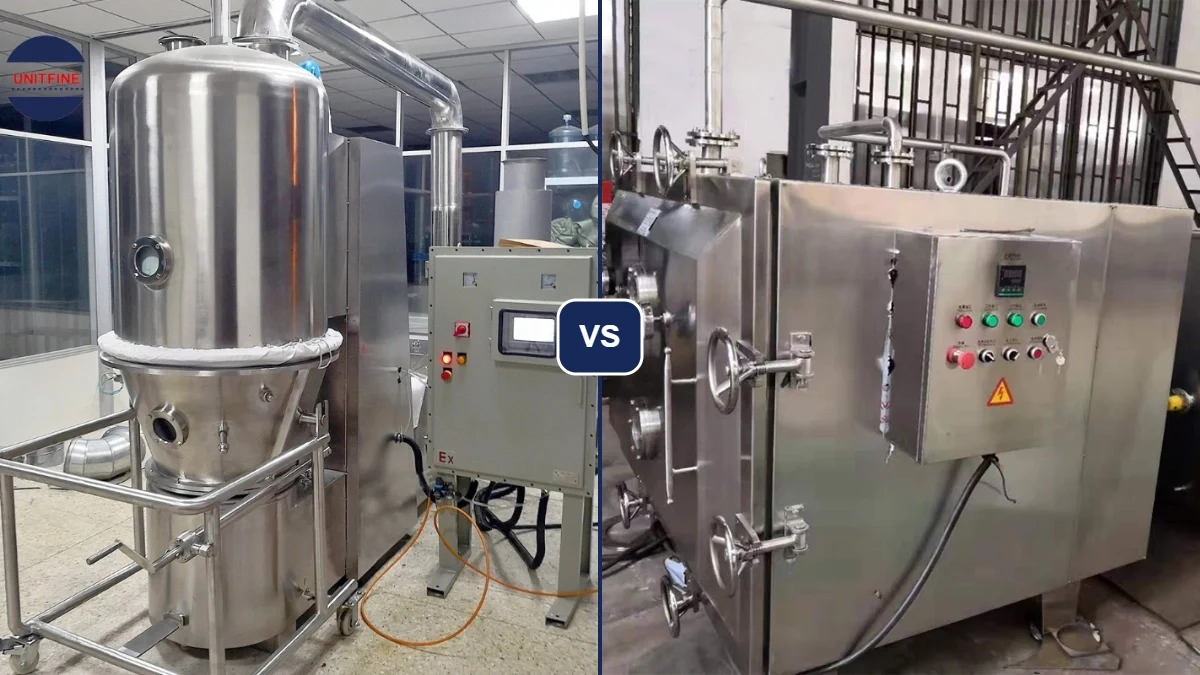
Quick answer: Consider fluid bed drying when the feed can fluidize in the proposed configuration and tolerate the associated particle movement. Consider tray drying when a stationary layer is appropriate, while confirming heat transfer, layer depth and loading consistency. Vacuum tray drying is a separate pressure and vapor-handling option. Neither technology is universally faster, cheaper or more suitable for sensitive materials; compare trials against the same moisture and quality endpoint.
How do fluid bed and tray dryers differ?
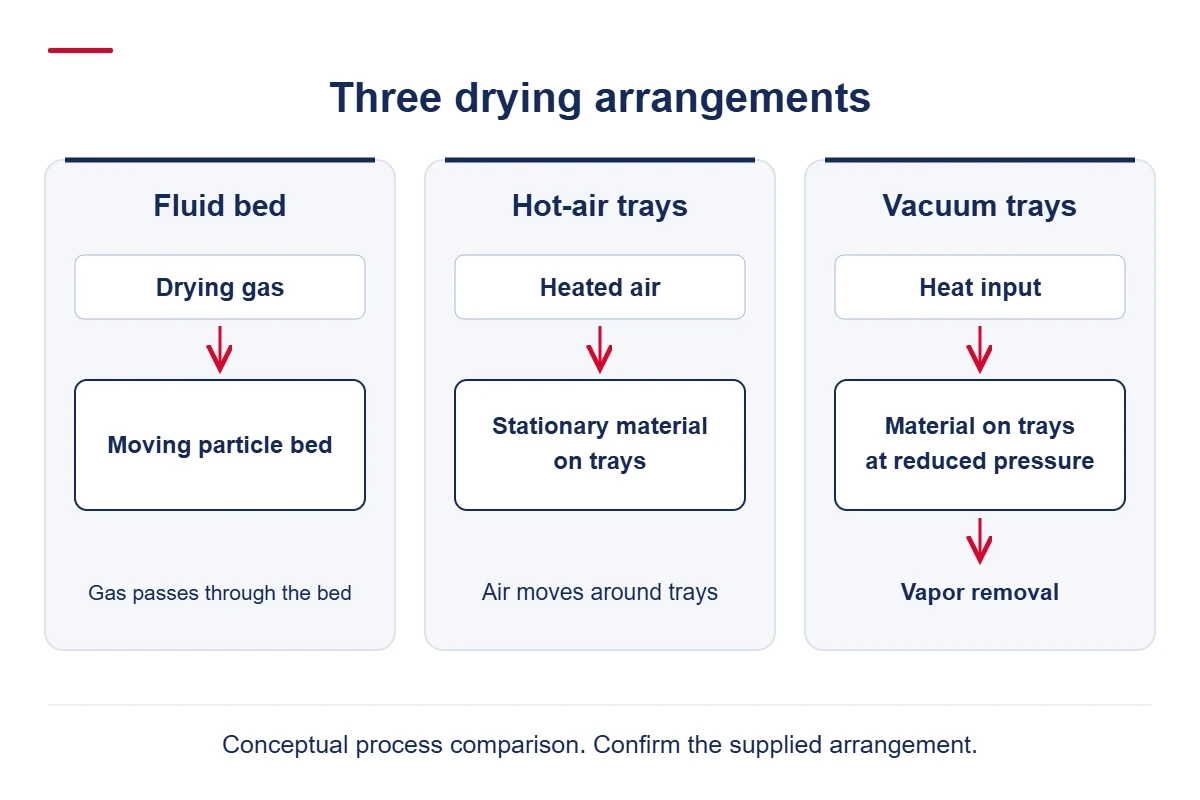
Fluid bed: contact between drying gas and moving particles
In a fluid bed dryer, gas passes through a particulate bed and supports particle movement. The intended contact depends on the feed and gas distribution working together. A material that flows well after drying may behave very differently when first charged wet. Sticky or cohesive regions can prevent consistent bed behavior, so dry-powder descriptions are not enough for selection.
Ask which type of fluid bed the supplier proposes, how feed enters and how the dry product leaves. Batch, continuous, vibrated and other assisted arrangements should not be treated as interchangeable. The equipment name does not establish residence time, the permissible fines fraction or a guaranteed moisture distribution.
Tray drying: distinguish hot air from vacuum
Tray dryers hold material in a defined layer on multiple trays. In a hot-air design, heated air moves around the loaded trays. A vacuum tray system instead combines reduced pressure with its specified heating and vapor-removal arrangement. Tray quantity alone does not describe the usable loading or drying duty.
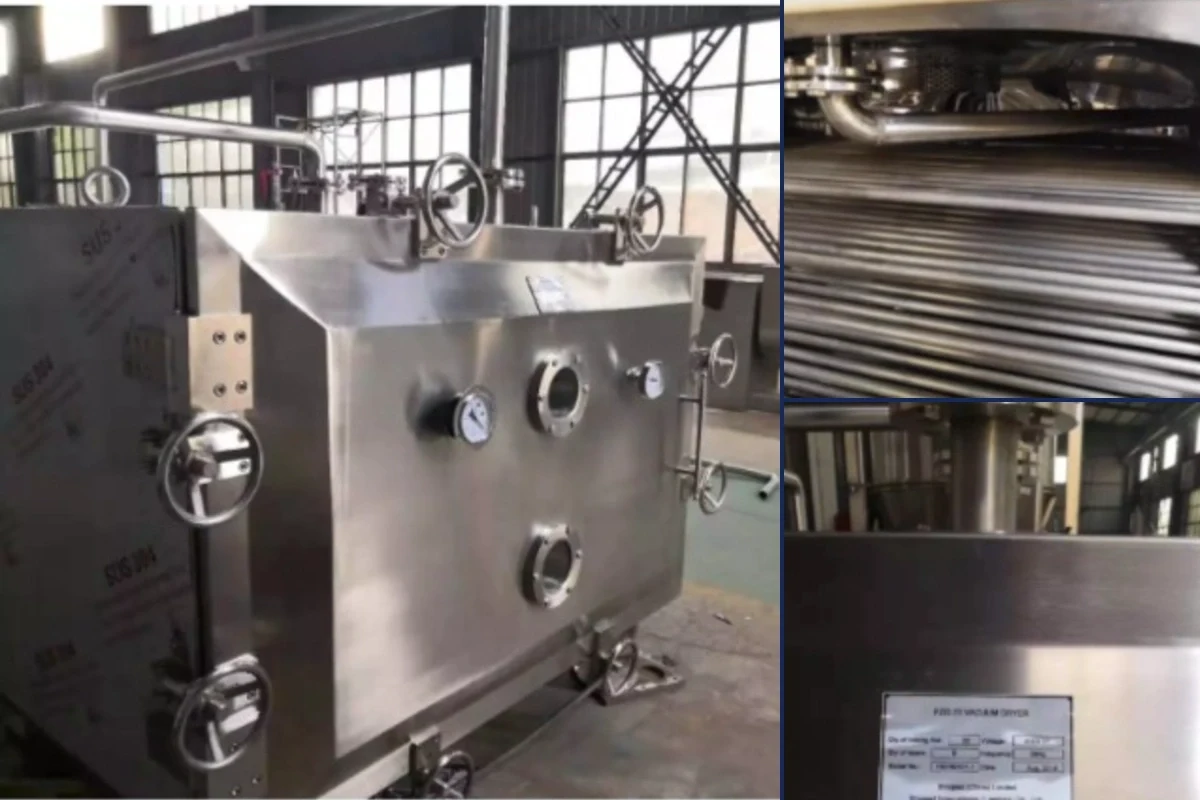
The UNITFINE FZG vacuum tray dryer belongs to the vacuum category. It should not be presented as a conventional hot-air tray cabinet. Review the offered chamber, heating arrangement, vacuum system and any vapor-recovery requirement as one configuration.
Fluid bed dryer vs tray dryer: procurement comparison
| Decision factor | Fluid bed dryer | Tray dryer |
|---|---|---|
| Material behavior | Particles must fluidize in the selected design. | Feed remains on trays; handling and bed depth still matter. |
| Heat and mass transfer | Drying gas contacts a moving particulate bed. | Hot-air and vacuum tray designs use different heat-transfer conditions. |
| Product movement | Fluidization can create fines or attrition in susceptible products. | Static placement reduces movement during drying; loading and unloading can still damage product. |
| Uniformity | Distribution depends on bed behavior, gas distribution and loading. | Distribution depends on loading, tray position and the specified heat/vapor arrangement. |
| Cycle and capacity | Compare the full process cycle and acceptable dry output. | Include filling trays, transport, heating, cooling and unloading. |
| Utilities and cost | Review gas flow, heating, exhaust collection and ancillary loads. | Review heating and air handling; vacuum designs also need vacuum and vapor-system assessment. |
Use this table to organize a supplier discussion, not to approve a material automatically. Product-specific trials should resolve uncertain feed behavior, quality change and drying endpoints before a purchase decision.
Which feed characteristics should you check first?
Wet-state behavior and particle integrity
Send a representative wet sample with information about particle distribution, bulk density, stickiness, agglomerates and how the feed changes during storage. Describe any pretreatment or upstream dewatering. State whether the product must retain granule size or shape after drying; visual appearance alone cannot establish that requirement.
A fluidization trial should examine bed stability, material carryover and any increase in fines. A tray trial should examine spreading, removal from the tray and variation through the layer. A result from a specially conditioned laboratory sample may not represent normal production feed. Record those differences explicitly.
Moisture definition and temperature exposure
Specify both the incoming moisture and final target, including whether the result is reported on a wet or dry basis and how it is measured. Two quoted moisture values cannot be compared fairly if the basis or test method differs. Identify the liquid being removed rather than assuming all feeds contain only water.
Separate heating-medium or inlet-gas temperature from the product temperature. A material limit applies to the product and its exposure history, not simply the heater setting. Ask how the proposed trial will monitor product condition and check agreed quality attributes alongside moisture.
Compare complete cycles, quality and operating cost
Do not compare the fluid bed drying stage with an entire tray-dryer shift. Define the same boundary for both proposals: charging, preparation, heating, drying, cooling where needed, discharge, cleaning and readiness for the next batch. Include any upstream handling or downstream collection required for an acceptable product.
Compare usable dry product output at the agreed quality endpoint. A quoted wet-feed batch mass does not directly establish water removal or saleable output. Require the supplier to state the feed basis, initial and final moisture, operating assumptions and the auxiliary equipment included in its estimate.
Energy comparisons should use the same duty and include the specified auxiliaries. Depending on the system, these can include fans, heating, cooling, vacuum equipment and vapor treatment. Installation, cleaning labor, product losses and changeovers may alter the decision. No fixed energy-saving percentage follows from the dryer family name.
Review cleaning, containment and the surrounding process
Describe the actual cleaning method, changeover frequency and material-contact expectations. Ask which surfaces and components require access, how retained material is handled and how cleaning will be checked. Do not infer a hygienic qualification, sterile process or particular material grade from a photograph or a general brochure.
For solvent-containing feed, combustible dust or other hazardous material, provide the relevant material information before selecting equipment. Suitability depends on a review of the whole proposed system and the installation requirements. A standard vacuum chamber or an air-heated dryer is not automatically a solvent-safe configuration. This comparison is not a safety design or an operating procedure.
Prepare a comparable trial and quotation request
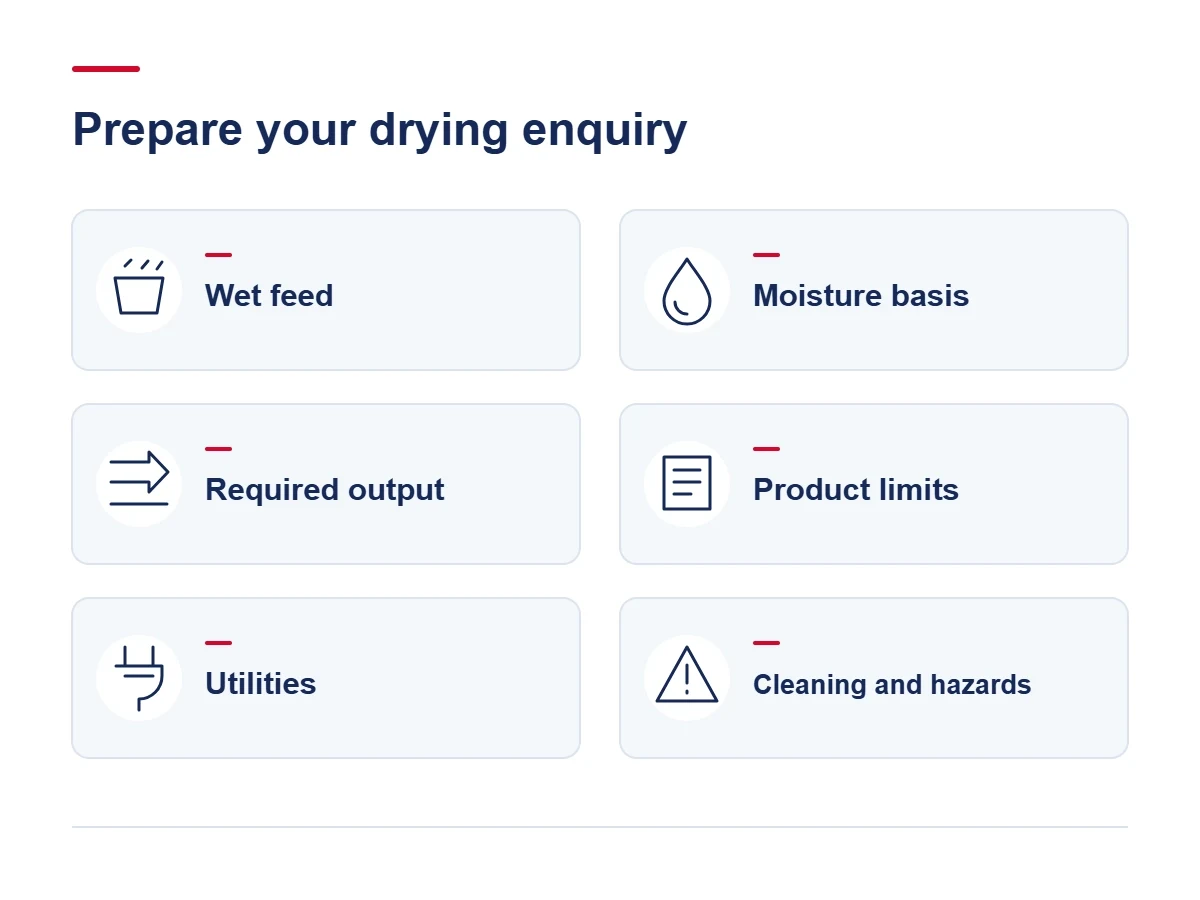
- Define the wet feed: particle form, liquid identity, moisture basis, density and difficult handling behavior.
- State the duty: batch or hourly demand, upstream preparation, available shift time and downstream handling.
- Agree the endpoint: final moisture method, product temperature limits and relevant quality attributes.
- Compare trial records: actual feed preparation, loading, operating conditions, collected product and any losses.
- Confirm the supplied boundary: dryer, utilities, auxiliaries, controls, installation and cleaning responsibilities.
Ask for the conditions under which a trial result applies. Keep a record of what still needs confirmation when the production formulation, scale or handling route changes. An attractive quotation without these boundaries is difficult to compare with another proposal.
Frequently asked questions
Is a fluid bed dryer always faster than a tray dryer?
No. Fluidization can improve gas–solid contact for suitable particles, but the complete cycle also depends on moisture removal, loading, heating, cooling and cleaning. Compare representative trials to the same final product specification rather than accepting a universal time advantage.
Can wet powder go directly into a fluid bed dryer?
Only when its wet-state behavior is compatible with the proposed bed design. Fine cohesive powder, sticky feed or agglomerates may not fluidize consistently. Review representative wet feed and trial the specified configuration; a powder label alone does not establish suitability.
Is a vacuum tray dryer the same as a hot-air tray dryer?
No. A vacuum tray dryer operates at reduced pressure with its specified heat supply and vapor-handling system. A conventional hot-air tray dryer usually relies on heated air moving around stationary trays. Compare their operating pressure and heat-transfer arrangements explicitly.
Which dryer is better for a heat-sensitive material?
There is no universal choice. Assess allowable product temperature, exposure time, moisture endpoint and quality changes. Vacuum tray drying may be worth evaluating when reduced-pressure processing is appropriate, while a suitable fluid bed may be evaluated for controlled gas–solid drying. Confirm the result by trial.
Can either dryer handle a solvent-containing feed?
Do not assume that a standard air dryer or vacuum chamber is suitable. Give the supplier the solvent identity, loading and hazard information. The complete system requires a configuration-specific review of containment, vapor handling, compatibility and applicable site requirements.
What information is needed for a dryer quotation?
Provide wet-feed properties, batch or hourly demand, initial and target moisture with the reporting basis, liquid identity, temperature and quality limits, utilities, cleaning needs and installation constraints. Include a representative sample and an agreed trial acceptance method.
Discuss your drying duty with UNITFINE
Send your wet-feed data, moisture endpoint, quality limits and operating constraints. Review the GFG fluid bed dryer and FZG vacuum tray dryer as separate configuration enquiries, or explore the drying equipment range. Product identity does not substitute for material trials.
Send your dryer selection enquiry. Ask which trial evidence and configuration details are still needed before an offer can be assessed.