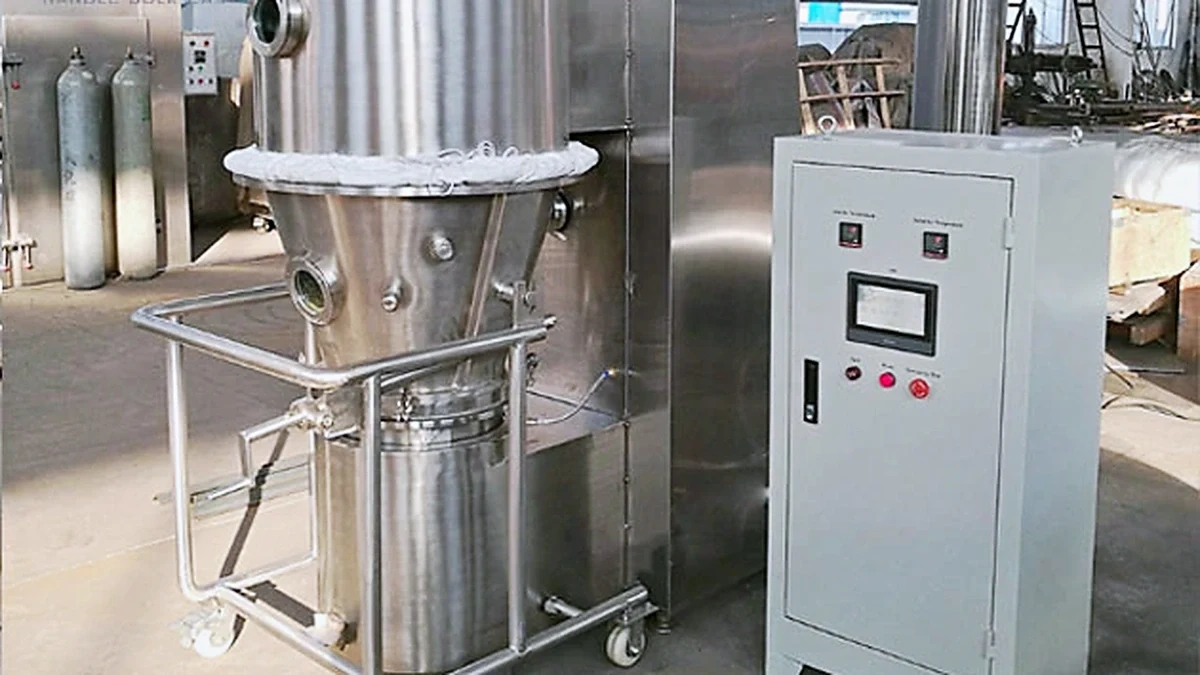
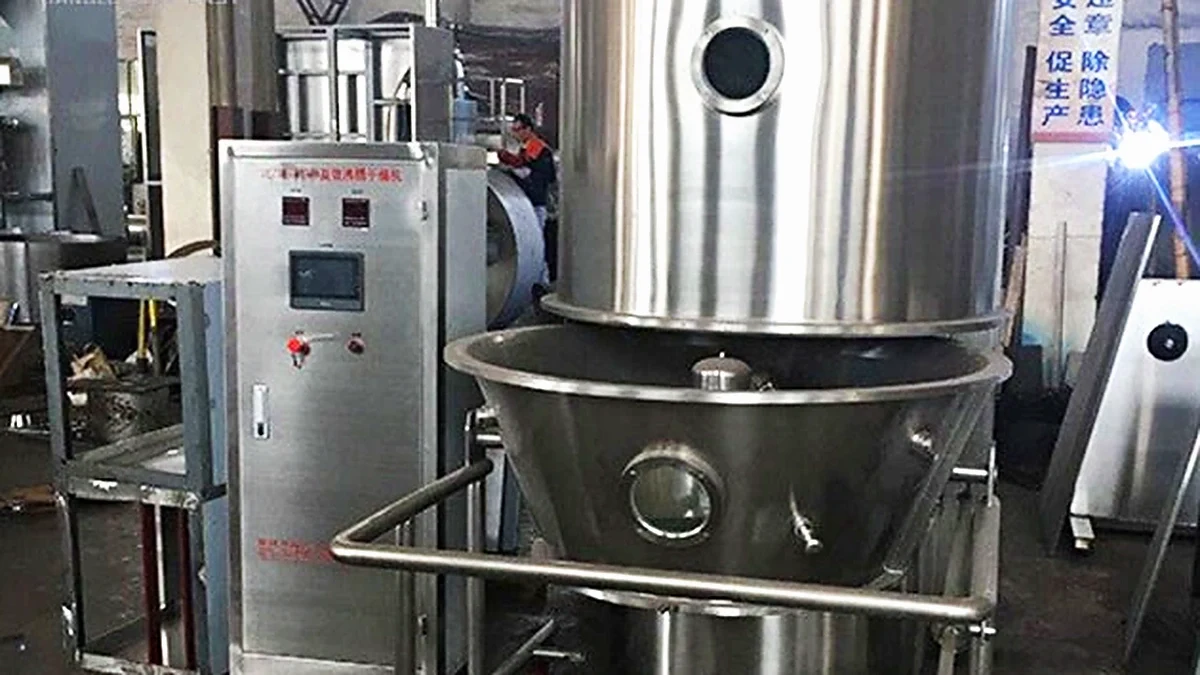
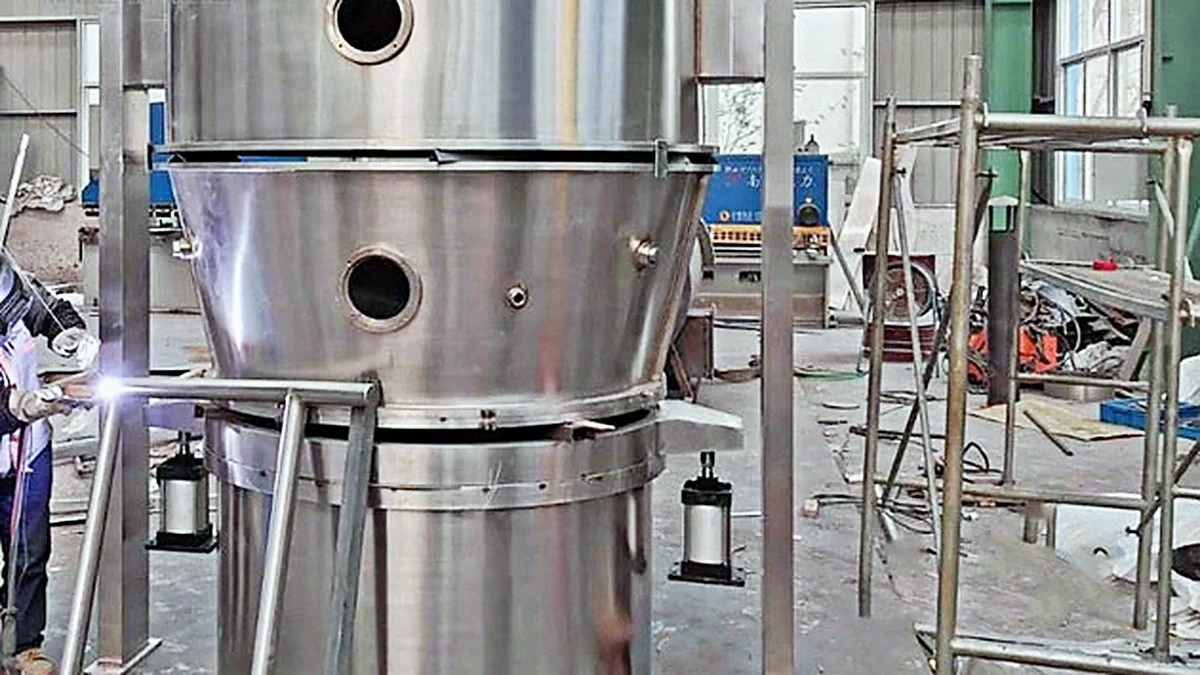
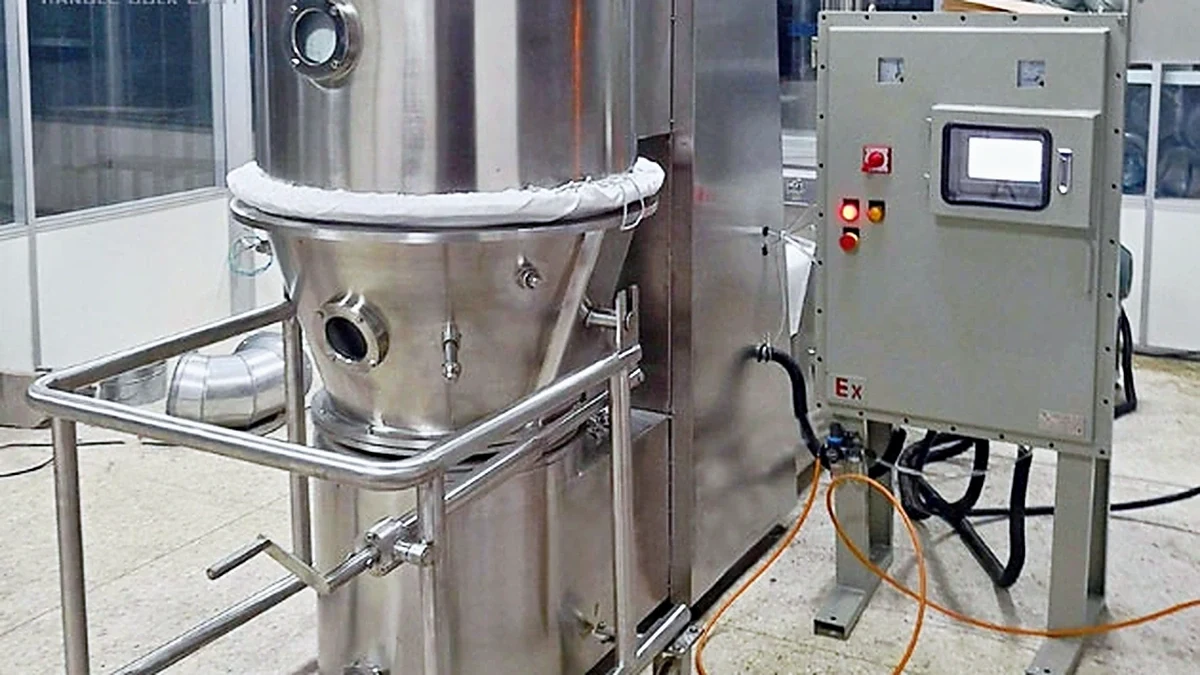
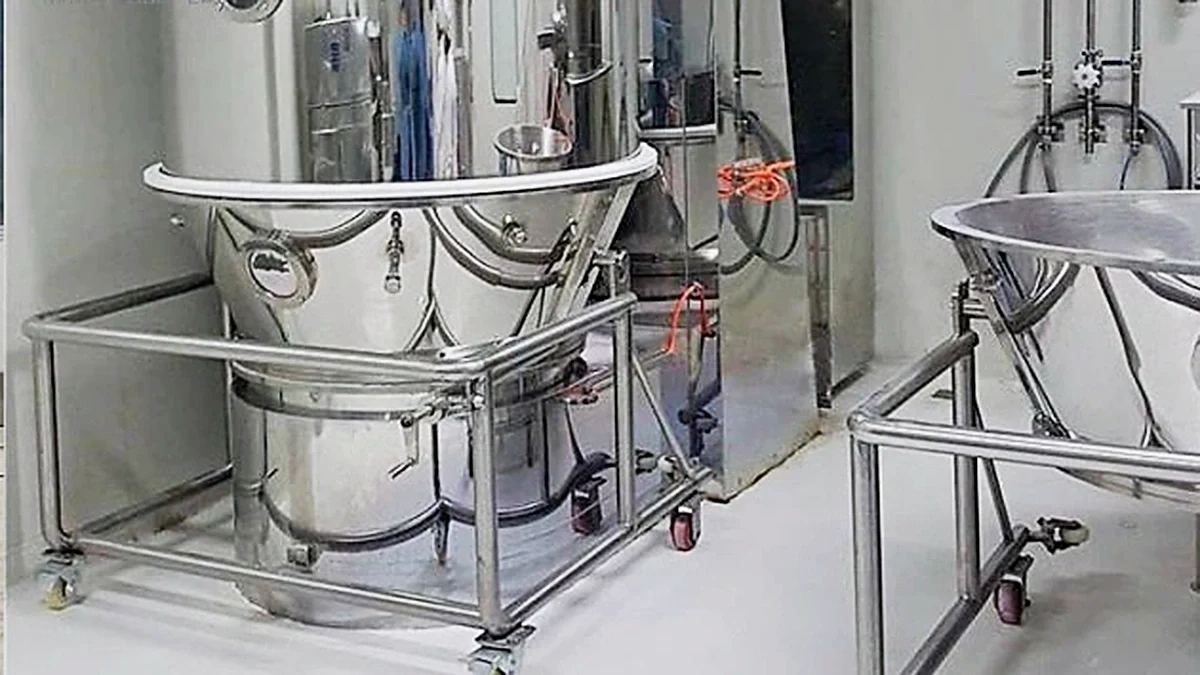
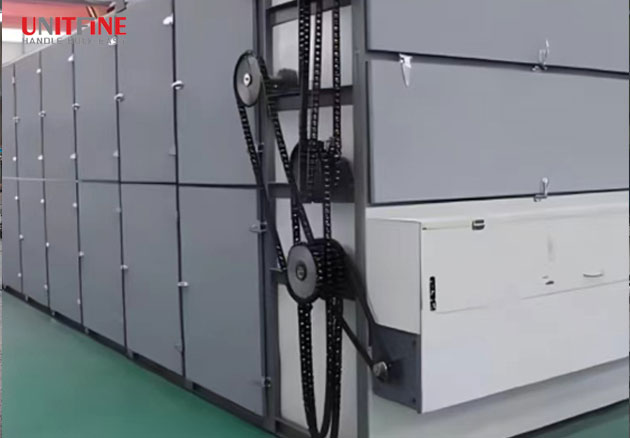
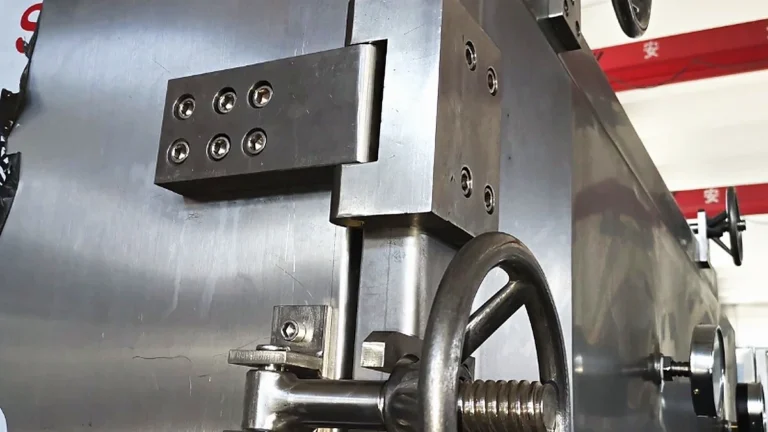

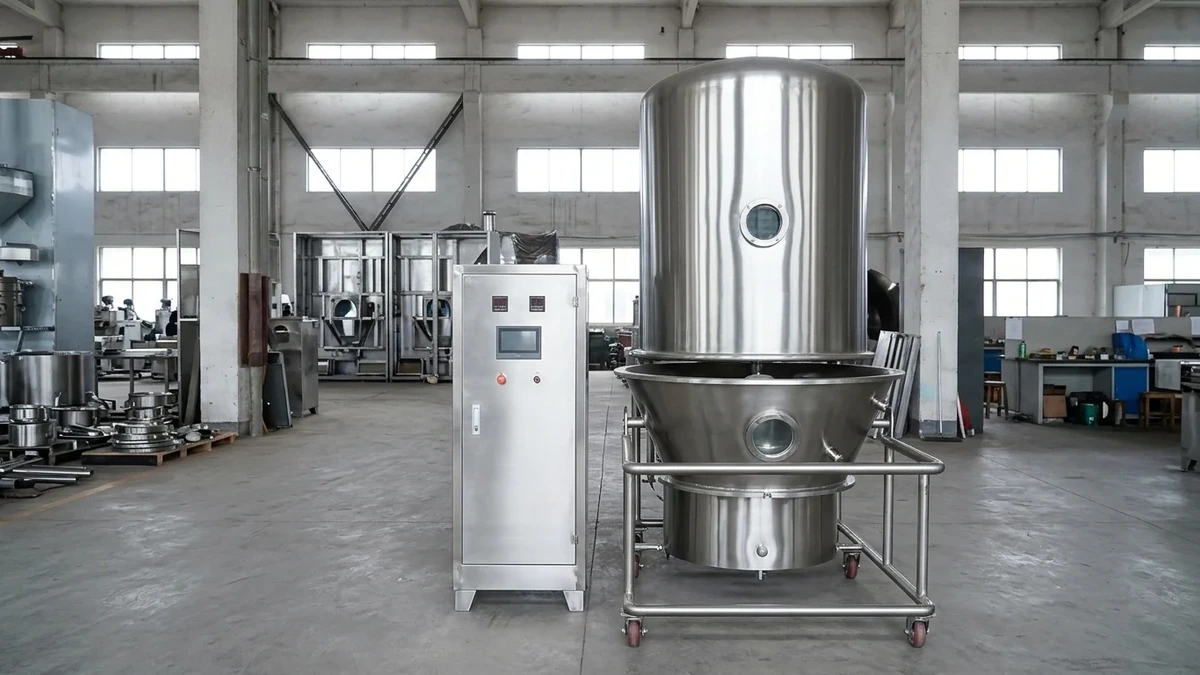
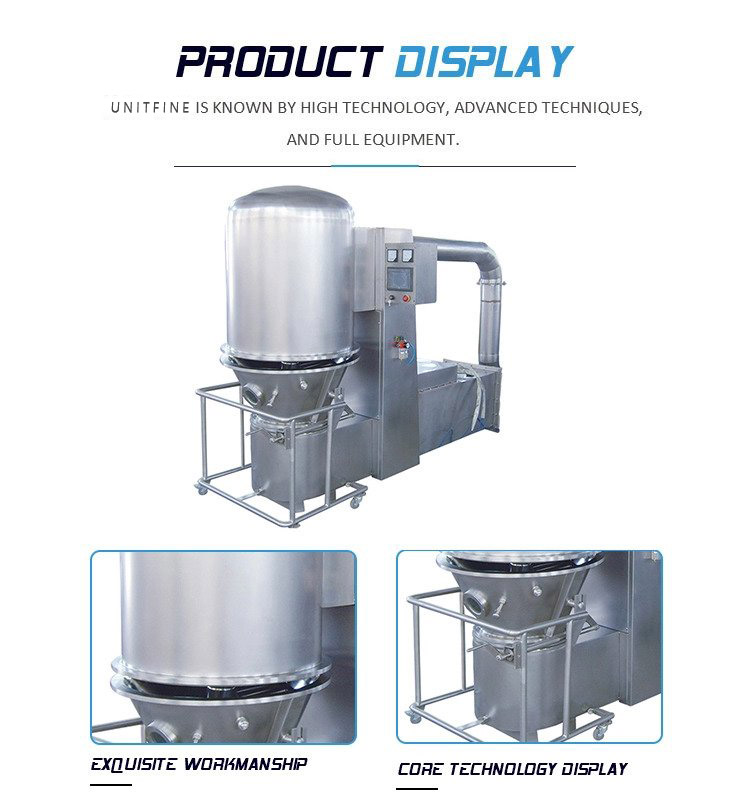
The UNITFINE GFG Series High-Efficiency Fluid Bed Dryer is a vertical batch drying machine engineered for uniform moisture removal from wet granules and free-flowing powders in pharmaceutical-material processing, food ingredient production, and chemical manufacturing. By drawing heated, filtered air upward through a perforated distribution plate under negative pressure, the GFG Series suspends wet granules in a fluidized bed to accelerate heat and mass transfer compared with static tray drying.
Quick Technical Overview
- Published Models: GFG-30, GFG-60, GFG-120, GFG-200, and GFG-300 (100 L to 1000 L drying bowl volume; 30 to 300 kg/batch nominal loading).
- Operating Principle: Vertical circular drying bowl, negative-pressure exhaust airflow, bottom air distribution plate, low-speed agitator (11 RPM), and multi-chamber anti-static bag filtration.
- Best Fit: Wet-granulated or extruded particles that can be fluidized cleanly without severe sticking, clumping, or excessive fines carryover.
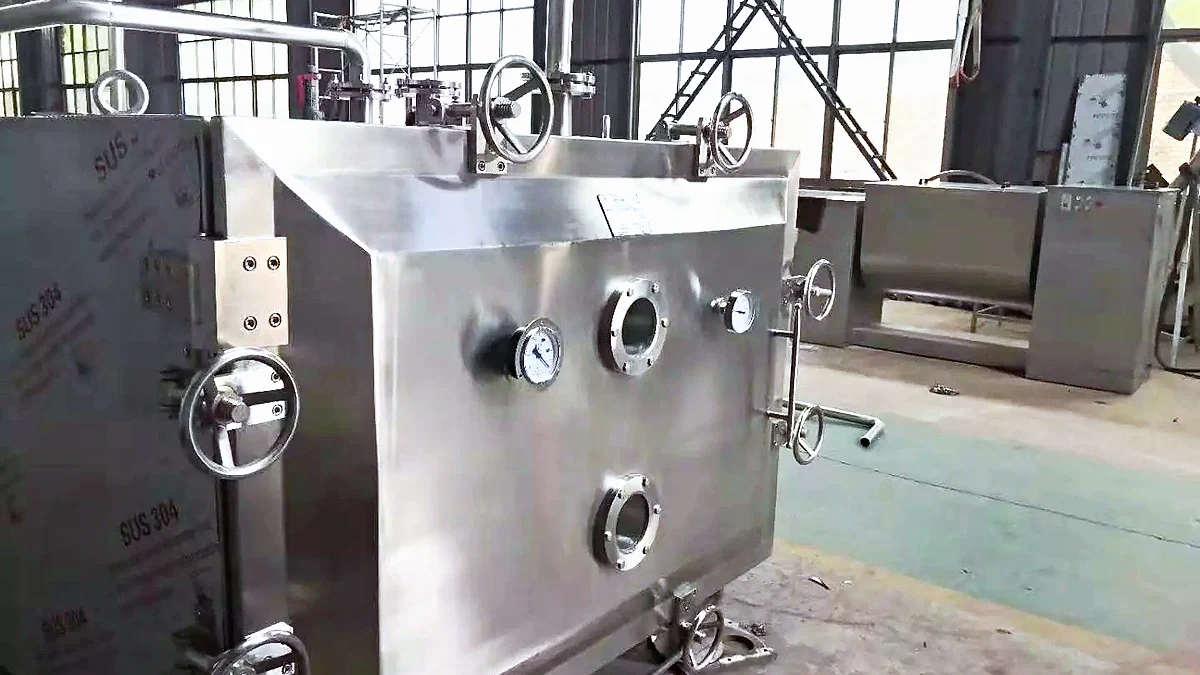
- When to Evaluate an Alternative: For sticky pastes, highly heat-sensitive extracts requiring low boiling temperatures, or materials that cannot withstand airflow agitation, compare with the UNITFINE FZG Industrial Vacuum Tray Dryer.
How the GFG Series Fluid Bed Dryer Works
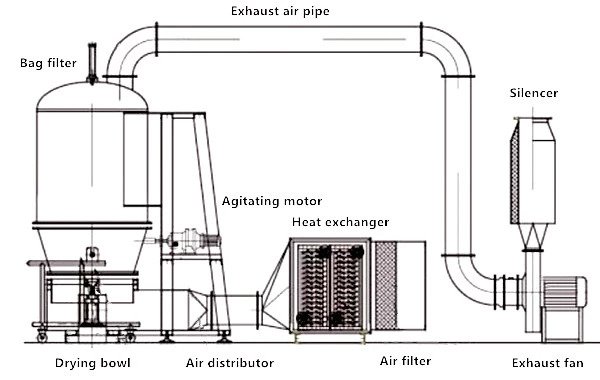
In a vertical batch fluid bed dryer, ambient air passes through air filtration and a heat exchanger (steam or project-specified heating source) before entering the lower plenum beneath the product bowl. An exhaust fan maintains negative pressure across the chamber, drawing heated air upward through a perforated distribution plate and into the wet granule bed.
Once the upward air velocity exceeds the minimum fluidization threshold of the wet granules, individual particles lift and circulate continuously in the hot air stream. Each granule is surrounded by drying air rather than resting in a static layer, allowing surface moisture to evaporate rapidly and uniformly. Fine particles carried upward are captured by an overhead multi-chamber anti-static bag filter, while a low-speed agitator (11 RPM across all GFG models) helps break up loose wet lumps during the initial fluidization stage. Moist exhaust air exits through the fan ducting.
GFG Series Technical Specifications (GFG-30 to GFG-300)
The table below summarizes the published baseline specifications for the five standard UNITFINE GFG models. Nominal loading capacity and drying time depend on wet bulk density, initial-to-final moisture difference, granule size distribution, and allowable inlet air temperature.
| Parameter | GFG-30 | GFG-60 | GFG-120 | GFG-200 | GFG-300 |
|---|---|---|---|---|---|
| Drying Bowl Volume (L) | 100 | 220 | 420 | 670 | 1000 |
| Bowl Diameter (mm) | 700 | 1000 | 1200 | 1400 | 1600 |
| Nominal Loading Capacity (kg/batch) | 30 | 60 | 120 | 200 | 300 |
| Exhaust Fan Power (kW) | 7.5 | 11 | 18.5 | 22 | 30 |
| Agitator Power (kW) | 0.55 | 0.55 | 1.1 | 1.5 | 2.2 |
| Agitator Speed (RPM) | 11 | 11 | 11 | 11 | 11 |
| Reference Steam Consumption (kg/h) | 70 | 140 | 210 | 282 | 366 |
| Reference Drying Time (min)* | 30–60 | 30–60 | 30–60 | 30–60 | 30–60 |
*Reference values only. Actual batch weight, steam or electric heating demand, and drying cycle duration depend on wet bulk density, moisture content, particle size, ambient humidity, and allowable product temperature.
Key Structural Features for Process Reliability
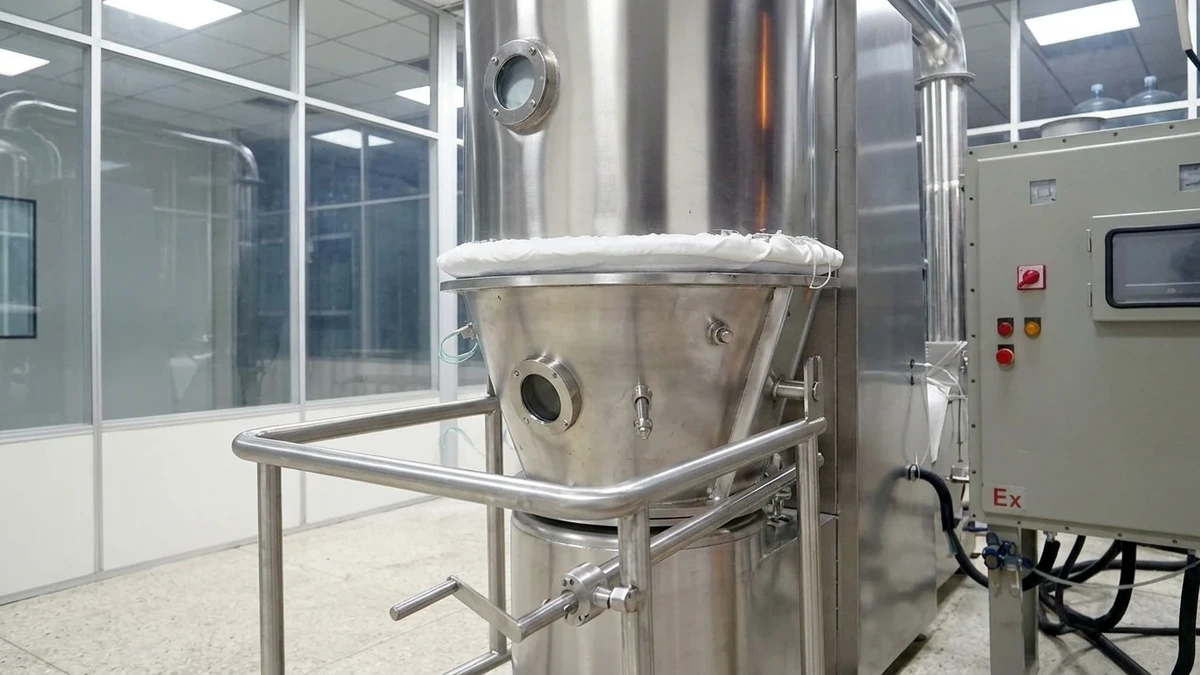
- Circular Drying Bowl Geometry: Compared with rectangular horizontal trays or box chambers, the round vertical bowl reduces stagnant corners where wet product can accumulate, helping streamline batch discharge and washdown between runs.
- Integrated Low-Speed Agitator (11 RPM): Gently breaks up soft wet agglomerates at startup so heated air penetrates evenly through the bed rather than forming air channels.
- Negative-Pressure Operation & Anti-Static Filtration: Drawing air through the system under negative pressure helps contain airborne fines during drying, while the multi-chamber anti-static bag filter captures entrained powder and returns it to the bowl during shaking cycles.
- Pressure-Relief Safety Design: Equipped with pressure-relief ports as part of dust-handling safety design. For organic solvents or combustible dust classes, grounding, explosion-vent routing, and electrical area classification must be specified during engineering review.
- Cleanable Stainless-Steel Construction: Product-contact stainless steel grade (such as SUS304 or SUS316L), internal surface polish, intake air filtration stages, and GMP/cGMP documentation packages are configured to match the buyer’s user requirement specification (URS).
Engineering Selection Boundaries: Wet Feed, Fluidization & Heat Sensitivity
Fluid bed drying delivers rapid batch cycles only when the wet feed can actually fluidize. Before selecting a GFG model, confirm four engineering boundaries:
1. Wet Material State & Granule Size
The GFG Series is designed for damp granules, screw-extruded pellets, or free-flowing wet powders produced upstream by equipment such as an oscillating granulator. Very fine cohesive powders tend to channel or blind filter bags, while overly sticky pastes or slurries will clump on the distribution plate instead of fluidizing.
2. Moisture Basis (Wet Basis vs. Dry Basis) & Bound Water
Always state initial and target final moisture clearly on a wet basis (% wb) or dry basis (% db), and note whether moisture is free surface water or tightly bound internal water. Free surface water evaporates quickly in a fluid bed, whereas tightly bound moisture requires longer falling-rate drying time and closer exhaust-temperature control.
3. Fluidization Airflow & Attrition Limits
Air velocity must sit comfortably between minimum fluidization velocity and terminal carryover velocity. If granules are unusually fragile, excessive airflow can cause particle attrition and extra fines in the bag filter; if batch loading is too high for the bowl volume (100–1000 L), the bed may collapse or dry unevenly.
4. Heat Sensitivity, Sugar/Resin Softening & Ambient Humidity
Confirm the maximum safe product temperature and glass-transition or softening point (critical for sugar-rich food blends, herbal extracts, and heat-sensitive APIs). In high-humidity climates, dehumidification of intake air may be required to maintain repeatable drying times across seasons.
GFG Fluid Bed Dryer vs. FZG Vacuum Tray Dryer
Buyers comparing batch drying technologies often evaluate whether a vertical fluid bed dryer or a static vacuum tray dryer fits their material better. For a deeper engineering breakdown, see our Fluid Bed Dryer vs. Tray Dryer selection guide.
| Selection Factor | GFG Series Fluid Bed Dryer | FZG Vacuum Tray Dryer |
|---|---|---|
| Heat Transfer Mode | Convective hot airflow through a fluidized bed | Conduction from heated shelves under vacuum |
| Ideal Feed State | Free-flowing wet granules and extruded particles | Pastes, cakes, fragile crystals, or oxygen/heat-sensitive materials |
| Typical Batch Drying Speed | Faster (often 30–60 min reference for fluidizable granules) | Longer static cycles at lower boiling temperatures |
| Solvent Recovery / Low-Temp Needs | Standard open-cycle air drying; solvent requires specialized closed-loop / explosion review | Well suited for vacuum solvent recovery and oxidation-sensitive products |
| Downstream Line Integration | Commonly paired with upstream wet granulation and downstream IBC bin blending or precision screening | Commonly paired with tray unloading and downstream milling/sizing |
Trial Drying & Acceptance Criteria
For new formulations or sticky wet granules, confirming drying performance on a representative sample before finalizing bowl size and heat-source capacity avoids undersizing or scorching risks. A structured trial plan typically verifies:
- Fluidization Stability: Visual and pressure-drop confirmation that wet granules lift smoothly without dead zones, channeling, or distribution-plate caking.
- Moisture Uniformity: Sampling from multiple zones of the dried bowl (top, center, wall) to confirm final moisture meets target tolerances.
- Granule Integrity & Fines Loss: Comparing particle size distribution before and after drying to verify acceptable attrition and filter-bag recovery.
- Thermal & Sensory Quality: Checking color, aroma, solubility, or active-ingredient stability at the chosen inlet and exhaust air temperatures.
What to Include When Requesting a GFG Fluid Bed Dryer Quote
To size the right GFG model (GFG-30 through GFG-300) and heat-exchange configuration, please share the following process inputs when contacting our engineering team:
- Material Name & Feed Condition: Wet granule size range, bulk density, stickiness, and whether moisture is water or organic solvent.
- Moisture Targets: Initial moisture content and required final moisture content (specify wet basis or dry basis).
- Throughput & Batch Size: Required output per batch (kg/batch) or per shift/hour.
- Allowable Product Temperature: Maximum safe inlet and product temperatures for heat-sensitive ingredients.
- Available Utilities: Preferred heating source (steam pressure/temperature, electric heating, or hot water/thermal oil) and local electrical supply (voltage/frequency/phase).
- Hygienic & Site Requirements: Contact stainless steel grade (SUS304/SUS316L), intake filtration level, cleaning requirements, and available ceiling height.
Need Model Sizing or a Drying Trial for Your Granules?
Send your material properties, initial/final moisture targets, batch capacity, and preferred heat source to the UNITFINE engineering team. Use the inquiry form below or contact UNITFINE directly to discuss GFG Series configuration options.
Frequently Asked Questions
What batch capacities are available in the UNITFINE GFG Series Fluid Bed Dryer?
The standard UNITFINE GFG Series includes five published models—GFG-30, GFG-60, GFG-120, GFG-200, and GFG-300—with drying bowl volumes from 100 L to 1000 L and nominal loading capacities from 30 kg/batch to 300 kg/batch. Actual batch weight depends on the wet bulk density and fluidization behavior of the material.
How long does a typical GFG fluid bed drying cycle take?
Published reference drying times for standard fluidizable wet granules are 30 to 60 minutes per batch. Actual cycle time varies with initial and target final moisture content, whether moisture is surface or bound water, granule size, inlet air temperature, and ambient air humidity.
What heating sources can be used with the GFG Series?
The published specification table lists reference steam consumption (70 to 366 kg/h depending on model). Depending on plant utilities and batch size, steam, electric heating, or other project-specified heat sources can be evaluated during engineering quotation.
When should I choose a vacuum tray dryer instead of a GFG fluid bed dryer?
Choose a static vacuum tray dryer such as the UNITFINE FZG Series when your feed is a sticky paste or cake that cannot fluidize, when the material is extremely fragile or oxidation-sensitive, or when low-temperature vacuum evaporation and solvent recovery are required.
What information is needed to get an accurate GFG Fluid Bed Dryer quotation?
Please provide the product name, wet granule condition and bulk density, initial and desired final moisture content (wet or dry basis), required batch capacity or hourly throughput, maximum allowable product temperature, preferred heat source (steam, electric, or gas), and any hygienic or dust-containment requirements.