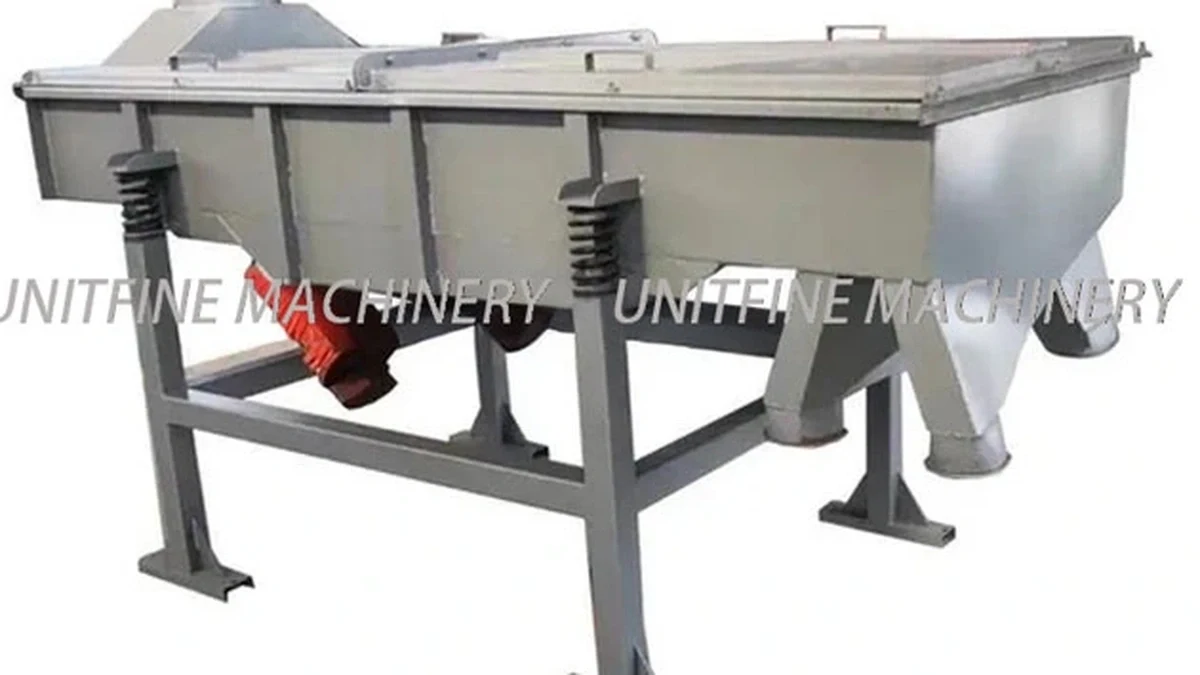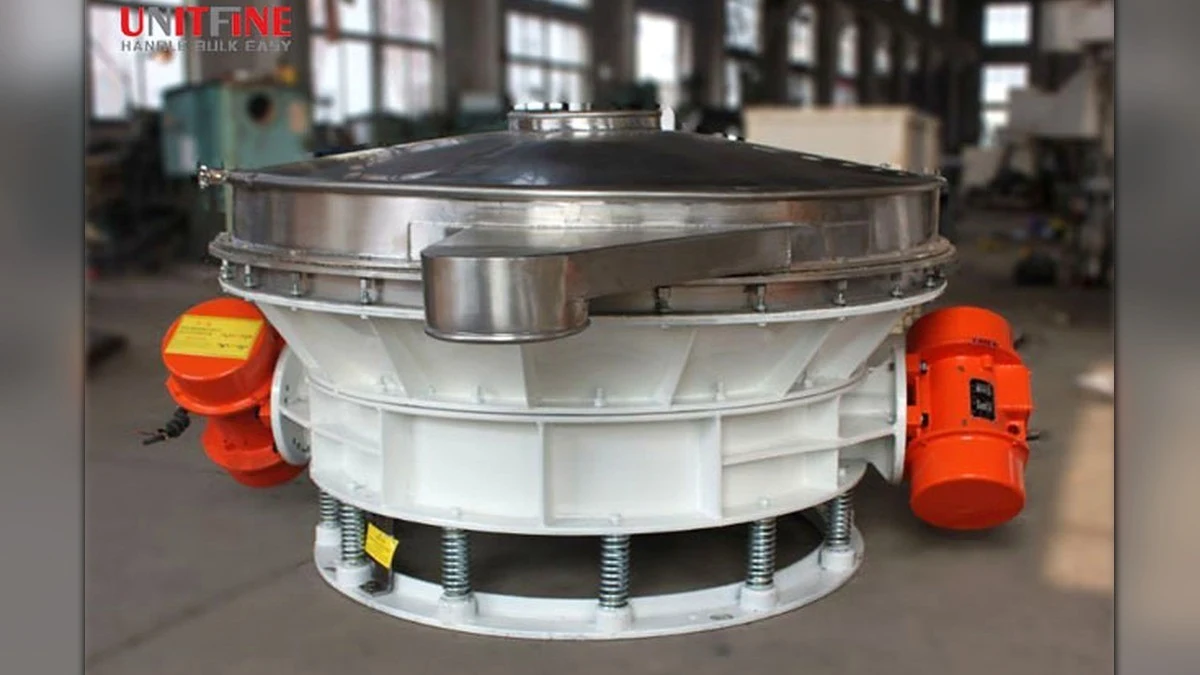


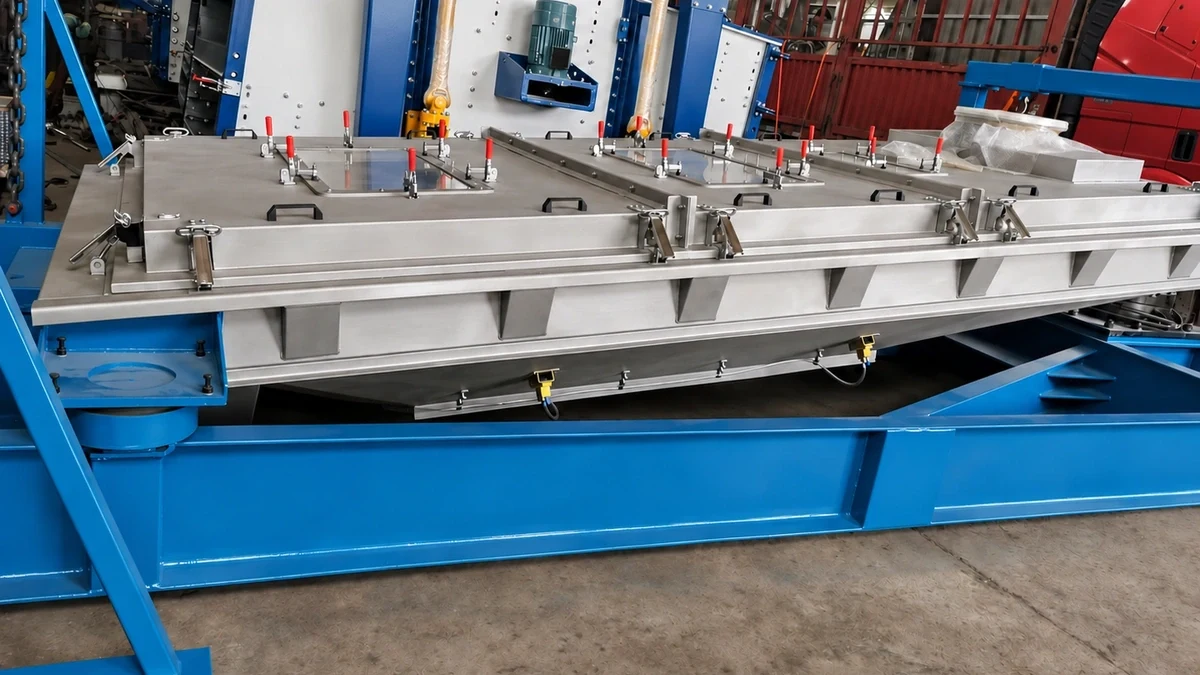

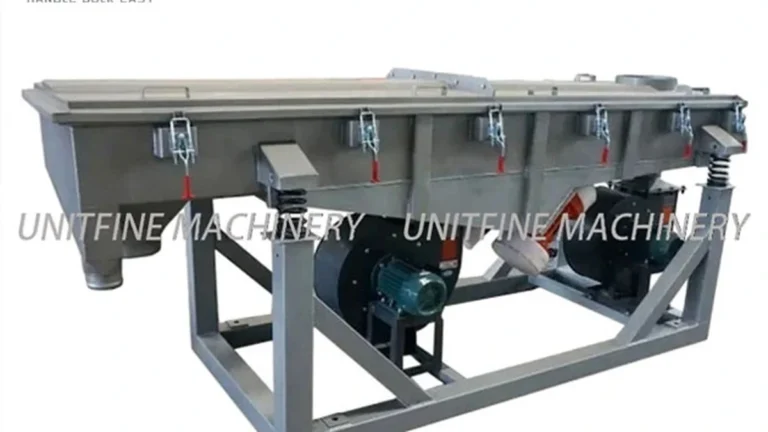
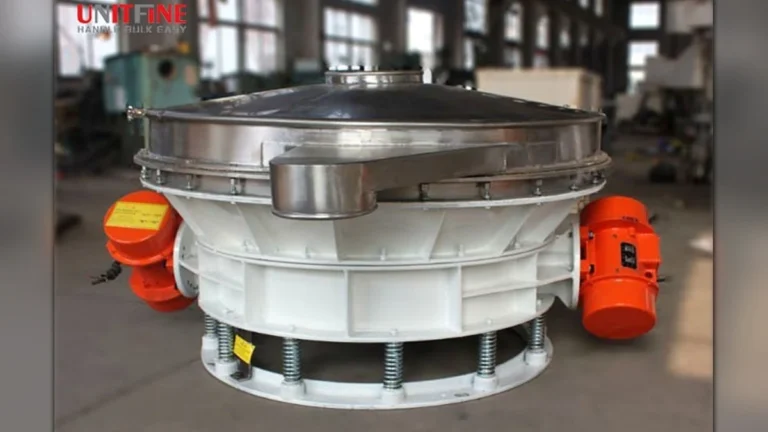
The UNITFINE UF gyratory screener separates powders and granules into specified size fractions. Its rectangular screening arrangement is a starting point for a grading enquiry when the material, required cuts and installation suit the proposed machine. Define the accepted product you need, then evaluate the screen configuration and trial result together.

Quick answer: when should you consider a UF gyratory screener?
Consider the UF machine for a powder or granule separation duty that needs defined fractions and a controlled feed-to-discharge route. Specify the cut sizes, normal and peak feed rate, material condition and acceptable misplaced material. Ask UNITFINE to confirm the screen arrangement and a representative trial basis. The term gyratory screener does not establish a universal capacity, separation accuracy or suitability for every powder.
How does the UF screening motion work?
The existing UF description identifies motion that changes along the screen: circular near the inlet, elliptical through the middle and approximately straight-line near the discharge. This describes the UF screening concept; the offered drive, supports and operating settings still need to be checked against the current assembly drawing.

At the inlet: spread the feed
The inlet-end motion is intended to distribute material across the screen. The upstream feed still matters: an uneven or surging supply can load part of a deck more heavily than the rest. Include the proposed feeder or chute, inlet position and changes in feed condition in the equipment review.
Through the deck: give particles a screening opportunity
Material continues across the deck as the motion changes. Particles close to the opening size need particular attention in a trial because their passage cannot be predicted from a simple model name or nominal mesh count. Agree the required fraction quality and operating rate together.
At discharge: account for every stream
Confirm where the retained and passing fractions leave the proposed assembly and where each stream goes next. Outlet routing, receiving equipment and product handling belong in the purchase specification. A motion illustration does not establish the exact trajectory of every particle or prove a separation result.
Define the screening task before choosing a model
Describe the problem in terms of the required output. Removing an occasional oversized piece, removing fines and producing several saleable fractions are different acceptance tasks. State which stream is valuable, what must be removed and how much misplaced material is acceptable. This helps keep quotations and trial results comparable.
| Duty | Define before selection | Review in the trial |
|---|---|---|
| Oversize removal | The wanted product and the oversized material to remove. | Product loss, retained material and the condition of the accepted stream. |
| Fines removal | The lower size limit and the allowed fines in the product. | Fines remaining in the accepted product and valuable material lost with the fines. |
| Grading | Each required fraction and its receiving process. | The size distribution, accepted rate and mass balance of all streams. |
Provide representative feed data
Send the material identity, particle-size distribution, bulk density, moisture and expected changes during storage or production. Describe adhesion, agglomerates, abrasive constituents and fragile particles where relevant. A clean, free-flowing sample may not represent a feed that arrives damp, compacted or in intermittent surges.
The existing UF application list includes materials such as fertilizer granules, salt, resin, mineral powders and grain-related products. Treat these as enquiry examples. The actual formulation and feed condition still need review; an industry name does not approve the standard machine for every material in that industry.
Review the screen openings, tensioning and cleaning arrangement
Specify the opening required for each cut and ask which screen medium is offered. For woven cloth, a mesh count alone does not fully define the opening: the wire construction also matters. Keep the product-size specification separate from the screen specification and agree how the separated fractions will be checked.
Ask which tensioning and mesh-cleaning components are included and how they are matched to the material. The existing listing discusses these features, but that does not confirm the same arrangement for every quoted model. Review access, replacement screens, cleaning-component condition and the possibility of carryover between products.
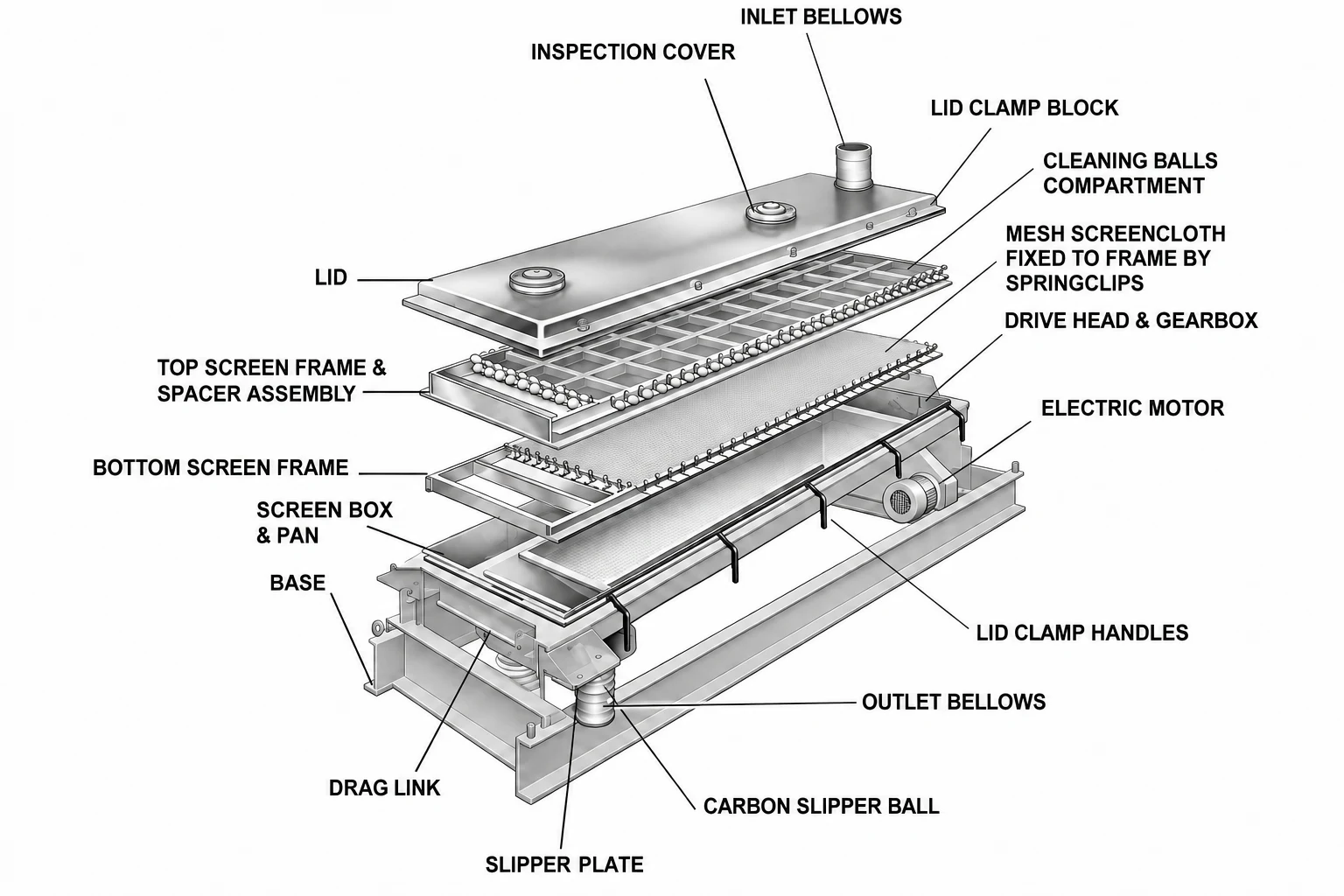
The component-reference illustration is a discussion aid; some illustrated parts may differ from the offered UF configuration. Confirm the included components, screen construction and service instructions against the current assembly drawing and parts list. Do not use the illustration alone to select replacement parts or verify contact-material grades, clearances or cleaning performance.
Read the catalog fields before requesting a UF model
The examples below reproduce selected entries from the existing product listing to help identify a quotation. They are reference entries, not a current supply commitment. Request the model, drawing revision and matched specification for the proposed installation before using a catalog row as a purchase requirement.
| Existing model reference | Listed layer group | Listed screen size, mm | Listed power, kW |
|---|---|---|---|
| UF1014 | 1 | 1000 × 1400 | 1.5 |
| 2UF1021 | 2 | 1000 × 2100 | 1.5 |
| 3UF1021 | 3 | 1000 × 2100 | 5.5 |
Confirm whether the listed size describes the screen frame or the usable screening area and how it applies to each deck. A listed power is not a measured energy-use figure or a capacity rating. The catalog also includes a rotation-speed field; confirm which component and operating condition it describes before treating it as the frequency of material motion.
Capacity must include the required fraction quality
State the feed rate and the required accepted-product rate separately. Moving material through an outlet does not prove that the required size fraction has been achieved. Compare proposals at the same feed condition, screen openings, quality limits and operating basis rather than comparing an unqualified maximum output.
For a trial, agree the sampling points, test method and acceptance criteria before running the material. Record the feed condition, screen configuration, steady operating rate and the mass and size distribution of each stream. If the production duty includes difficult cuts or changing feed conditions, identify which of those conditions the trial represents.
Plan the installation, access and product changes
Send a layout showing the inlet, every outlet and the upstream and downstream equipment. Confirm the supply boundary, supporting arrangement, movement clearance and access for screen replacement. Do not fabricate site supports or rigid connections from a general product image; use the installation requirements for the offered unit.
Cleaning and maintenance requirements
Describe the product-change schedule, the cleaning method and any limits on retained material or cross-contamination. Ask how screen components can be reached and removed and which contact parts are offered. A metal exterior or an enclosed cover does not establish food-contact compliance, washdown suitability or a validated cleaning process.
Use the supplied isolation, guarding and service instructions before access. This purchasing guide does not authorize opening or adjusting running equipment. Request the relevant spare-screen and component information, and confirm commissioning support, delivery and warranty terms in the current quotation.
Compare screening arrangements on the same duty
Use the same sample, fractions, required delivery and cleaning objective when comparing alternatives. A linear vibrating screen offers another screening arrangement to review; a rotary vibrating sieve has a different layout and material-motion concept. Neither link establishes an automatic substitute for the proposed UF unit.
Keep the final choice tied to representative testing and installation fit. A general label such as fine screening does not establish a universal winner for capacity, product damage or separation accuracy. Ask for the proposed screen arrangement and acceptance basis when reviewing any alternative.
Prepare your quotation and screening trial brief
Send the following inputs together so UNITFINE can review the proposed separation task. Identify any unavailable data and agree how to obtain it; do not replace a material review with an assumed catalog capacity.
- Material data: representative samples, particle distribution, bulk density, moisture and available hazard information.
- Required fractions: cut sizes, number of accepted streams and limits on misplaced material.
- Required delivery: normal and peak feed, accepted output and upstream feed pattern.
- Layout and utilities: inlet/outlet positions, supports, receiving equipment, power and available space.
- Screen and cleaning requirements: proposed screen medium, product changes, access and contact documentation.
- Trial acceptance: sampling method, size analysis, mass balance and any product-damage limits.

Frequently asked questions
What does a gyratory screener do?
It separates feed into size fractions using the proposed screen openings and material-motion arrangement. For the UF model, specify the wanted fractions, feed condition and accepted output, then confirm the assembly and a representative trial basis.
Is the UF gyratory screener the same as a rotary vibrating sieve?
They are different screening arrangements. The UF description identifies changing motion along a rectangular screen. Compare the offered machines by the actual material, required fractions, rate, access and layout rather than treating the equipment names as interchangeable.
What capacity can the UF screener achieve?
Capacity depends on the feed, screen configuration, loading and required fraction quality. Provide normal and peak feed rates and the accepted-product requirement. Ask for a configuration-specific trial or calculation basis instead of applying a universal output figure.
What mesh size should I request?
Start with the required product fractions and acceptable misplaced material. Ask for the opening specification and screen construction for each cut. A mesh count alone does not fully specify woven cloth or establish the achievable separation for a particular feed.
How many decks are needed?
Define every required fraction and receiving stream first. Ask UNITFINE to confirm how the proposed decks and outlets produce those streams. A catalog layer group or a component illustration is not a complete supply specification for your application.
Can it handle wet or sticky material?
Describe the actual moisture, adhesion and agglomeration before selection. Confirm whether the proposed UF arrangement can meet the required separation and cleaning objective in a representative trial. Do not assume wet-screening or dewatering capability from a general material list.
Does mesh cleaning guarantee that the screen will not blind?
No. Confirm the cleaning components offered for the material and review screen behavior at the intended operating rate. Feed condition, opening size, loading and component condition still matter; the presence of a cleaning arrangement does not establish a no-blinding guarantee.
What should I send for a quotation?
Send material data, required fractions, normal and peak feed rates, accepted output, layout, utilities and cleaning requirements. Include the proposed sampling and acceptance method so the quotation and trial can be reviewed against the same duty.
Discuss your UF gyratory screening duty
Send us your material data, target fractions, required delivery and layout sketch to request a UF gyratory screener review. Ask UNITFINE to identify the proposed model, screen arrangement, supply boundary and trial acceptance basis. Browse the screening equipment range if the duty needs another arrangement.