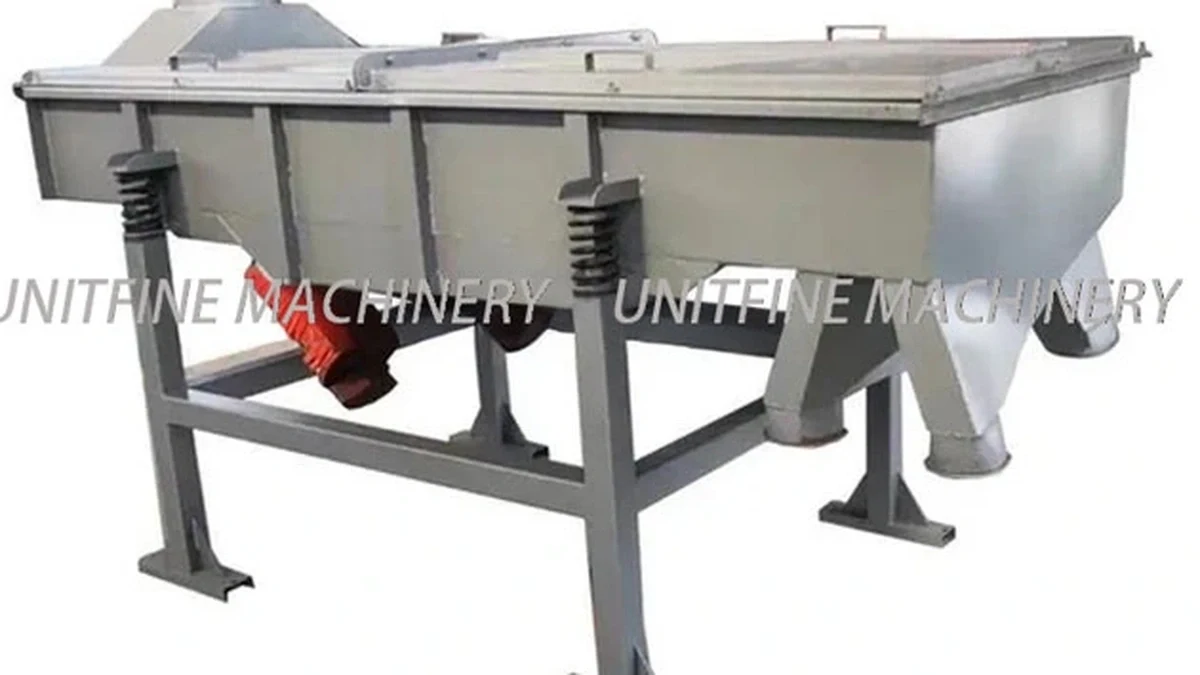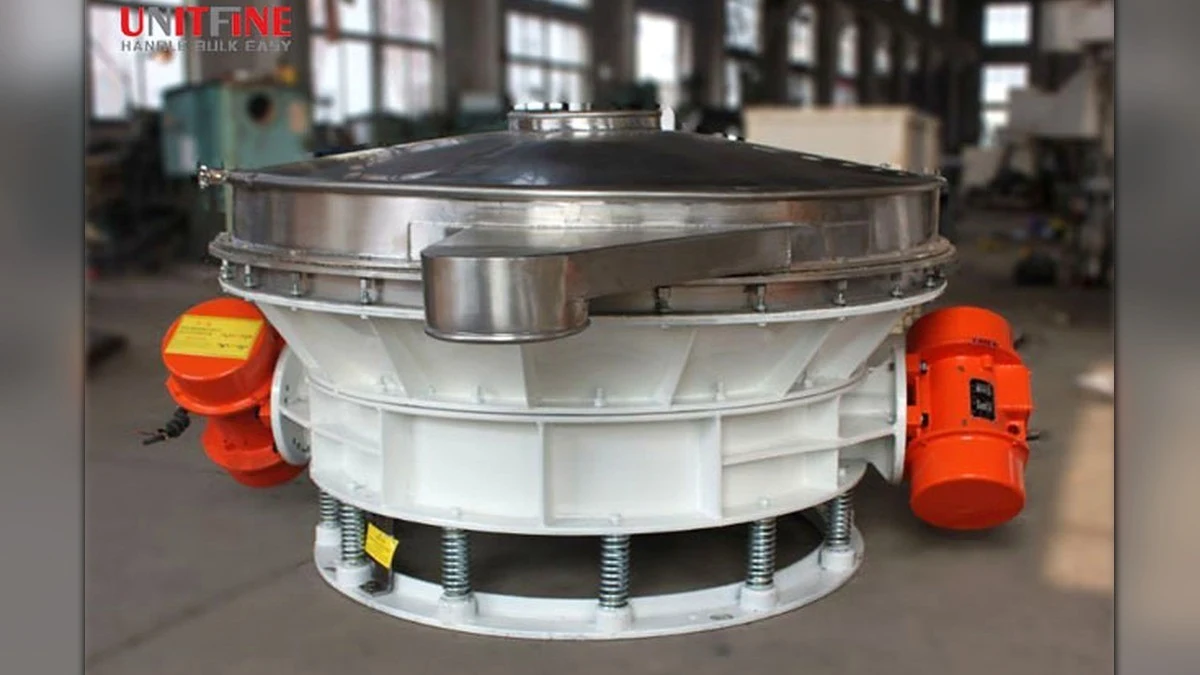



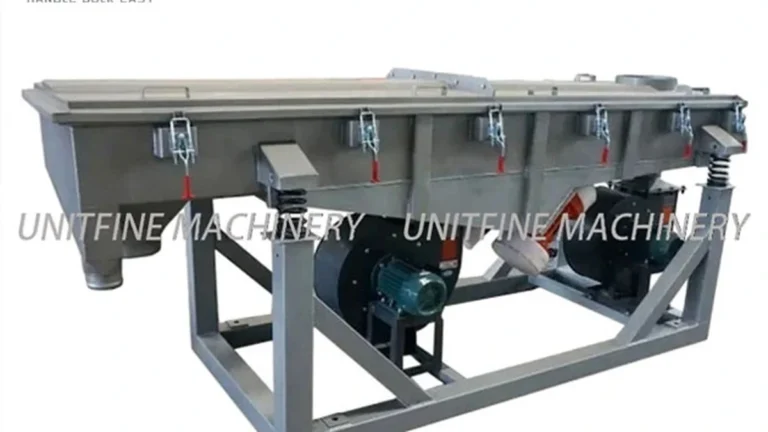
The UNITFINE rotary vibrating sieve separates material across circular screen decks for check screening, particle-size grading and selected liquid-solid filtration duties. Specify the material, target aperture and required collected fractions before choosing a model. A machine selected for dry powder should not automatically be assumed suitable for a slurry, a corrosive ingredient or a powder with special containment requirements.
Quick answer: The UNITFINE rotary vibrating sieve described here uses a vertical vibration motor with eccentric weights to move material across a circular mesh. Particles smaller than the selected opening can pass through, while retained material travels toward its outlet. Screen area, aperture, feed loading, material behavior and mesh cleaning jointly determine the result. Use a representative trial to establish the achievable delivery rate and separation quality for the proposed configuration.
How does a rotary vibrating sieve work?
Upper and lower eccentric weights on a vertical vibration motor produce horizontal, vertical and inclined movement in the screening assembly. This movement distributes the feed and brings particles into contact with the mesh. The relationship between the weights affects material travel and residence on the screen. Adjustment must follow the instructions for the supplied machine; a general diagram is not an operating or maintenance procedure.
The aperture defines the intended cut, but particle shape, loading and moisture influence actual passage. Near-size particles can lodge in openings, and a deep or uneven feed bed can prevent fine particles from reaching the mesh. Adding decks provides additional separation cuts only when the required fractions, screen sequence and discharge arrangement have been designed together.

Components to check on the configuration drawing
The supplied assembly should identify the inlet and cover, screen frames, mesh support, clamps, product outlets, vibration drive and spring-supported base. Mesh-cleaning parts belong to the specified screen assembly. Confirm access for screen inspection and replacement as well as the interface to upstream feeding and downstream collection equipment; these details affect both installation and changeover.
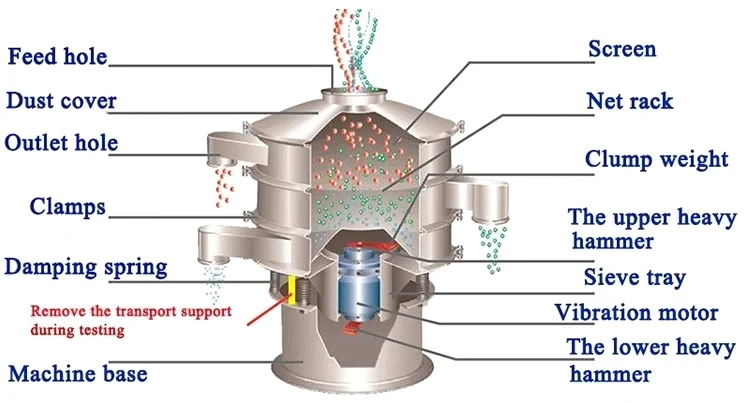
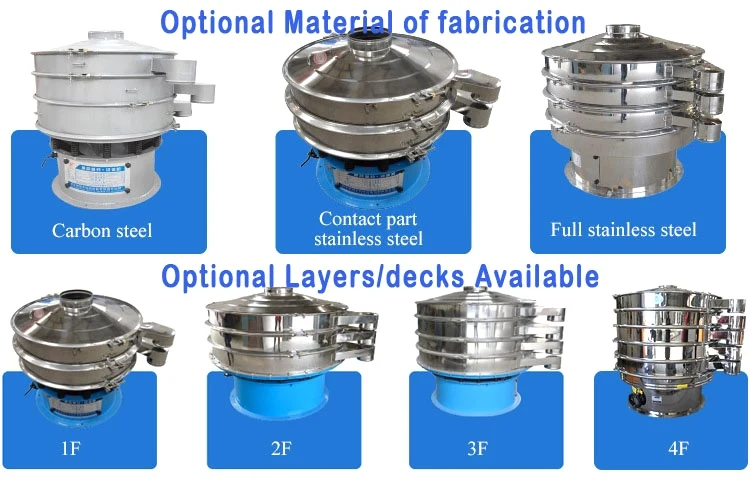
The original component drawing is an explanatory illustration. Visible labels and the number of illustrated frames do not define the material grade, deck count or supplied accessories of every model. Use the current approved drawing and machine instructions for maintenance, isolation and commissioning.
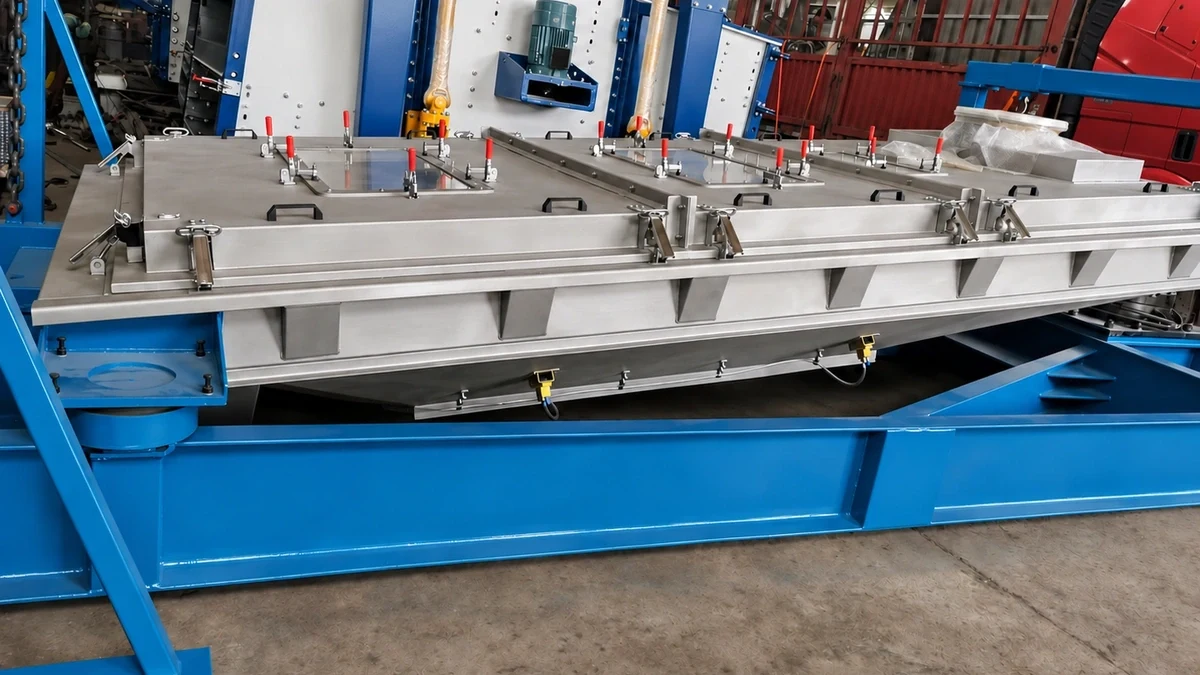
Screen access, outlets and contact surfaces
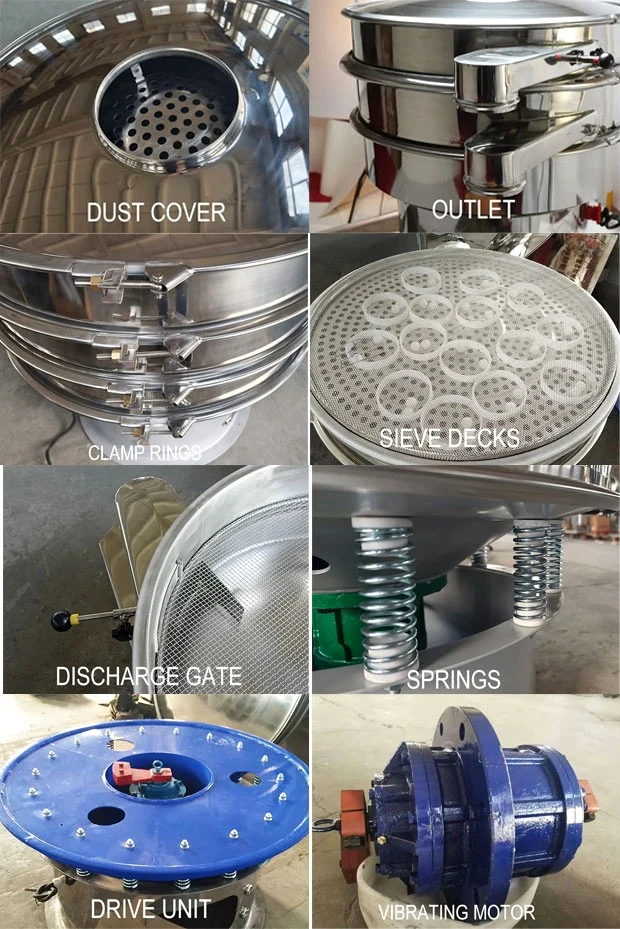
Ask how the selected mesh is secured, how seals are inspected, and how retained material leaves each deck. Review clamp access, outlet clearances and available lifting space before deciding where to install the sieve. A polished surface in a photograph does not establish a stainless-steel grade, hygienic qualification or chemical compatibility.
Choose the screening duty before the machine size
Start by deciding whether the process needs a protective check screen, several particle-size fractions, or liquid-solid filtration. These are different duties. A broad material category is only a starting point: the intended aperture, acceptable retained fraction, contamination limits and feed condition must be reviewed for the actual product.
| Duty | Possible enquiry examples | Selection information |
|---|---|---|
| Check screening | Flour, starch, sugar, spices or chemical ingredients before a downstream operation. | Normal particle distribution, unwanted oversize, required rate and product-contact requirements. |
| Particle-size grading | Granules, mineral material or metal powders requiring separate collected fractions. | Apertures, target fraction yields, number of cuts, abrasion and discharge arrangement. |
| Fine or cohesive powder screening | Pigments, resins or powder-coating material that repeatedly blinds the selected mesh. | Moisture, particle behavior, feed loading and a trial of an appropriate cleaning system. |
| Liquid-solid filtration | A process liquid or slurry with retained solids. | Liquid properties, solids loading, temperature, chemical compatibility and drainage duty. |
Food and pharmaceutical enquiries need their own product-contact material, seal, cleaning and documentation review. Combustible or hazardous powders require a site-specific safety assessment. A motor option, closed cover or industry name alone does not establish certification or complete dust containment.
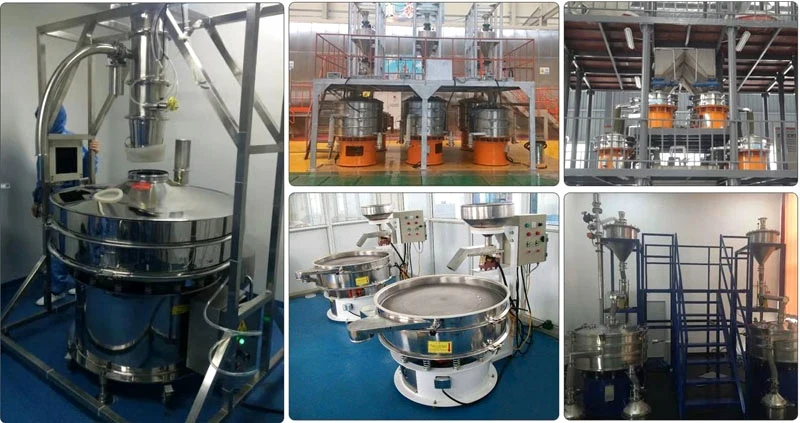
The original application photographs illustrate different arrangements. They are not a record of a verified customer trial, a named installation or a guarantee that the same configuration will suit a new material.
Model references from the existing product page
Keep the existing UNITFINE model identifiers when requesting a quotation. The following values reproduce the original web listing as reference information; they are not a final specification schedule. The linked catalogue contains different entries for some motor powers, layer ranges and output figures. Confirm the current model, effective screen dimensions, deck arrangement and motor selection on one quotation and drawing before ordering.
| Listed model | Published diameter reference | Published layer reference | Published motor reference |
|---|---|---|---|
| UF-600 | 600 mm | 1–3 | 0.37 kW |
| UF-800 | 800 mm | 1–3 | 0.55 kW |
| UF-1000 | 1000 mm | 1–4 | 0.75 kW |
| UF-1200 | 1200 mm | 1–5 | 1.1 kW |
| UF-1500 | 1500 mm | 1–5 | 1.5 kW |
| UF-1800 | 1800 mm | 1–5 | 3 kW |
A nominal diameter is not necessarily the effective screening diameter. Published capacity ranges are not repeated here as production promises because the original information does not define a common material, aperture and test method. Establish the required delivery rate using representative material and agreed acceptance criteria. Screen area and additional decks alone cannot demonstrate that the duty will be achieved.
Construction and installation options
The original material and deck illustration shows several construction arrangements. Specify product-contact parts and seals separately from the base and external frame. Ask UNITFINE to confirm the current available materials, corrosion and abrasion requirements, cleaning method, inlet/outlet orientation, electrical supply and available floor space. Do not infer stainless-steel grade or a complete sanitary configuration from appearance.
Which mesh-cleaning method should you evaluate?
Match the cleaning system to the cause of blockage. Correct damp feed, damaged mesh, poor tension or feed surges before adding an accessory. A cleaning device can help maintain usable screen area; it does not change the aperture or remove the need for inspection. Confirm contact materials and possible wear or product contamination for the proposed arrangement.
| Approach | Reason to evaluate it | Checks before selection |
|---|---|---|
| Ball cleaning | Particles lodge in openings and the selected screen assembly can accommodate cleaning balls. | Ball and support materials, screen compatibility, wear inspection and contamination limits. |
| Rotary brush or scraper arrangement | Material behavior and a compatible assembly justify mechanical assistance. | Geometry, mesh wear, contact materials, product change and cleaning access; confirm the specific accessory. |
| Ultrasonic assistance | Fine powder repeatedly blinds an otherwise appropriate mesh. | Matched generator, transducer and screen assembly, electrical compatibility and a representative powder trial. |
| Feed conditioning or mesh correction | Moisture, damaged mesh or uneven loading is the main cause. | Correct the cause upstream or replace the affected screen before assessing added assistance. |
Review the rotary brush system for compatible mechanical assistance. Compare a complete ultrasonic vibrating sieve when fine-mesh blinding defines the duty. For an existing machine, the GTS30 deblinding system is a separate compatibility review, not an automatically interchangeable attachment. The mesh-blinding guide helps structure the diagnosis.
Prepare the sample and enquiry information
Send a representative sample and describe the normal and worst expected feed conditions. Agree the sample quantity, number of trial runs and feed-rate range with UNITFINE before dispatch. Before a trial, agree the target rate, acceptable passing and retained fractions, duration, sampling method and permitted variation. Record these results with the aperture, feed method and screen condition so that the proposed separation can be assessed against a defined duty.
- Material: name, particle-size distribution, bulk density, moisture, temperature, abrasiveness and relevant safety information.
- Separation: target aperture, acceptable oversize, required fractions and any fragile-particle concern. Include aperture units and wire specification when discussing woven wire mesh.
- Feed and delivery: required rate, batch or continuous feed, surges and upstream/downstream interfaces.
- Construction and access: contact materials, seals, cleaning/changeover method, floor space, inlet height, outlets and electrical supply.
- Acceptance: measured trial outputs and the documents required for the supplied configuration.
Frequently asked questions
Is a rotary vibrating sieve the same as a rotating drum screen?
No. This UNITFINE product uses a vibration-driven circular screen assembly. It is not a rotating drum or a centrifugal sifter with rotating blades. Match the enquiry to the actual separation duty and machine construction.
Can one sieve process both powder and slurry?
The product family includes powder, granule and liquid-solid duties, but each supplied configuration must suit the material. Review liquid properties, solids loading, drainage, contact surfaces and seals before using a powder-screening configuration for slurry.
How do I choose the aperture and number of decks?
Start with the required size cuts and collected fractions, then define the apertures and discharge arrangement. Provide the particle-size distribution and target separation. A mesh count without its standard and wire information does not fully specify an opening.
When should I choose ultrasonic cleaning?
Evaluate ultrasonic assistance when fine powder repeatedly blinds a correctly installed mesh despite suitable feeding. Confirm a matched ultrasonic screen assembly and trial the actual material. It does not replace moisture control, screen maintenance or safe dust handling.
Is capacity or certification guaranteed for every application?
No universal capacity or certification is established by this overview. Agree performance for the material, aperture and feed conditions, and request the current documents applicable to the exact machine and intended installation.
What should I provide when ordering a replacement screen?
Provide the machine identification, screen-frame drawing or measured interface, aperture and wire specification, contact-material requirements and any cleaning-system connection. Compatibility must be confirmed before ordering; nominal machine diameter alone is insufficient.
Request a rotary vibrating sieve configuration review
Send your material data, target aperture, required delivery rate, collected fractions and available installation space. Include photographs and drawings for an existing machine or retrofit. UNITFINE can review the proposed screen, cleaning approach and supply boundary before a quotation or material trial is agreed.
Contact UNITFINE about your screening duty or email info@unit-fine.com.