
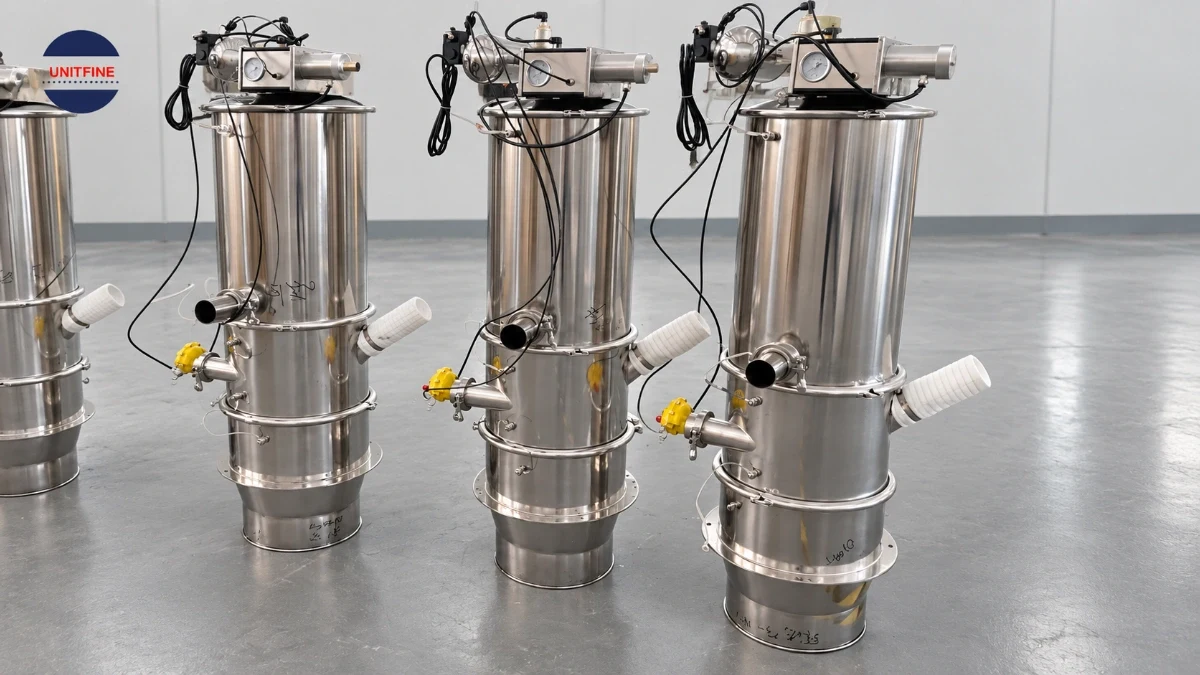

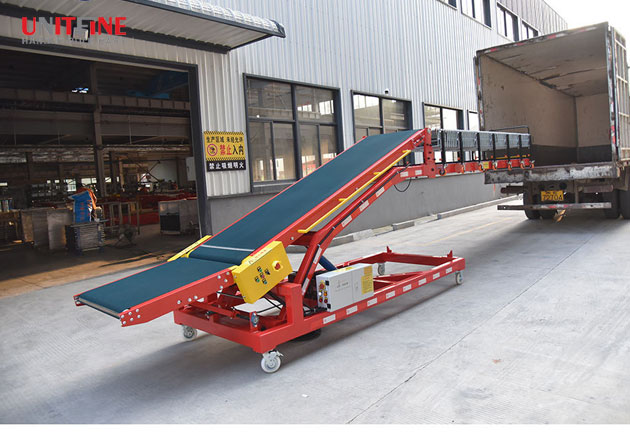
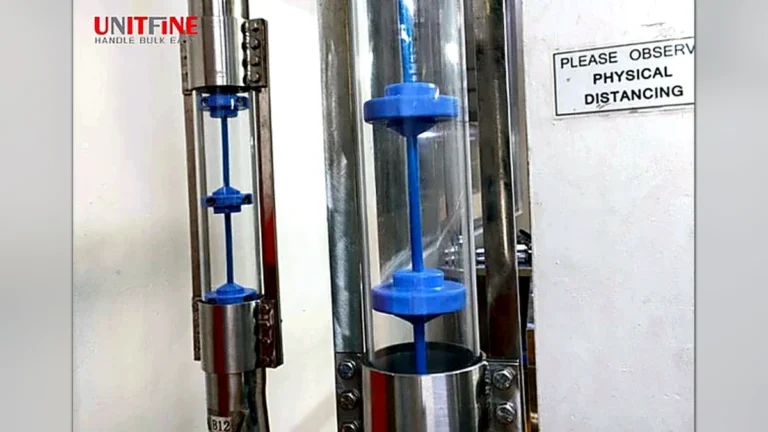

The UNITFINE UFLOW is a vacuum conveyor for powder and suitable granular materials. This product page explains the transfer cycle and the information needed to assess a proposed installation, rather than selecting equipment from a headline capacity alone. Start with the material, receiving process and conveying route, then confirm the offered configuration with UNITFINE.
Quick answer: A vacuum conveyor uses a pressure difference to draw material through a conveying line into a filtered receiver. In a typical cyclic arrangement, collection alternates with discharge. For UFLOW selection, confirm material behavior, required average delivery rate, route, filtration, utilities and receiving-hopper demand together. A vacuum conveyor is not automatically a precision dosing device or a validated containment system.
What should a UFLOW system quotation define?
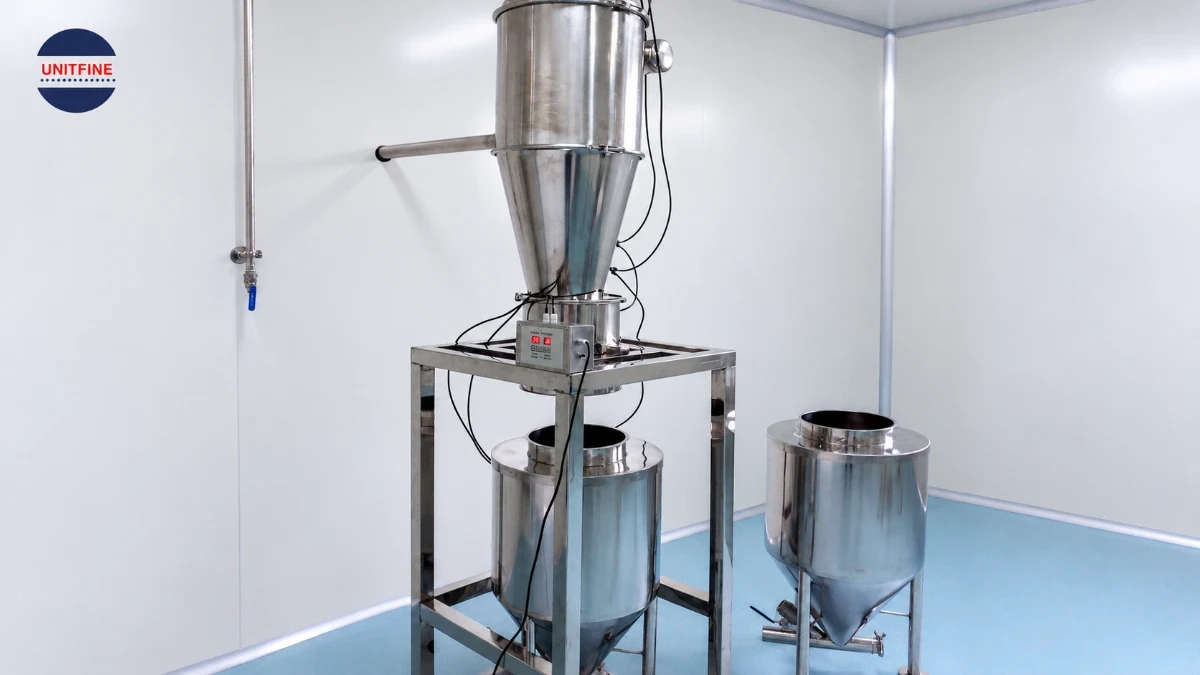
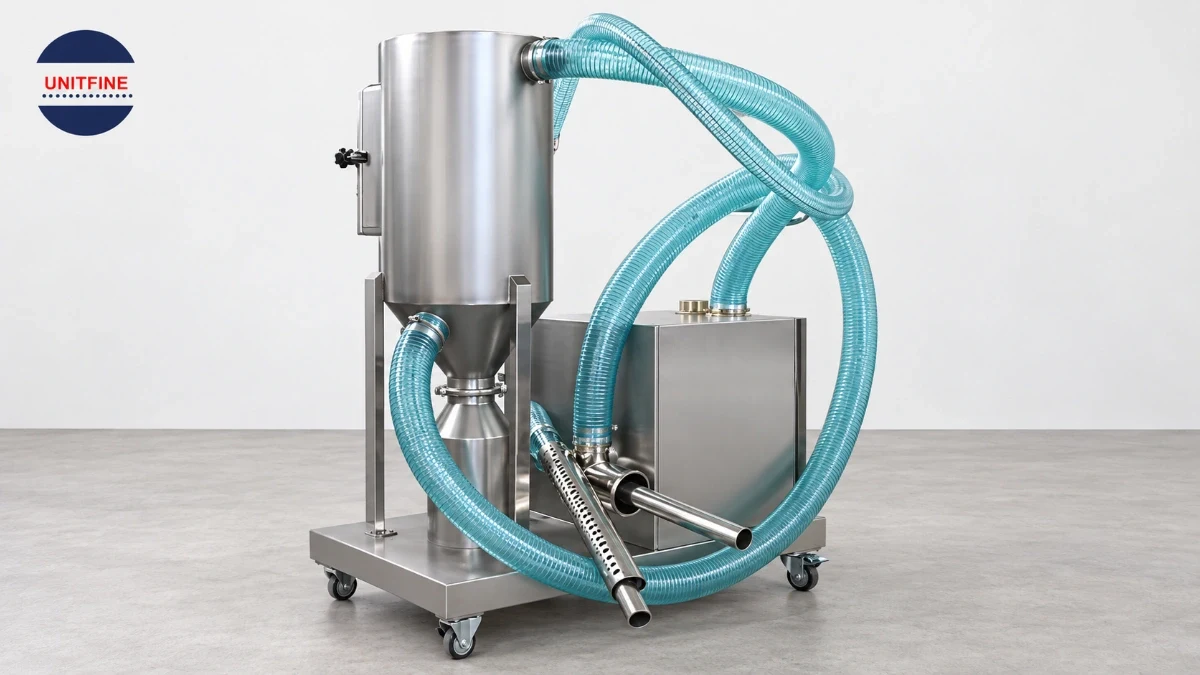
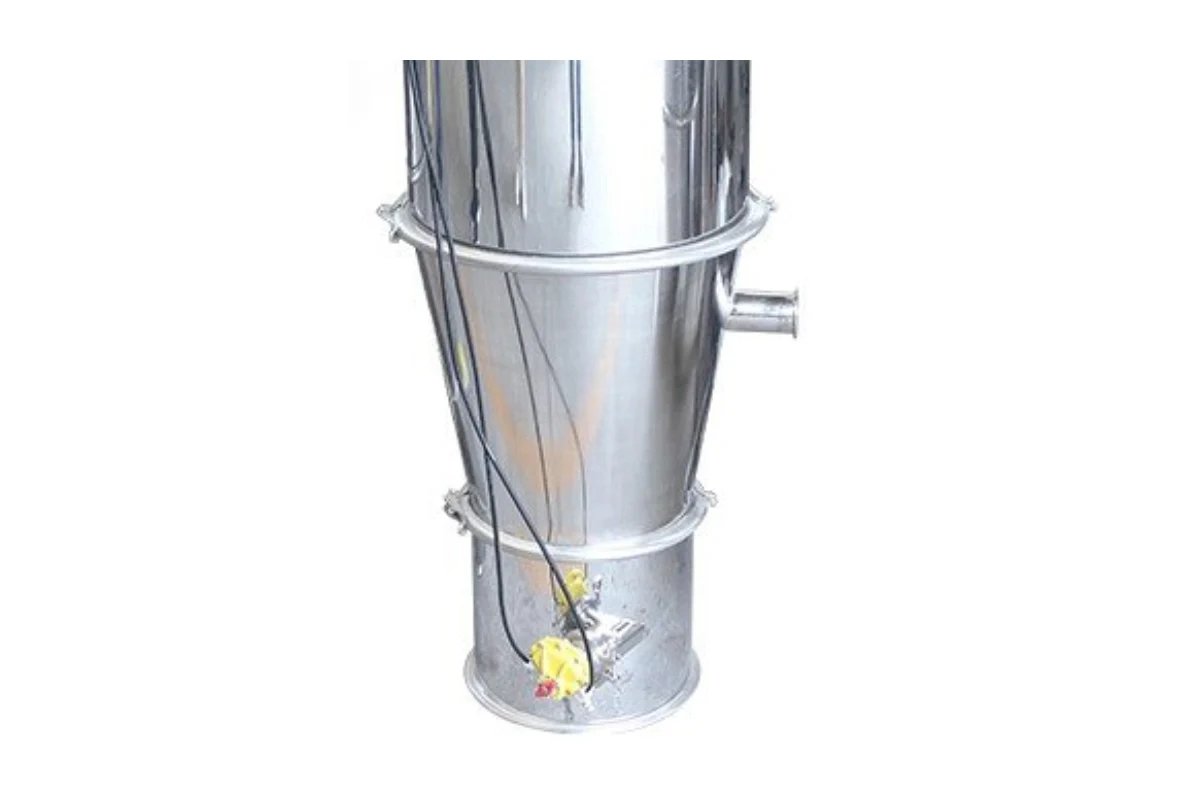
Ask for a configuration drawing identifying the pickup point, conveying line, receiver, filter, vacuum source, discharge arrangement and controls. The existing product information describes filter options and automatic operation, but the purchase specification should identify the exact components supplied. Confirm whether the quoted vacuum source is a compressed-air generator or another arrangement; do not treat all illustrated configurations as one standard machine.
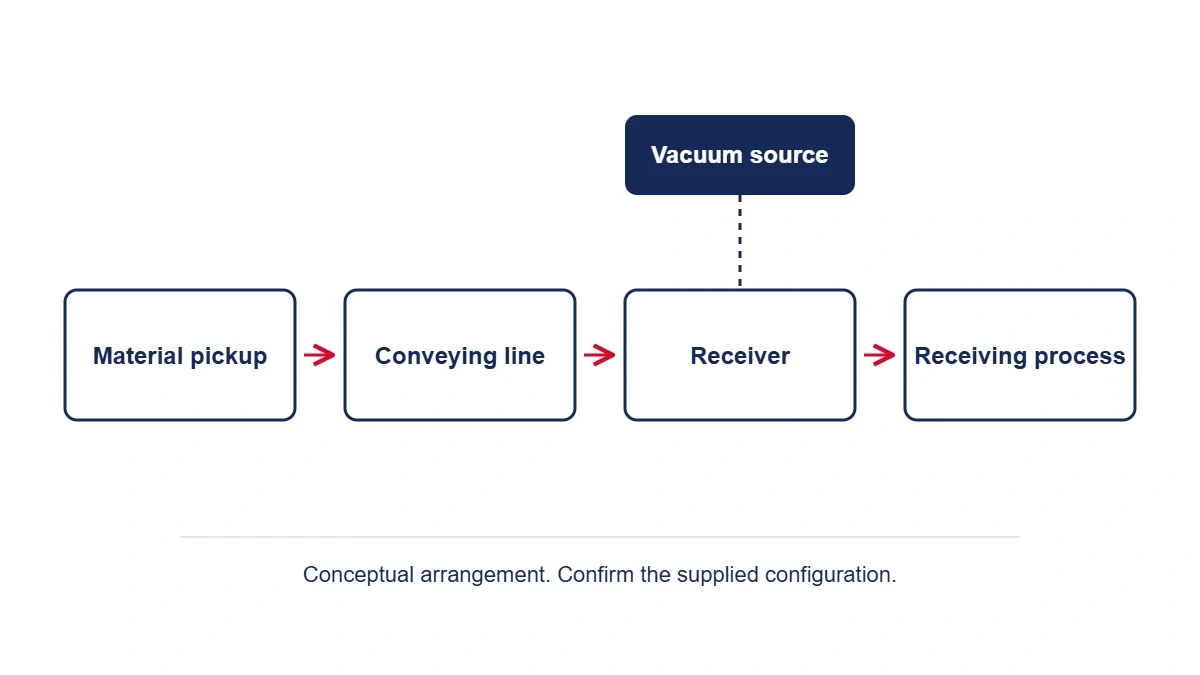
Define the handover points before ordering. Who supplies the pickup lance, hoses, supports, compressed-air treatment and receiving-vessel connection? Where does conveying air exhaust, and what happens when the downstream machine cannot accept more material? Clear interface responsibilities help prevent a receiver that fits mechanically but cannot meet the process duty.
Explore the wider UNITFINE conveying equipment range when comparing how material will move between process stages.
How does the vacuum conveying cycle work?
Pickup and collection
During suction, conveying air carries material toward the receiver. The receiver and filter arrangement separates the collected solids from the outgoing air. Pickup conditions matter: the supply point must admit an appropriate air-and-material mixture, and the line must suit the powder and route. Bridging, an unstable pickup supply or a restricted filter can interrupt feeding even when the vacuum source is operating.
Discharge and filter cleaning
In a cyclic receiver, suction stops before the discharge stage. Collected material falls into the receiving process when the discharge valve opens. Reverse-air cleaning can release deposited powder from a suitable filter; the exact sequence, pressure equalization and interlocks must follow the supplied equipment instructions. Filter cleaning during operation is not a substitute for inspection or validated cleaning between incompatible products.
Restart and downstream coordination
The next cycle may be requested by a timer or a material-level signal, depending on the supplied control scheme. Confirm the actual triggers, high-level stop and fault response in the control description. If a mixer or packing process needs a steady feed, assess the buffer volume and cycle interruptions. Repeating cycles may support ongoing production when buffer volume, receiving demand, cycle timing and control logic are matched; this does not make receiver discharge continuous or guarantee a particular mass per cycle.

Which material and application details matter?
UFLOW can be evaluated for powder and granular transfer to processing or packing equipment. A material name alone is insufficient to establish suitability: provide representative bulk density, particle-size distribution, moisture, flowability, temperature and any tendency to cake, abrade, segregate or generate static. For fragile granules or blends, specify an acceptable change in product quality and verify it with a representative conveying trial.
For loading a ribbon mixer, define the batch quantity, available loading window and inlet arrangement. For feeding a screen or packing machine, describe the receiving hopper and its demand signal. Confirm access for inspection and cleaning at the pickup, receiver and downstream connection, not just at the main vessel.
Selection checklist for a vacuum conveyor for powder
| Selection input | Information to provide | What the quotation or trial should confirm |
|---|---|---|
| Material and bulk density | Representative sample, loose bulk density, particle distribution and flow behavior | Pickup stability, usable receiver charge and discharge behavior for this material |
| Required delivery | Average mass flow, batch quantity, loading window and peak demand | Average delivered output over complete cycles, not suction time alone, with material conditions, route, cycle definition and measurement method stated in the acceptance basis |
| Route and lift | Horizontal run, vertical lift, bends, hose sections and pickup/receiver elevations | Conveying-line design and output on the proposed route |
| Filter and carryover | Fine-particle fraction, tendency to blind filters, allowable carryover and product-contact requirements | Filter media, retention basis, cleaning method and inspection interval |
| Utilities | Available compressed-air conditions and quality, electrical supply and exhaust restrictions | Demand at the equipment inlet under load and the selected vacuum-source arrangement |
| Cleaning and changeover | Dry or wet cleaning requirement, allergens, residues and drying constraints | Access, disassembly, compatible seals and filters, and a site-approved procedure |
| Safety and integration | Dust hazards, area classification, receiving equipment and control interfaces | Documented suitability, protective measures, supports and agreed interlocks |
Capacity must refer to the complete duty
Request performance expressed as delivered mass over an agreed operating period, using the intended material and route. The period should include suction, discharge and necessary pauses. Receiver volume alone does not establish throughput: delivered output depends on the material, route and complete cycle. The same receiver may deliver different output with different powders. State whether the acceptance target includes normal interruptions and downstream waiting, so supplier and purchaser evaluate the same duty.
UFLOW technical parameters and models
The existing UNITFINE product specification lists four models: UFZ180, UFZ250, UFZ320 and UFZ430. The original model names and numerical values are retained below.
Published reference data: This historical table is not a verified selection specification for your duty. Confirm the air-consumption and vacuum-flow notation, pressure reference, UFZ320 outlet entry, and humidity and particle-size basis against the current offered configuration before sizing utilities or selecting a model. Do not interpret RH as product moisture content or the particle-size range as filter retention. Throughput and conveying distances require agreed material, route, cycle and test conditions; they are not simultaneous performance guarantees.
| Model | UFZ180 | UFZ250 | UFZ320 | UFZ430 |
|---|---|---|---|---|
| Equipment height | 850MM | 950MM | 1100MM | 1400MM |
| Inner diameter | 180MM | 250MM | 320MM | 430MM |
| Effective volume | 7L | 18L | 35L | 60L |
| Equipment weight | 20KG | 35KG | 37KG | 55KG |
| Blanking butterfly valve caliber | 150MM | 150MM | 320MM | 200MM |
| Air consumption | (0L/min,0.6L/min) | (0L/min,0.6L/min) | (0L/min,0.6L/min) | (0L/min,0.6L/min) |
| Vacuum flow | (0L/min,90L/min) | (0L/min,90L/min) | (0L/min,90L/min) | (0L/min,90L/min) |
| Work pressure | (-92.5kpa,0kpa) | (-92.5kpa,0kpa) | (-92.5kpa,0kpa) | (-92.5kpa,0kpa) |
| Throughput | (0.1t/h-0.5t/h) | (0.3t/h-0.8t/h) | (0.5t/h-2t/h) | (1.3t/h-5t/h) |
| Applicable Item Properties | ||||
| Applicable Material Type | Powder | Granule | ||
| Applicable Material Temperature | (-10℃-70℃) | (-10℃-70℃) | ||
| Applicable Material Humidity | (0%RH-20%RH) | (0%RH-20%RH) | ||
| Applicable Material Particle Size | (0.2um-10mm) | (0.2um-10mm) | ||
| Vertical Conveying Distance | (0m-20m) | (0m-20m) | ||
| Horizontal Conveying Distance | (0m-80m) | (0m-80m) | ||
| If larger capacity equipment is needed, please contact us for customization. | ||||
Selection note: Listed throughput and conveying-distance ranges are not guaranteed simultaneously for every material or route. Confirm the required duty and offered configuration in the quotation. Air-consumption, vacuum-flow and pressure entries retain the original published notation; confirm their units and operating basis before utility sizing.
Filtration, cleaning and regulated applications
Filter choice is part of material selection, not an accessory decision after the receiver is sized. Ask which offered filter is compatible with the powder, the intended cleaning method and the required product-contact documentation. Confirm the retention specification, test method, particle-size basis and test conditions rather than inferring filtration performance from a material label such as PE or stainless steel. Inspect seals and filter condition according to the supplied maintenance instructions.
For food or pharmaceutical use, prepare a user requirements specification covering contact materials, surface condition, seals, cleaning access, residue limits and documentation. GMP suitability depends on the equipment configuration, installation, procedures and validation within the user’s quality system. This page does not establish GMP certification or a validated pharmaceutical containment rating. Request and review the actual documents required for your process before approving the equipment.
Dust and safety boundary: An enclosed vacuum line can help contain powder during suction, but pickup, discharge, exhaust and maintenance remain potential exposure points. Do not assume zero emissions, explosion protection or suitability for combustible, toxic or solvent-bearing material. Obtain a material-specific risk assessment and evidence for the offered configuration. Read the powder conveying dust-leakage checklist for interface questions.
Trial and purchase acceptance
Agree the trial method before discussing acceptance. Identify the sample, route, operating conditions and receiving arrangement, then document delivered output, interruptions and filter behavior. If product damage, segregation or residual carryover matters, specify how those outcomes will be evaluated. A short demonstration with a different powder is not proof of performance on your line. Sampling and inspection must use an approved safe procedure with the required isolation.
Where a vacuum system is not the best fit, compare an enclosed mechanical option such as a tubular cable drag conveyor against the same material, route, cleaning requirements and acceptance criteria. Neither technology is universally better; the relevant question is which proposed system meets the defined duty with acceptable product quality and operating requirements.

Frequently asked questions
Does UFLOW deliver material continuously?
The described receiver operates in suction and discharge cycles. If the downstream process needs steady feeding, confirm buffer capacity, cycle timing and controls. Continuous process operation does not mean uninterrupted receiver discharge.
Can I select a model from its listed capacity?
Use the UFZ180, UFZ250, UFZ320 and UFZ430 specification table as a starting point. Confirm the required delivery rate for your powder, route, filter and complete cycle with UNITFINE before selecting a model.
Which filter should I choose?
Choose with UNITFINE using particle distribution, filter-loading behavior, cleaning requirements and contact-material documentation. Confirm the offered filter specification; PE or stainless steel alone does not define retention performance.
Is the conveyor automatically GMP compliant?
No blanket GMP compliance is established by this page. Assess the offered configuration, documentation, cleaning procedure and validation requirements within your facility’s quality system.
Is a vacuum conveyor safe for combustible powder?
Do not assume suitability from vacuum operation alone. Provide material hazard data and area requirements, and obtain an engineering risk assessment and configuration-specific protective documentation before selection.
What information is needed for a quotation?
Send material data, required delivery or batch quantity, loading window, route drawing, receiving-equipment details, utilities, cleaning requirements and safety constraints. Include a sample or trial request when suitability is uncertain.
Request a UFLOW configuration review
Send UNITFINE your powder data, required capacity, route and lift, receiving-equipment drawing, utilities and cleaning requirements. Ask for a current datasheet and an agreed trial or acceptance basis stating the test material, operating conditions and measurement method for the proposed system.