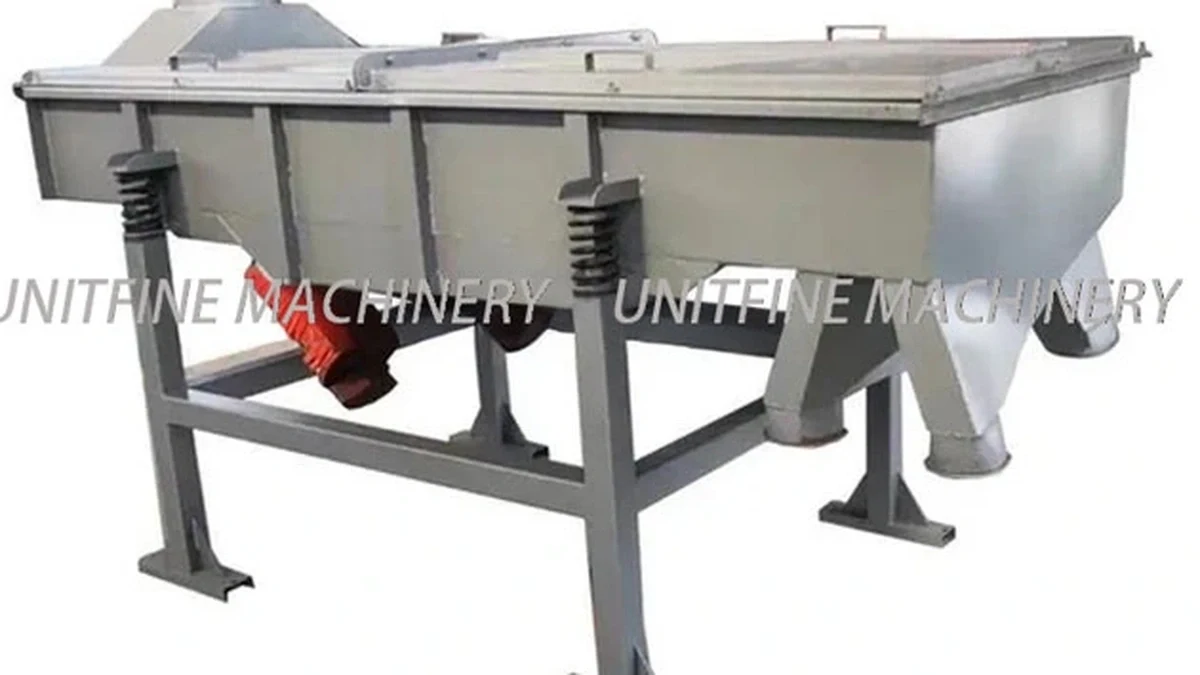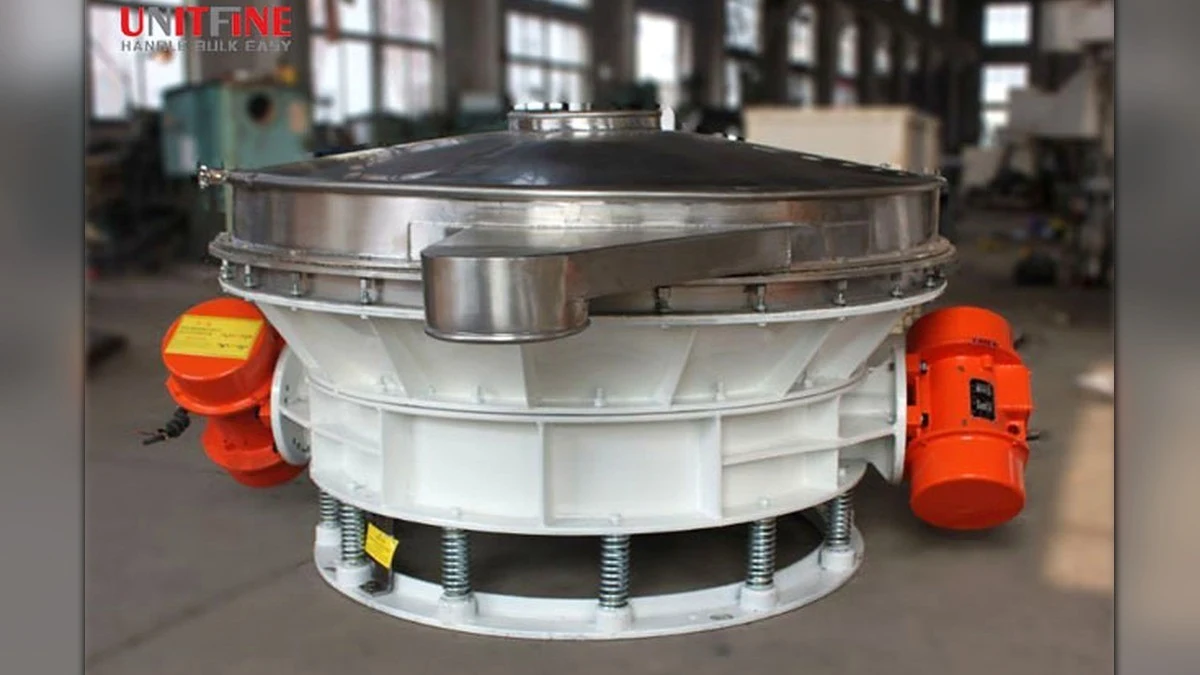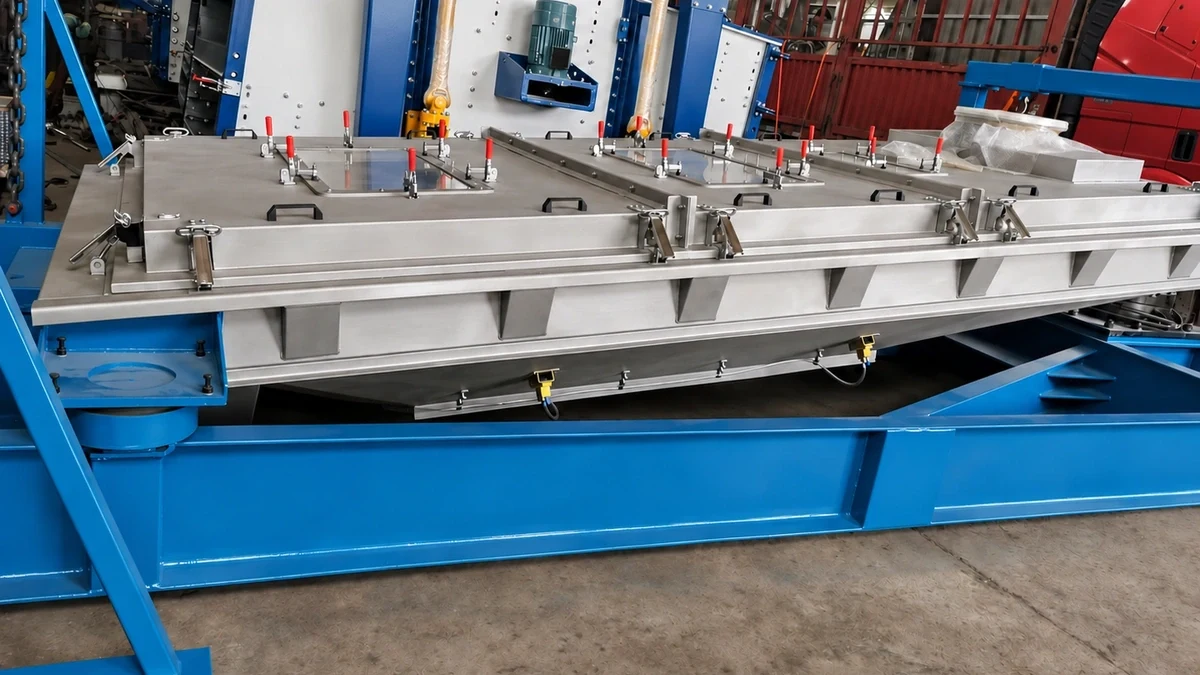


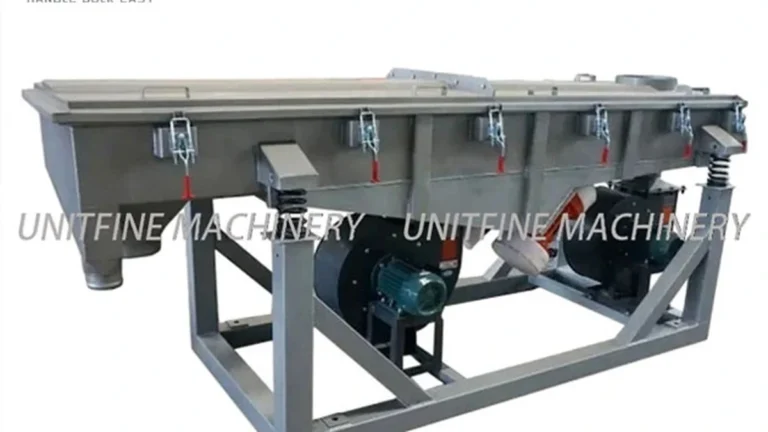
The UNITFINE ultrasonic vibrating sieve combines circular screening motion with ultrasonic vibration at the mesh. It is intended for fine-powder duties where particles adhere to the screen or obstruct its openings. Use the machine to evaluate a defined separation task: the material, required aperture, acceptable oversize and target delivery rate must be considered together.
Quick answer: For fine-powder screening duties affected by mesh blinding, an ultrasonic vibrating sieve adds high-frequency, low-amplitude mesh vibration to a conventional vibrating separator. This assistance can reduce blinding and help fine particles reach open apertures. It does not change the specified aperture, remove excessive moisture, or guarantee a capacity increase. Confirm performance with representative material and the proposed screen assembly.
How does ultrasonic mesh deblinding work?
The vibrating separator distributes material across the screen. An ultrasonic generator supplies an electrical signal to a transducer, which converts that signal into mechanical vibration. A matched conduction or resonance ring transfers the vibration to the mesh. The screen opening still determines which particles can pass; ultrasonic assistance helps maintain access to those openings.
Blinding reduces usable screening area when particles lodge in or adhere around the mesh. Ultrasonic vibration can help release such particles, but its effectiveness depends on powder behavior, screen tension, feed loading and the matched ultrasonic components. It should not be described as neutralizing electrical charge or breaking every agglomerate. Drying, upstream conditioning or another process may be necessary for damp or strongly bonded material.
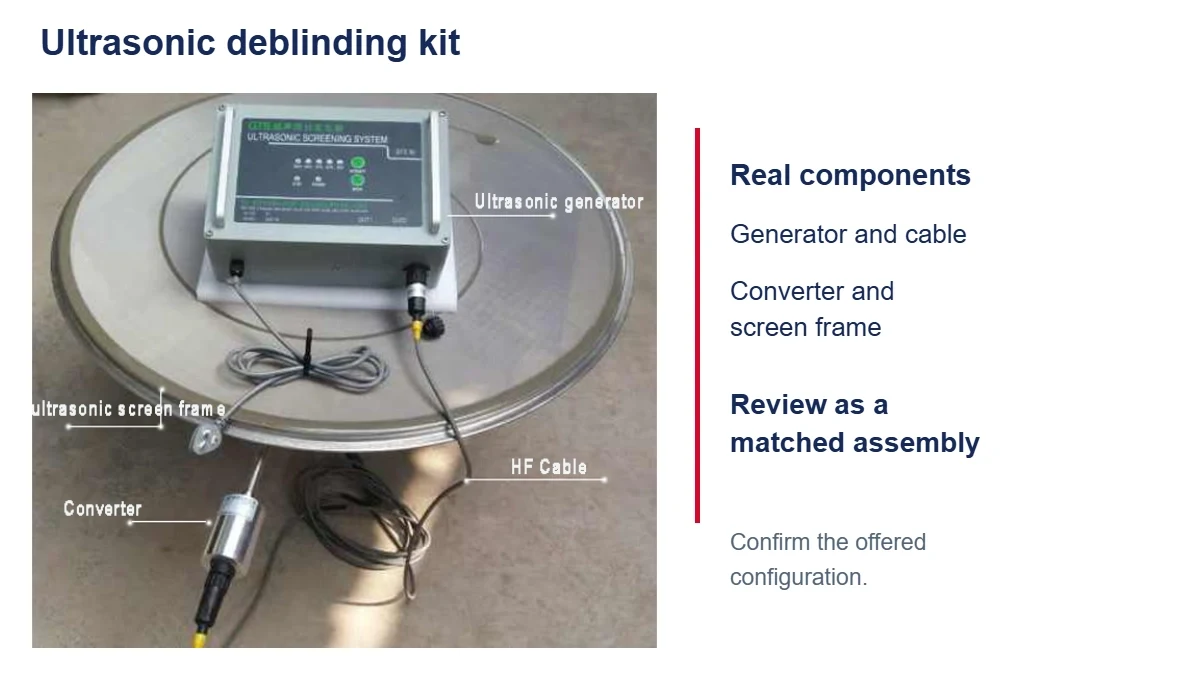
What is included in the screening assembly?
- Vibrating sieve body: supports the screening deck and directs the separated fractions to their outlets.
- Ultrasonic generator and cable: provide the electrical drive for a compatible transducer.
- Transducer: converts electrical energy into mechanical vibration; position and connection depend on the offered assembly.
- Resonance ring and screen mesh: form the matched screen assembly that receives ultrasonic energy.
For replacement or retrofit work, compare the generator, transducer, cable, ring and mesh as a system. A matching connector alone does not establish compatibility. If you already have a separator, review the GTS30 ultrasonic screen deblinding system with UNITFINE before choosing a complete replacement machine.
Which powders should be evaluated?
UNITFINE lists resin and powder-coating materials, pigments, metal powders and alloys, chemical powders, pharmaceutical or biotech powders, and food or baking ingredients as application groups. These categories identify possible enquiries, not blanket suitability approvals. Moisture, bulk density, particle-size distribution, abrasiveness, temperature and contamination limits can change the appropriate screen and equipment configuration.
| Material or duty | Reason to evaluate ultrasonic assistance | Information needed before selection |
|---|---|---|
| Resins, coatings and pigments | Fine powder may adhere to mesh or form soft agglomerates. | Moisture, operating temperature, particle distribution and acceptable product change. |
| Metal powders and alloys | Fine fractions and near-aperture particles may limit open screening area. | Abrasion, contamination limits, powder hazards and the required separation result. |
| Chemical powders | Adhesive or cohesive material may need mesh deblinding assistance. | Compatibility with contact surfaces and seals, material behavior and cleaning method. |
| Food, baking, pharmaceutical or biotech powders | Fine screening may require close control of retained oversize and product recovery. | Hygiene requirements, cleaning access, traceability and any required documented qualification. |
Industry names do not establish food-contact, pharmaceutical or hazardous-area certification. Specify the actual documentation and construction requirements in the enquiry. Dust containment also depends on the enclosure, seals, feed and discharge connections, and extraction arrangement; ultrasonic vibration alone is not a dust-control system.
Standard sieve, ultrasonic sieve or retrofit?
Choose ultrasonic assistance when mesh blinding is a demonstrated limit on the intended fine-powder duty. A larger motor or an ultrasonic generator will not correct a damaged screen, unsuitable aperture or uncontrolled feed. Compare alternatives using the same material and target separation, including product recovery, retained oversize, cleaning frequency and the condition of the mesh.
| Situation | Starting point | Decision check |
|---|---|---|
| Free-flowing material with little mesh blockage | Evaluate a conventional vibrating sieve. | Confirm that normal screening achieves the required cut and delivery rate. |
| Fine powder repeatedly blinds a correctly installed mesh | Evaluate an ultrasonic vibrating sieve. | Trial the powder with the intended mesh, feed rate and ultrasonic assembly. |
| An existing separator is mechanically suitable | Assess a compatible deblinding retrofit. | Check frame geometry, screen mounting, generator/transducer matching and access. |
| Wet caking, damaged mesh or severe feed surges | Correct the underlying cause first. | Do not treat ultrasonic assistance as a substitute for conditioning or maintenance. |
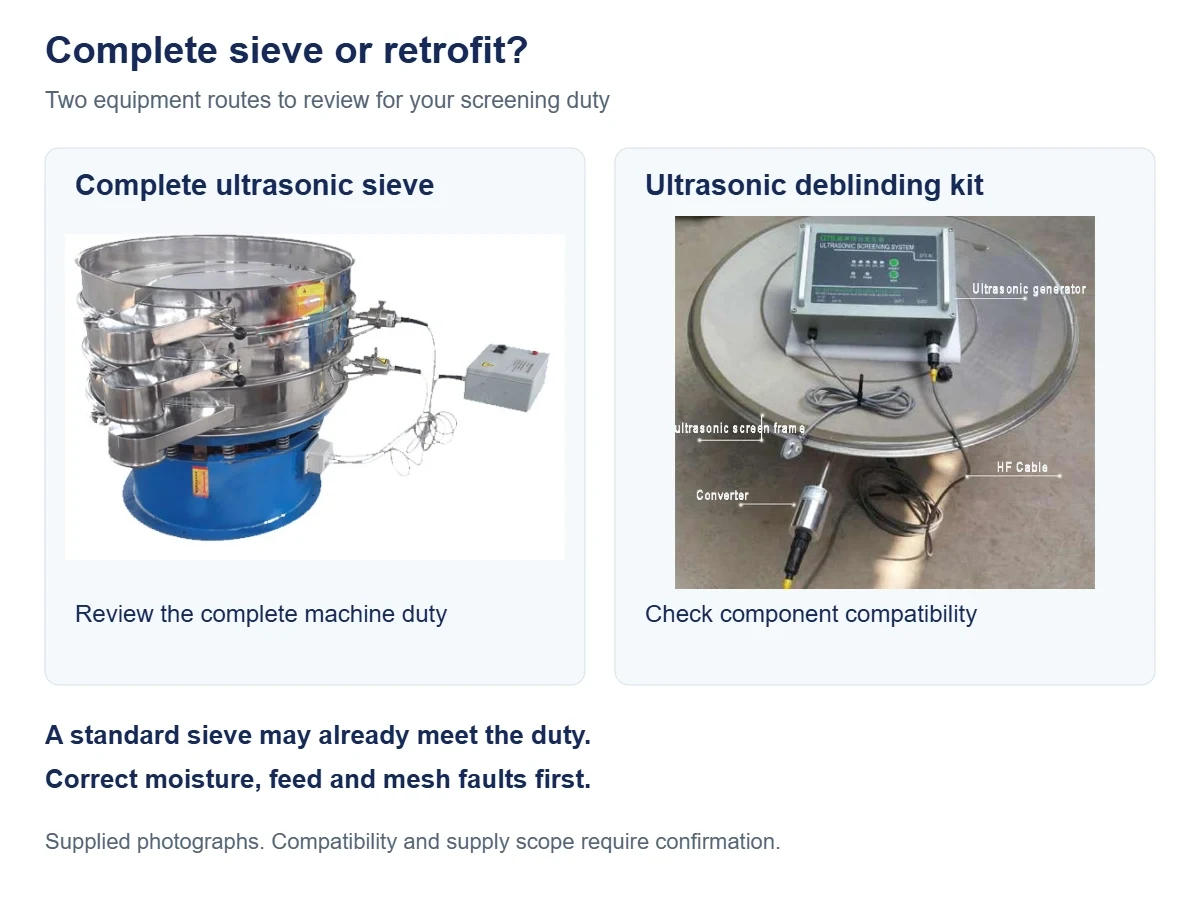
Compare the UNITFINE rotary vibrating sieve for the base screening arrangement. For a diagnosis of recurring blockage, use the mesh-blinding troubleshooting guide.
Model references and specification checks
The following model names come from the existing UNITFINE product listing. Generator entries are reference pairings from that listing, not a final compatibility schedule. Confirm the current generator, transducer and screen assembly on the quotation and drawing. Model numbers alone do not establish throughput, screen aperture, installed dimensions or the number of screening cuts.
| Listed sieve model | Generator reference in the existing listing |
|---|---|
| UFC-200 | UF08 |
| UFC-400 | UF08 |
| UFC-600 | UF08 |
| UFC-800 | UF08 / UF60 |
| UFC-1000 | UF60 |
| UFC-1200 | Requires confirmation |
| UFC-1500 | UF60 |
Select the generator, transducer and screen assembly as a matched system. Confirm the operating frequency and electrical requirements for the exact components on the quotation; a model name or connector alone does not establish compatibility. Request the electrical supply, current rating, operating modes and enclosure dimensions of the generator to be supplied.
The UF08 generator information is a separate reference for component enquiries. For the screen, provide aperture and wire specification as well as any mesh designation; woven wire mesh selection should be checked against the required separation. Confirm all product-contact materials and seals instead of treating a transducer-casing description as a specification for the whole machine.
Define the trial and installation requirements
Define a material trial using a representative sample, the proposed aperture and the intended feed method. Before testing, agree the target delivery rate, acceptable passing and retained fractions, run duration, measurement methods and permitted deviations. Record these results and the screen condition against the agreed criteria. A short run with a substitute powder does not establish capacity for the production material.
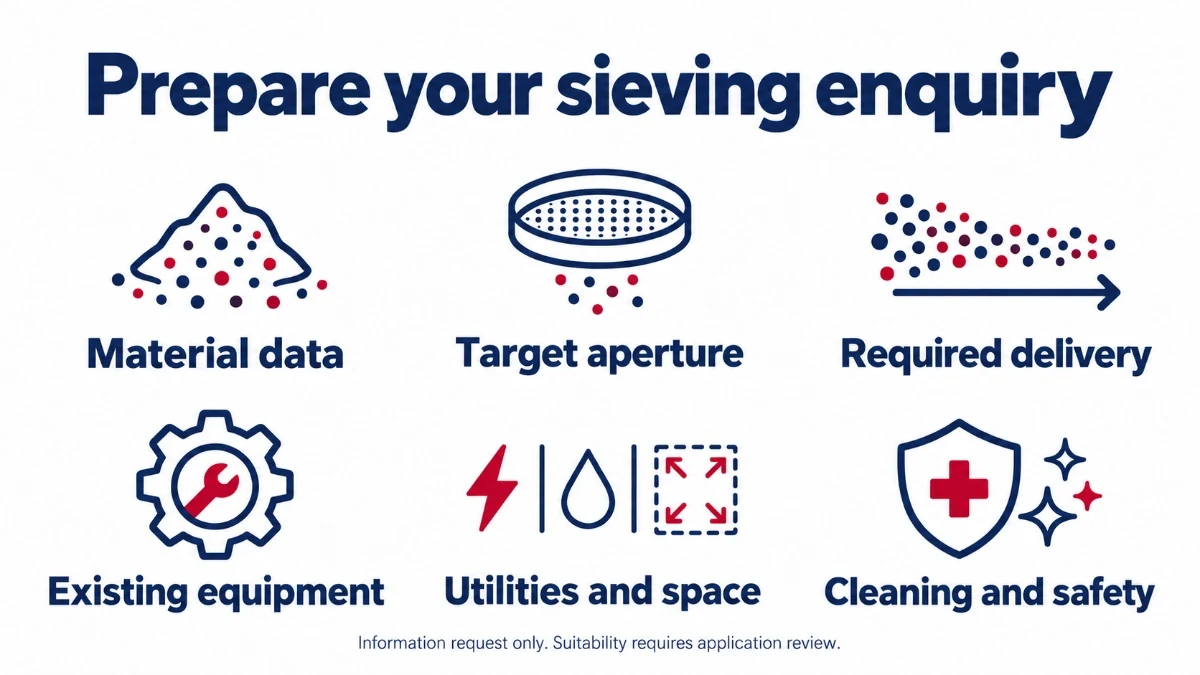
- Material: name, representative sample, particle-size distribution, bulk density, moisture, temperature and flowability.
- Separation: target aperture, acceptable oversize, number of fractions and any concern about fragile particles.
- Delivery: required rate, batch or continuous feed, feed surges and upstream/downstream equipment.
- Installation: available space, feed/discharge heights, power supply, connections and maintenance access.
- Cleaning and safety: changeover method, contamination limits, powder hazards and required supporting documents.
Before purchase, request a configuration drawing and a written supply boundary covering the separator, ultrasonic components, screens and any auxiliary equipment. Confirm cleaning access and the replacement-screen procedure for that assembly. Use the supplied operating and isolation instructions for maintenance; this product overview is not an operating or safety procedure.
Frequently asked questions
What does an ultrasonic vibrating sieve add to a standard sieve?
It adds high-frequency, low-amplitude vibration to a matched mesh assembly. This can help reduce mesh blinding during fine-powder screening while the conventional vibrating separator distributes the material.
Can ultrasonic deblinding solve every blockage problem?
No. Excessive moisture, damaged or poorly tensioned mesh, hard agglomerates and uncontrolled feed may need separate corrective action. Evaluate ultrasonic assistance against the actual cause of blockage.
Which mesh size and throughput can UNITFINE supply?
The required aperture and delivery rate must be evaluated for the material and proposed configuration. Send the particle-size distribution, moisture, bulk density and target separation; do not infer a guaranteed capacity from a sieve model or generator name.
Can an existing vibrating sieve be upgraded?
A retrofit may be possible only after UNITFINE confirms the mechanical, electrical and frequency compatibility of the screen frame, mounting, generator, transducer and cable. Provide the existing machine model, photographs and drawings for review before ordering a deblinding kit.
Are UF08 and GTS30 interchangeable?
UF08 is listed as an ultrasonic generator, while GTS30 is listed as a screen-deblinding system. These names alone do not establish interchangeability. Confirm the matched generator, transducer, cable and screen assembly, including its frequency and electrical requirements, with UNITFINE.
Does ultrasonic screening guarantee dust-free operation?
No. Dust containment depends on the enclosure, seals, feed and discharge connections, extraction and the powder being handled. Specify containment and cleaning requirements separately.
Request an ultrasonic sieve configuration review
Send UNITFINE your material data, target aperture, required delivery rate, available installation space and electrical supply. For a retrofit, include the existing sieve model and clear photographs of the frame and ultrasonic connections. State the cleaning, contamination and safety requirements, and agree the trial sample, measured delivery rate, passing and retained fractions, run duration and permitted deviations before testing.
Contact UNITFINE to discuss your screening duty or email info@unit-fine.com.