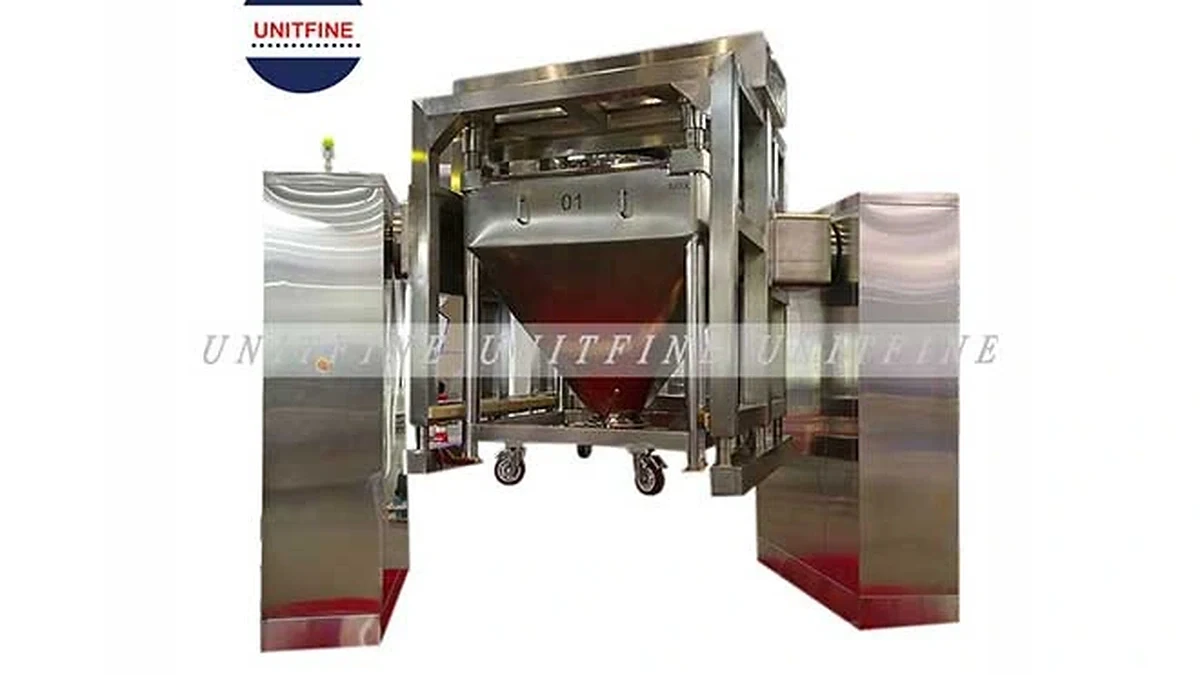
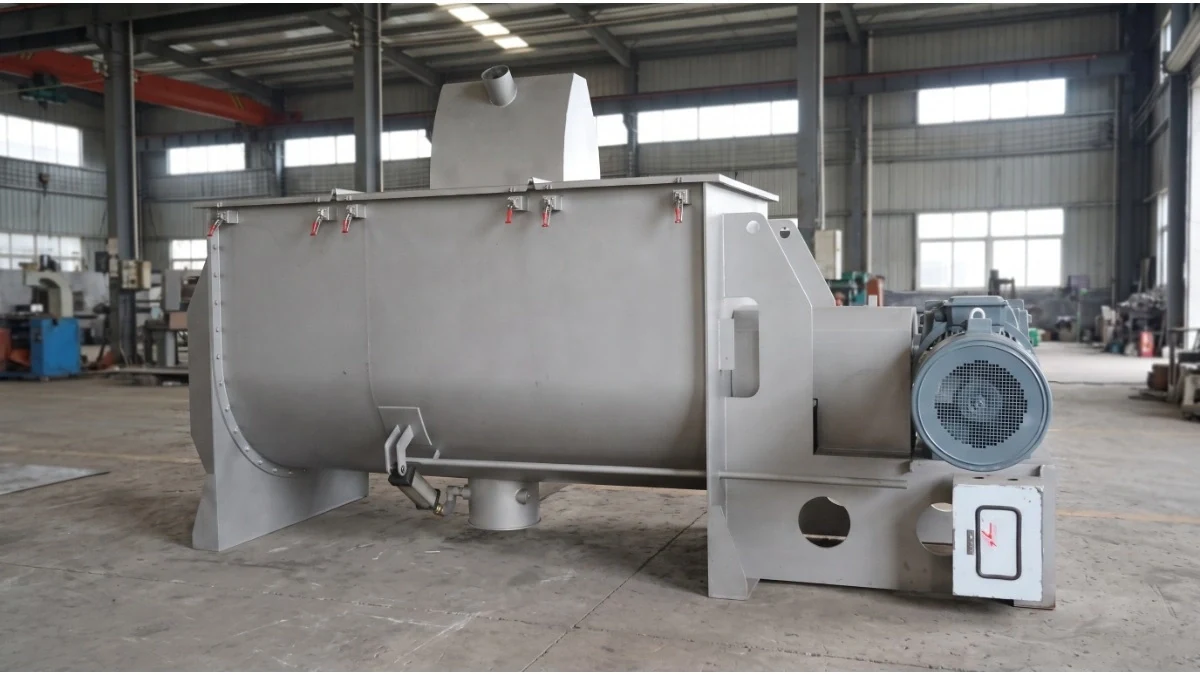
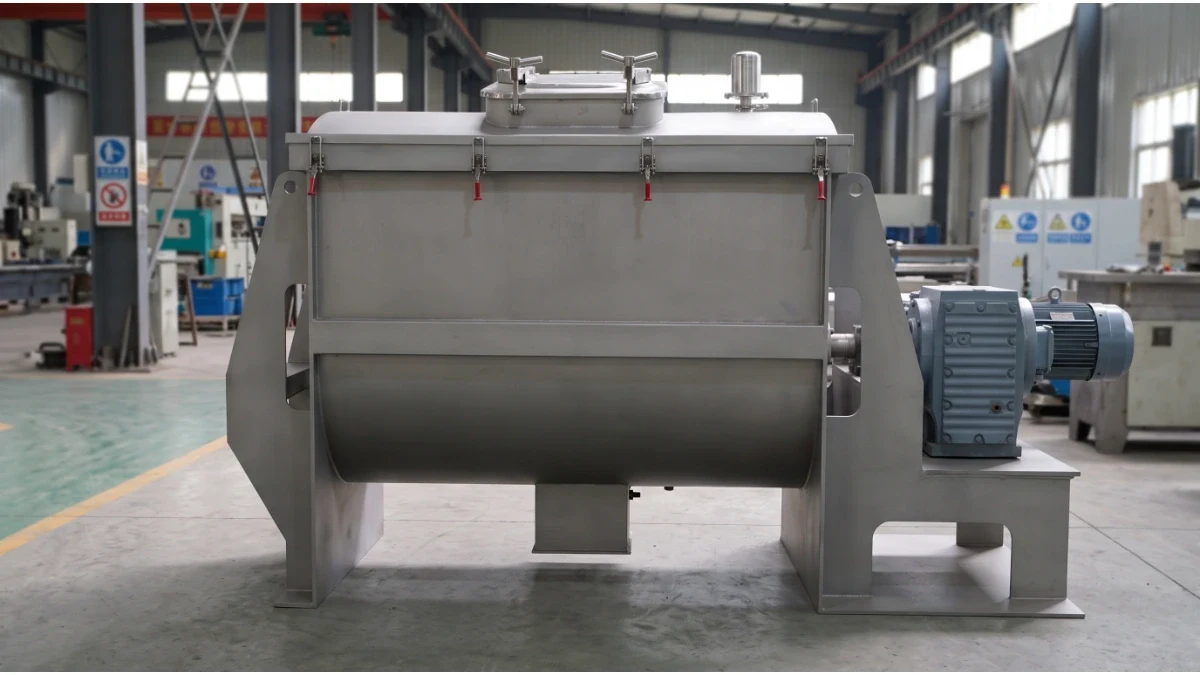
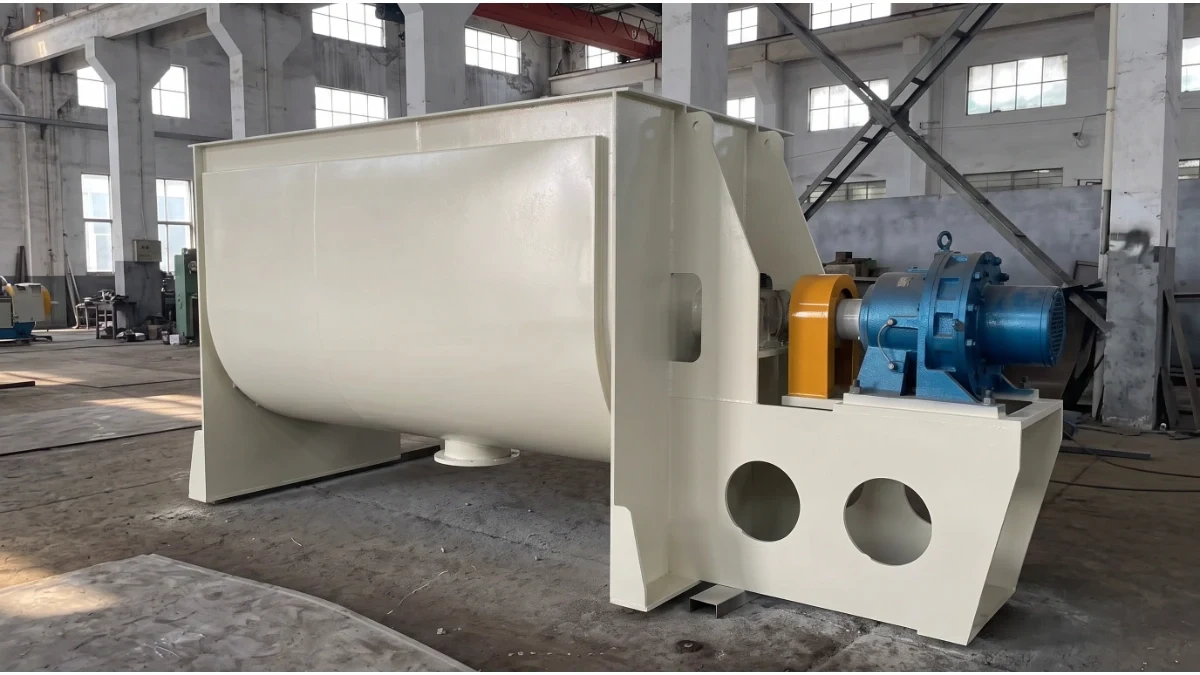
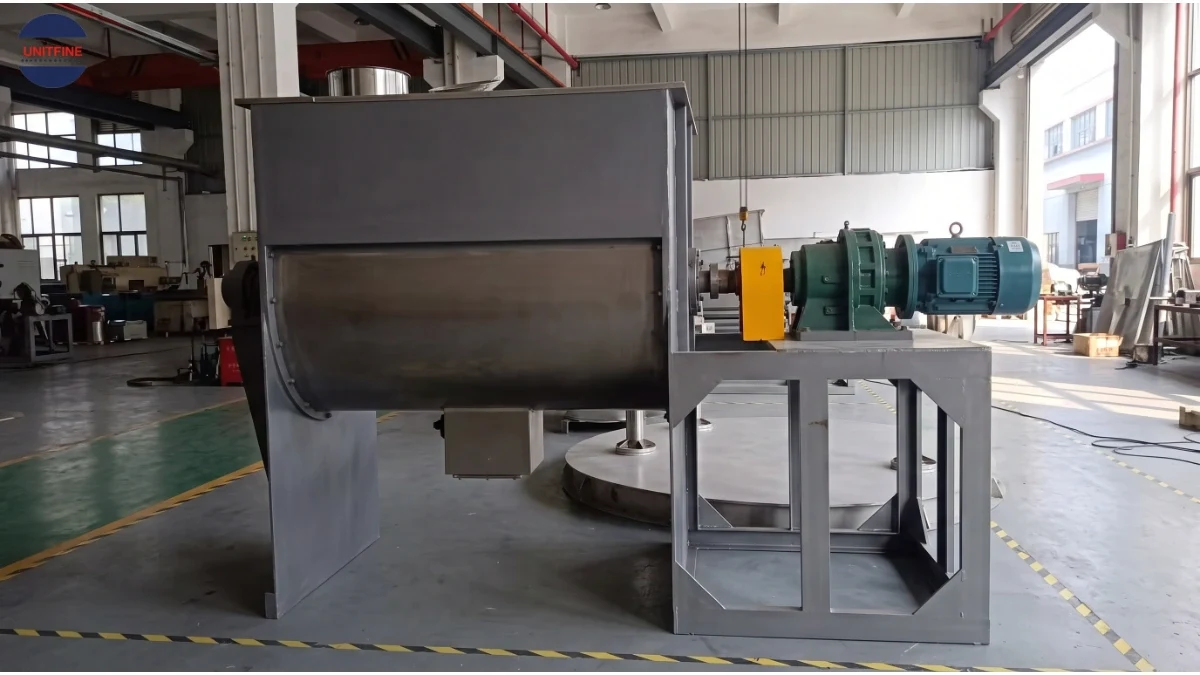
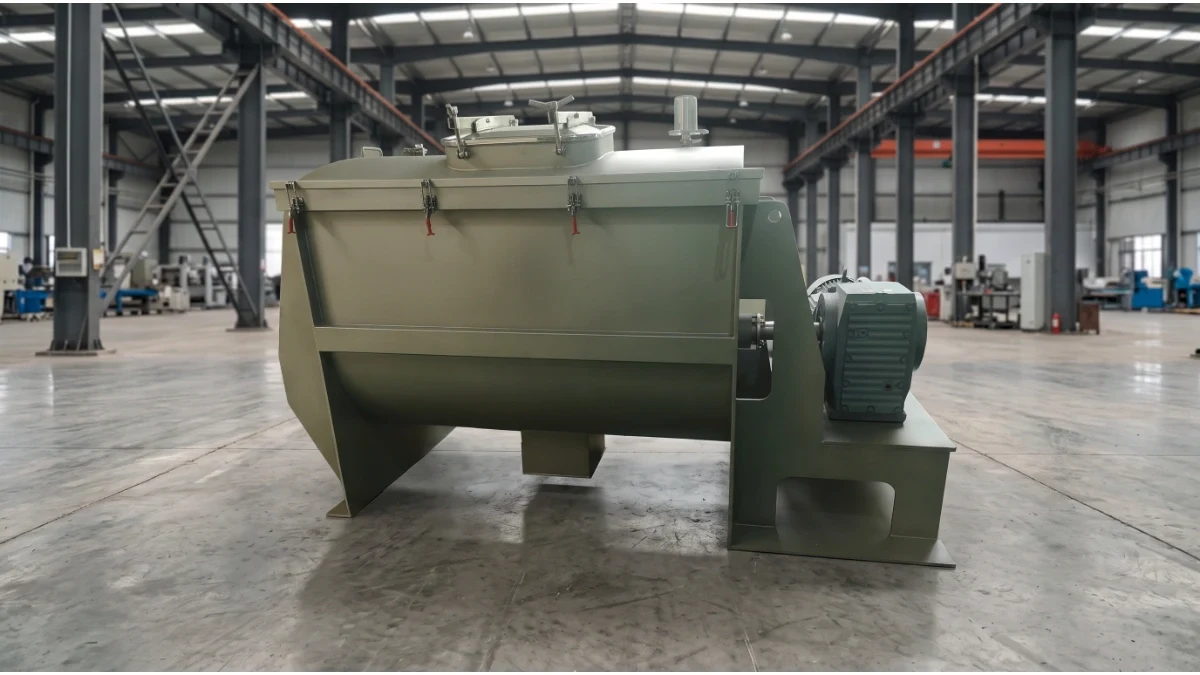


A ribbon mixer is a batch blender for dry powders, granules, and selected powder-with-liquid duties. The correct machine is not chosen from nominal vessel size alone: usable batch volume, bulk density, flowability, liquid addition, cleaning, discharge, and the surrounding process determine the required configuration.
This guide explains how to approach ribbon mixer selection for an industrial process and how UNITFINE can configure the mixer, drive, contact materials, openings, discharge, and optional components around representative material data.
What Is a Ribbon Mixer?
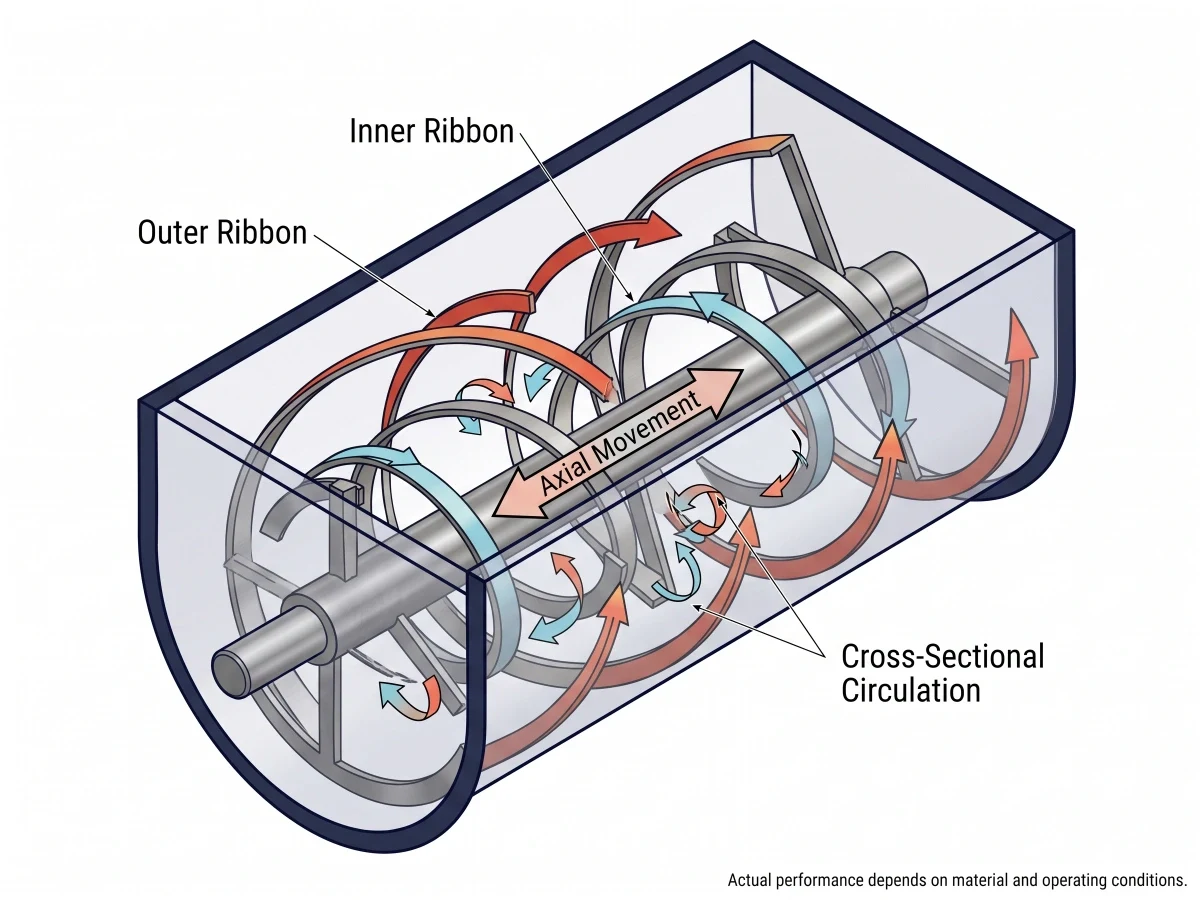
A ribbon mixer normally uses a horizontal trough containing a central shaft with inner and outer helical ribbons. As the shaft rotates, the ribbons move material through different axial and radial paths. The combined circulation repeatedly redistributes material through the batch.
This arrangement is commonly considered for free-flowing or moderately cohesive powders, powder-and-granule blends, and selected applications where a controlled quantity of liquid is sprayed into a dry mix. Material behavior can change markedly when liquids, fats, binders, fragile particles, fibers, or abrasive ingredients are present, so suitability should be confirmed with representative material data and, where uncertainty remains, a controlled mixing test.
How the Double-Ribbon Mixing Motion Works
The outer and inner ribbons are arranged to move material in opposing axial directions while the rotating assembly also creates cross-sectional circulation. This motion is intended to reduce unmixed zones and redistribute components throughout the trough. Because blend uniformity depends on the formulation, loading sequence, working fill, speed, ribbon clearances, segregation tendency, sampling method, and discharge point, it must be verified against a defined acceptance criterion.
What the mixer can and cannot do by itself
- It can provide batch blending: suitable ingredients are loaded, mixed for a validated period, and discharged.
- It can accept configured additions: a liquid-spray system, heating or cooling jacket, optional chopper, scraper, or alternative agitator may be evaluated for specific duties. Chopper duty and operating speed require application-specific confirmation.
- It does not guarantee a universal mixing time: the cycle must be established from the actual formulation, working batch, loading sequence, operating settings, sampling method, and uniformity target.
- It does not replace conveying equipment: a UFLOW Vacuum Conveyor or U Type Screw Conveyor may be integrated for feeding or discharge when suitable.
Material Suitability and Application Boundaries
| Material or duty | Why it may fit | Key application checks |
|---|---|---|
| Dry powders | Batch circulation can distribute multiple powder ingredients. | Bulk density, flowability, cohesion, dust control, particle-size spread, and segregation risk. |
| Powder and granules | Suitable combinations may be blended in one batch. | Particle fragility, density difference, size difference, ribbon speed, and discharge segregation. |
| Powder with limited liquid addition | A spray system can distribute a controlled liquid addition. | Spray rate, nozzle position, wetting behavior, lump formation, wall build-up, chopper need, and cleaning. |
| Abrasive products | Possible after the product’s abrasivity and expected wear rate are reviewed. | Measured or comparative abrasivity, particle hardness, contact-material thickness, coatings, clearances, shaft seal, maintenance access, and acceptable service interval. |
| Fragile particles | May be feasible at a conservative operating condition. | Breakage limit, speed, agitator geometry, batch size, loading and discharge method; test with representative material. |
| Sticky, highly cohesive, or paste-like products | A standard ribbon requires further evaluation when wall adhesion, poor discharge, or high torque prevents reliable circulation. | Torque, wall adhesion, scraper or chopper need, discharge behavior, cleanability, and whether another agitator or mixer type is more suitable. |
Ribbon Mixer Selection: Seven Inputs That Drive the Decision
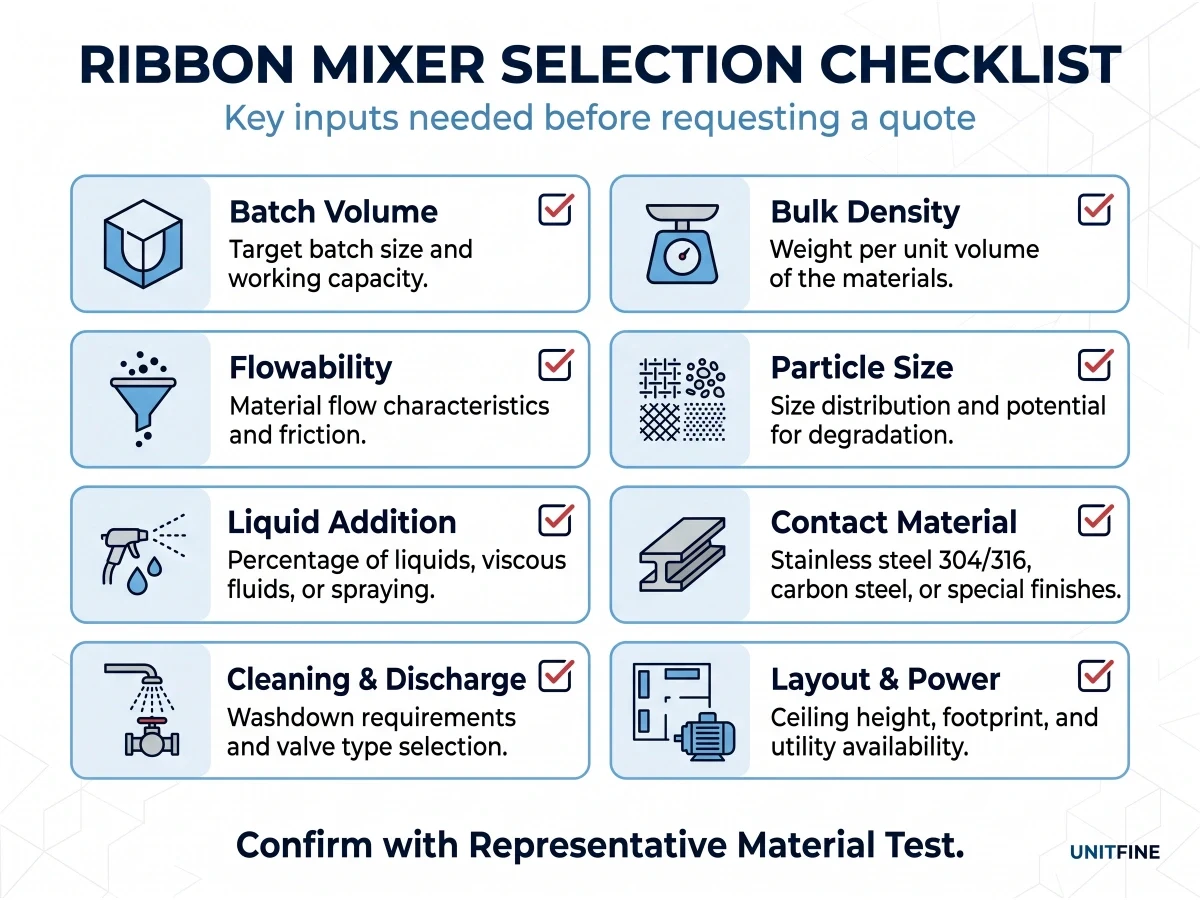
1. Working batch volume, not only vessel volume
Define the minimum, normal, and maximum batch. The mixer must hold the batch while maintaining a working fill that allows the ribbons to circulate material. Do not convert liters directly into kilograms without the product’s measured bulk density.
2. Bulk density and flowability
Bulk density affects batch mass and drive loading. Flowability influences feeding, circulation, discharge, and the risk of bridging or dead zones. Provide loose and, when relevant, tapped bulk density together with a practical description of the material.
3. Particle size, density differences, and segregation risk
A blend containing very different particle sizes or densities may segregate during loading, mixing, discharge, or downstream conveying. The mixer should therefore be evaluated as part of the complete process, not as an isolated vessel.
4. Liquid addition or agglomerate control
If the recipe includes liquid, specify the liquid type, quantity, viscosity, addition time, and desired final texture. A spray manifold and optional chopper may be considered, but chopper duty, operating speed, and arrangement should be selected from the material behavior and test objective.
5. Contact material, surface finish, and cleanability
UNITFINE reference options include carbon steel and stainless-steel grades such as 304, 316L, and 321. The appropriate grade and finish depend on corrosion, abrasion, hygiene, cross-contamination control, cleaning chemistry, and the customer’s applicable standards. A material grade alone does not establish regulatory compliance.
6. Inlets, vents, inspection access, seals, and discharge
Specify how each ingredient enters, where displaced air exits, whether dust collection is required, how operators inspect or clean the trough, and how the finished batch leaves. Manual, pneumatic, or electric discharge actuation may be considered according to the required automation and site utilities.
7. Process layout and downstream handling
Confirm platform height, floor space, headroom, maintenance access, upstream feeding, downstream receiving, and electrical supply. Vacuum conveying offers enclosed transfer for suitable powders, while a screw conveyor can provide controlled mechanical transfer for suitable materials and layouts.
Published UFM Model Reference
The table below reproduces data from a legacy UNITFINE product sheet. That source combines a nominal mass and vessel-volume reference but does not state the assumed bulk density, measurement tolerance, or complete standard-configuration basis. Use the table for preliminary comparison only; the working batch, motor, dimensions, and interfaces must be defined on the application-specific quotation and approved drawing.
| Model | Nominal mass / vessel volume reference (kg / L) | Legacy motor reference (HP) | Legacy dimensions L × W × H (mm) |
|---|---|---|---|
| UFM-100 | 100 / 260 | 2 | 2210 × 600 × 1450 |
| UFM-200 | 200 / 500 | 3 | 2310 × 710 × 1660 |
| UFM-300 | 300 / 700 | 5 | 2310 × 900 × 1750 |
| UFM-500 | 500 / 1200 | 7.5 | 2790 × 960 × 1830 |
| UFM-1000 | 1000 / 2400 | 15 | 3420 × 1220 × 2150 |
| UFM-2000 | 2000 / 4800 | 25 | 3900 × 1350 × 2450 |
| UFM-3000 | 3000 / 6500 | 40 | 3700 × 1850 × 2803 |
Layout note: The legacy sheet does not define a model-specific outlet-height basis. Confirm the final outlet elevation, overall dimensions, power, supports, openings, jackets, and discharge arrangement on the approved drawing before designing platforms or connected equipment.
Configuration Options
| Configuration area | Available direction | Selection question |
|---|---|---|
| Product-contact construction | Carbon steel or specified stainless-steel construction; different contact and non-contact materials may be discussed. | What corrosion, hygiene, abrasion, and cleaning conditions apply? |
| Surface treatment | Blasted, brushed, or polished finishes may be configured. | What finish and roughness acceptance must be documented? |
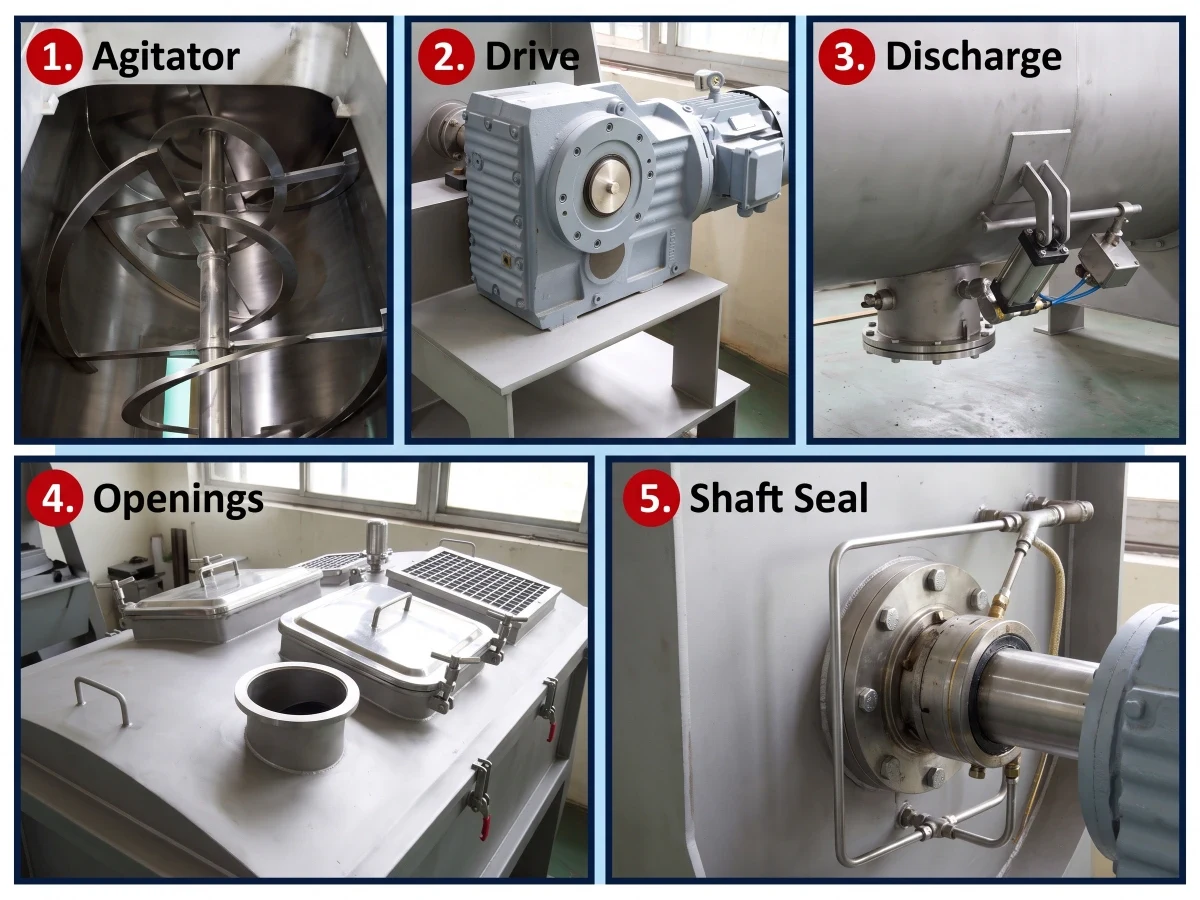
| Drive | Motor, gearbox, direct or alternative coupling arrangements can be selected for the application. | What torque, voltage, frequency, speed control, and hazardous-area requirements apply? |
| Agitator | Double ribbon and application-specific alternatives such as scraper or combined arrangements may be evaluated. | Is the product free-flowing, cohesive, sticky, fragile, abrasive, or liquid-bearing? |
| Liquid addition | Spray system and optional chopper, with duty and speed selected for the application. | How much liquid is added, at what rate, and what final texture is acceptable? |
| Temperature control | Heating or cooling jacket where the process requires it. | What medium, temperature range, pressure basis, and control method are required? |
| Openings and discharge | Configured feed ports, vents, inspection/cleaning access, and discharge valve. | How will the mixer connect to upstream and downstream equipment? |
| Shaft sealing | Seal arrangement selected for the powder and cleaning method. | How dusty, abrasive, fine, or contamination-sensitive is the product? |
How to Validate Mixing Time and Blend Uniformity
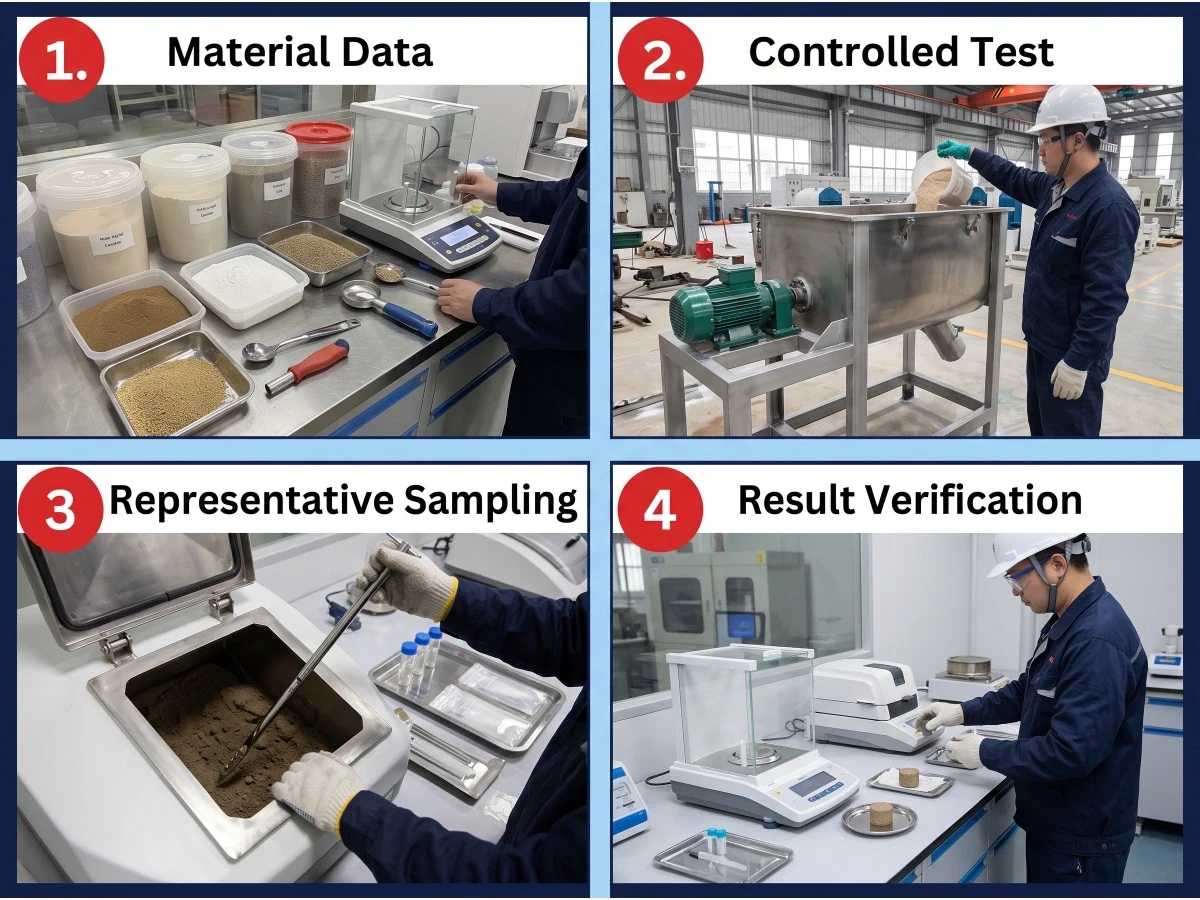
Mixing time is formulation-specific. A legacy UNITFINE product sheet lists 3–15 minutes only as a general reference and does not define the formulation, working fill, speed, sampling plan, or uniformity criterion behind that range. It must not be used as a cycle-time commitment; establish the production cycle with representative materials and a defined acceptance method.
- Record each ingredient, proportion, bulk density, particle-size range, moisture, and loading sequence.
- Define the minimum acceptable batch and the normal production batch.
- Select a measurable tracer or critical component and an agreed analytical method.
- Take samples from a documented set of locations or discharge intervals at defined mixing times.
- Compare uniformity, particle damage, temperature rise, wall build-up, residue, and discharge completeness.
- Confirm the result again after transfer to the receiving equipment, because downstream handling can cause segregation.
Ribbon Mixer, Vacuum Conveyor, and Screw Conveyor: Different Roles
| Equipment | Primary role | Typical integration question |
|---|---|---|
| Ribbon mixer | Batch blending in a horizontal trough. | What batch, recipe, uniformity target, discharge method, and cleaning procedure are required? |
| UFLOW Vacuum Conveyor | Enclosed pneumatic transfer of suitable powders or granules. | Can the material be conveyed at the required distance and rate without filter, segregation, or product-damage problems? |
| U Type Screw Conveyor | Mechanical conveying and controlled transfer of suitable bulk solids. | What capacity, route, inclination, wear, cleanability, and discharge control are required? |
For most process layouts, these machines serve complementary rather than interchangeable roles. A complete line may use conveying equipment to feed the mixer and remove the finished batch, but every transfer step must be checked for dust control, segregation, residue, cleaning, and layout.
Information to Send for a Ribbon Mixer Proposal
- Material and industry application
- Ingredient list, proportion range, and loading sequence
- Loose bulk density and normal batch mass or volume
- Particle-size range, flowability, moisture, and temperature
- Liquid-addition quantity, viscosity, and spray requirement
- Required blend-uniformity test or acceptance criterion
- Contact material, finish, cleaning, and contamination-control requirement
- Inlet, vent, inspection, dust collection, and discharge arrangement
- Available space, inlet height, outlet height, access, voltage, and frequency
- Upstream feeder and downstream receiver or conveyor
Frequently Asked Questions
How do I choose the right ribbon mixer size?
Calculate the required working batch volume from batch mass and measured bulk density, then confirm that the proposed mixer can operate within an appropriate working fill for both minimum and maximum batches. Final sizing must also consider flowability, liquid addition, torque, discharge, and cleaning.
What materials can a ribbon mixer handle?
Ribbon mixers are commonly considered for powders, granules, powder-and-granule blends, and selected dry mixes with limited liquid addition. Suitability should be confirmed from representative material data; highly sticky, paste-like, fragile, heat-sensitive, or strongly segregating products require a specific review and may need another agitator or mixer type.
How long does ribbon mixing take?
There is no universal ribbon-mixer cycle time. It depends on the formulation, working fill, loading order, operating settings, liquid addition, sampling method, and uniformity criterion. Confirm the cycle with representative material testing.
Can a ribbon mixer add liquid to powder?
Yes, selected applications can use a liquid-spray system, and an optional chopper may be evaluated where wet agglomerates must be controlled. Provide liquid quantity, viscosity, spray time, final texture, and cleaning requirements; chopper duty and speed must be selected for the application.
Which contact material should I choose?
The choice between carbon steel and stainless-steel grades such as 304 or 316L depends on corrosion, abrasion, hygiene, cleaning chemicals, contamination control, and the standards applicable to the installation. Material grade alone does not prove food, pharmaceutical, or hazardous-area compliance.
Can a vacuum or screw conveyor be connected to the mixer?
Yes, suitable conveying equipment may feed the mixer or transfer the finished batch. The complete layout must be checked for rate, headroom, dust containment, venting, segregation, residue, access, and cleanability.
What should be confirmed before ordering?
Confirm the approved general arrangement drawing, working batch, product-contact materials and finish, motor and electrical supply, seal, openings, discharge valve, optional systems, safety interfaces, documentation scope, and the agreed material-test basis.
Discuss Your Ribbon Mixer Selection with UNITFINE
Send your representative material data, batch requirement, process layout, cleaning method, and acceptance criteria. UNITFINE can review the mixer size, drive, contact construction, openings, discharge, and conveying interfaces for your application.