
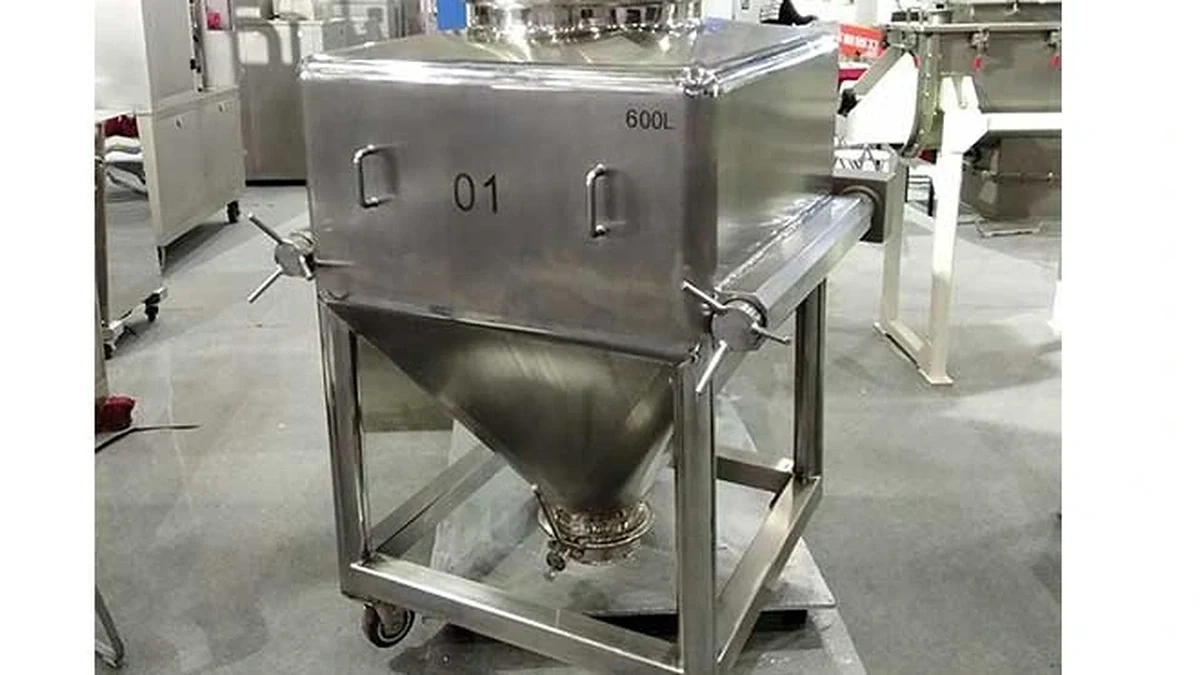
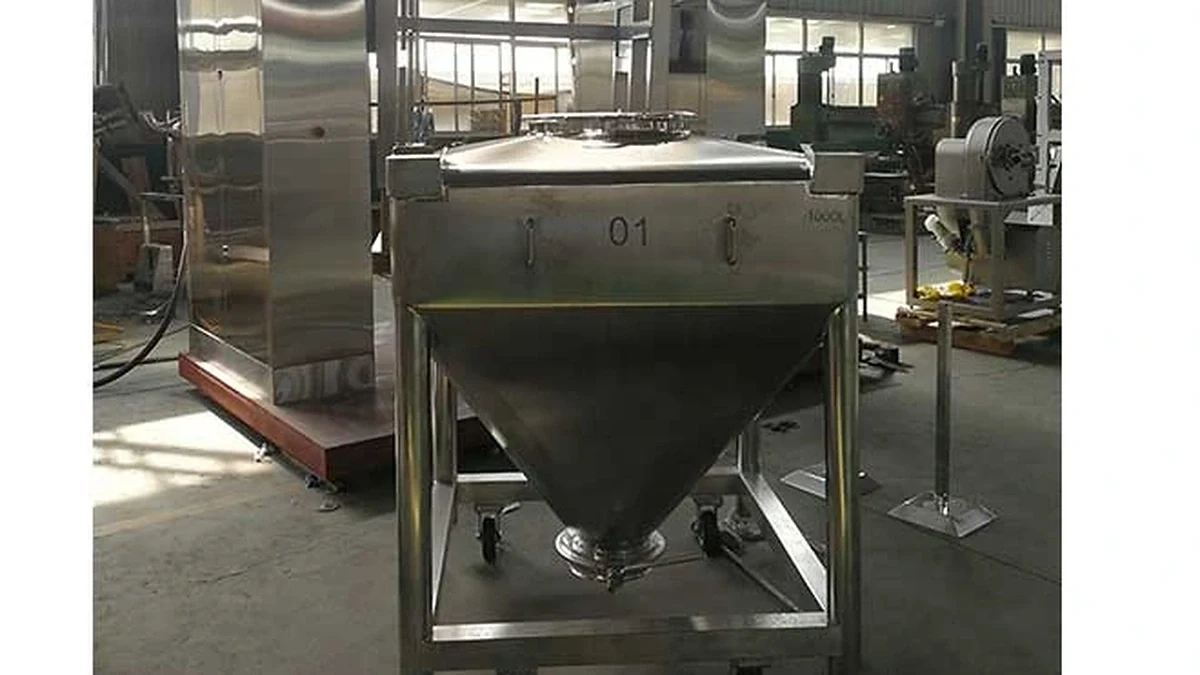
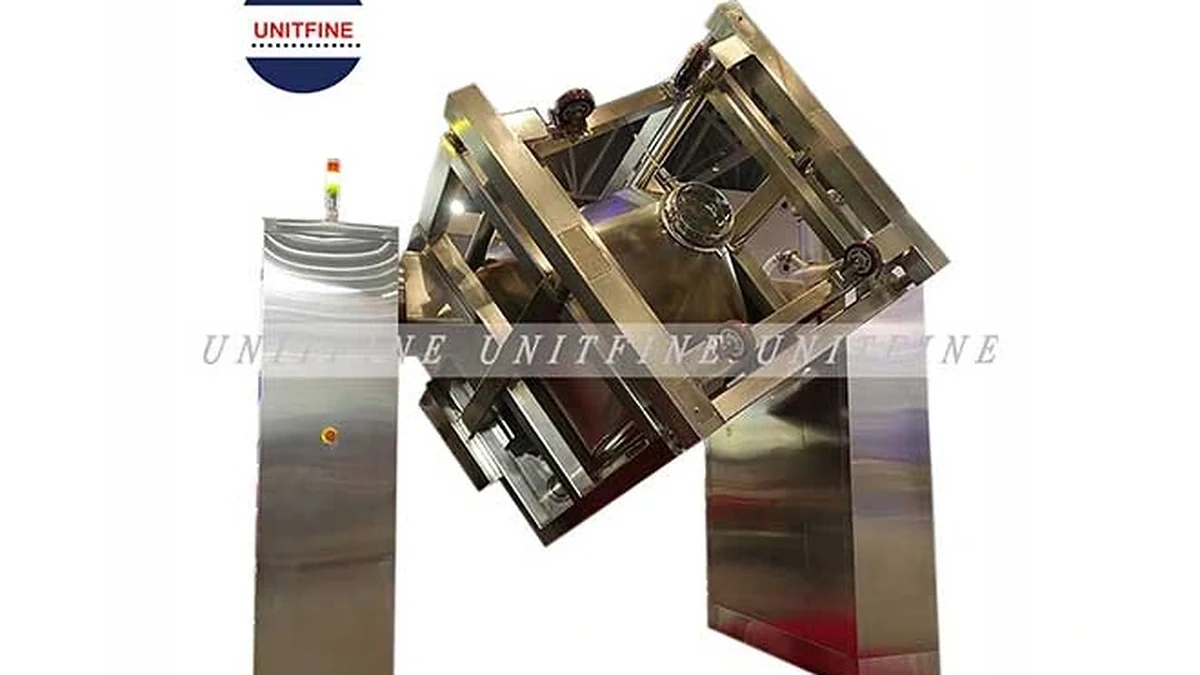
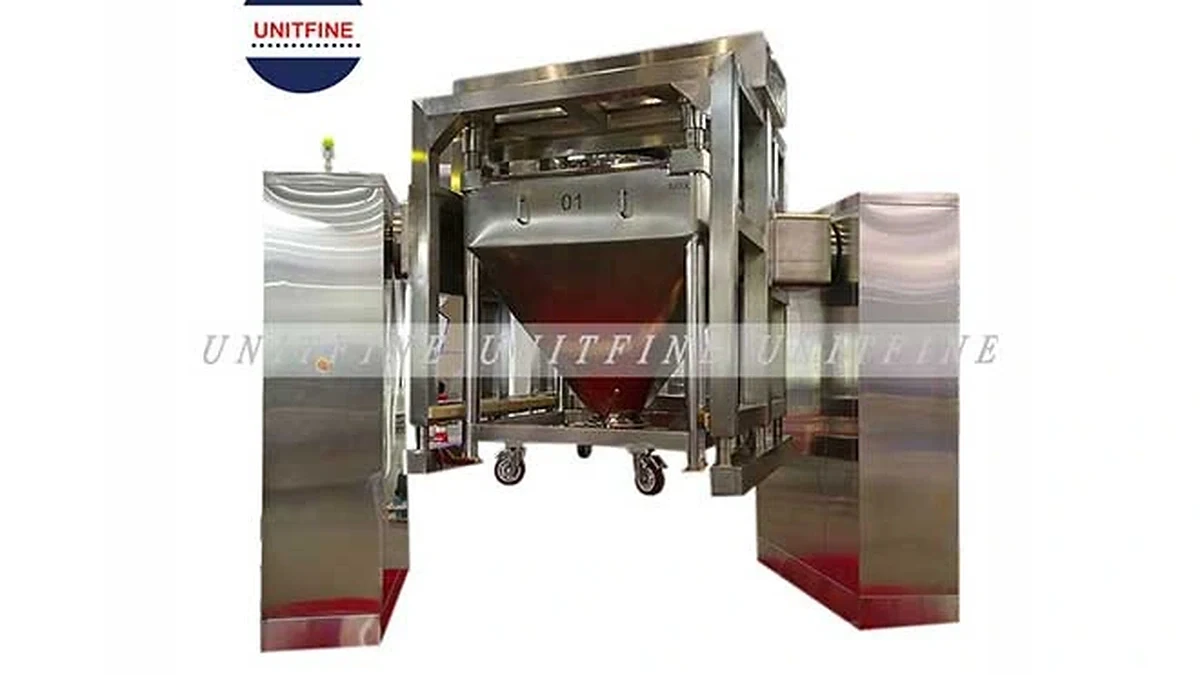
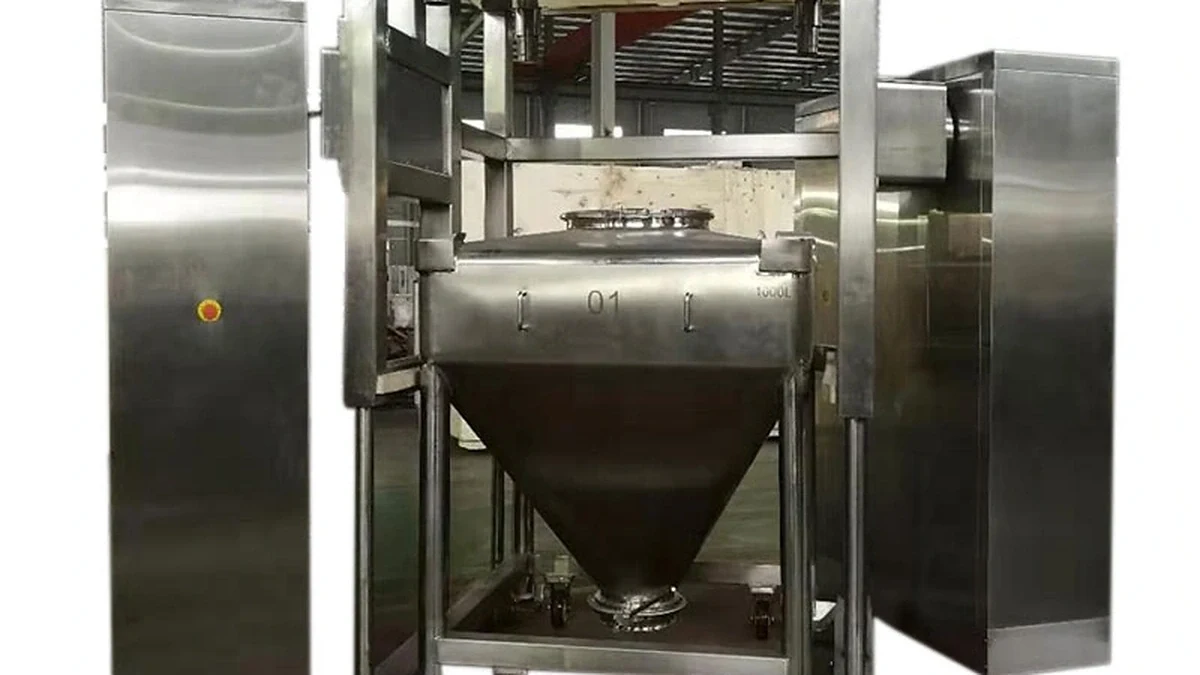


An IBC bin blender mixes a batch inside a removable intermediate bulk container. For a UNITFINE proposal, review the formulation, working batch volume, container geometry, loaded weight and handling route together. A container capacity in liters is not a batch-mass rating, and an enclosed bin does not by itself establish blend uniformity or contamination control.
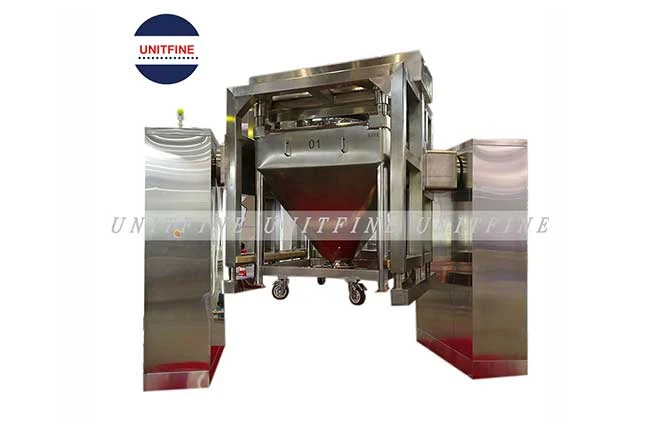
Quick answer: how should you specify an IBC bin blender?
Start with the minimum and maximum batch mass and measured bulk density, then establish the required working volume. Match the complete loaded container to the offered lifting and rotating assembly. Agree the loading sequence, operating settings, sampling method, discharge checks and cleaning requirements. Confirm the approved layout, container interfaces, safety functions and documentation before ordering; use a representative trial to establish the acceptable mixing cycle for your formulation.
What does the UNITFINE IBC blender do?
The product described here is a bin-tumbling arrangement: a compatible container is secured in a supporting rotary frame and moved through an agreed mixing cycle. The original UNITFINE description identifies lifting, drive, rotary-frame, control and stopping functions. Their presence in a general description does not define the exact supplied assembly. Ask for a current configuration drawing, component list and operating instructions for the proposed machine.
Keep container blending separate from other mixing mechanisms
This page concerns suitable powder and granule batches blended by moving the container. It does not specify a liquid-tank agitator, screw conveyor inside the bin, high-shear disperser or emulsifier. If the formulation needs active lump breakup, liquid dispersion or another intensive mixing action, describe that requirement before selection. Do not infer those functions from the name IBC or from a general list of industries.
For pharmaceutical, food and chemical projects, define the actual ingredients and process objective rather than relying on the industry label. Moisture, cohesion, particle-size differences, density differences, fragile granules and small-dose ingredients can change the trial requirements. Product-contact construction, surface finish and cleaning acceptance must be specified for the proposed duty; the product category alone does not prove a particular certification or regulatory qualification.
Batch mass, working volume and container capacity
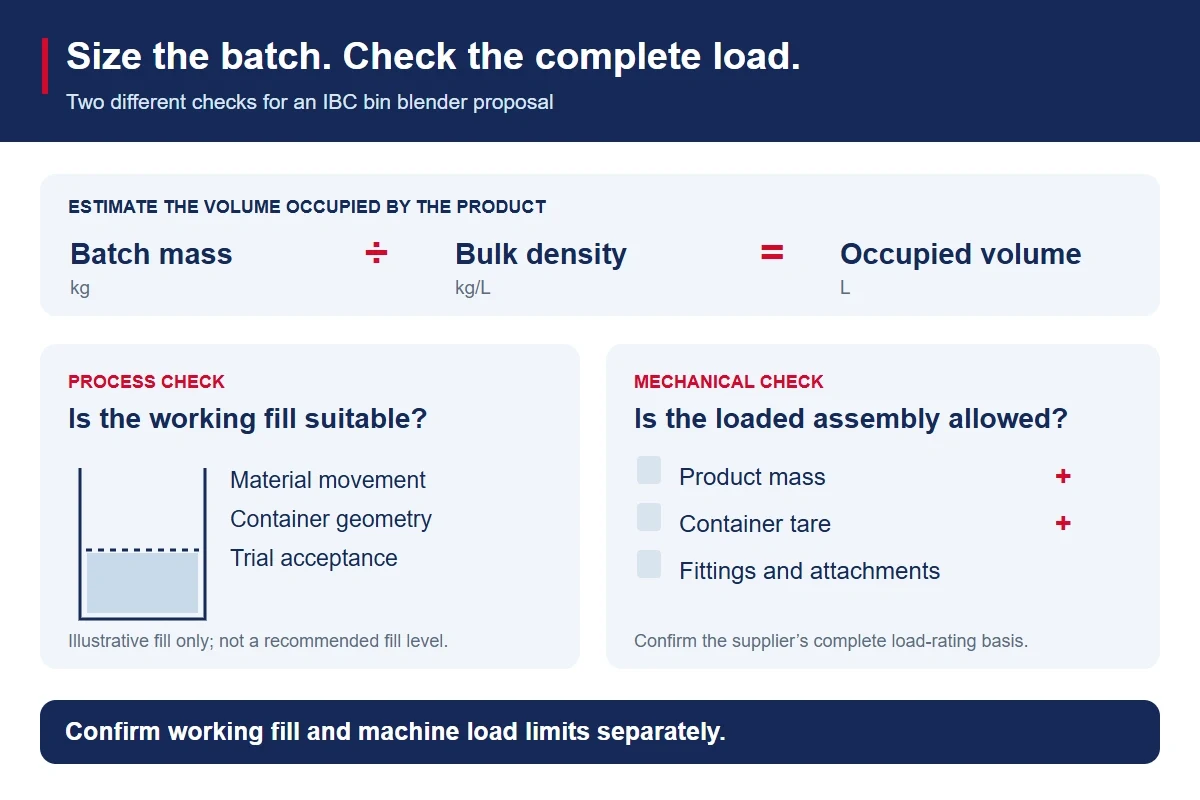
Use batch mass divided by measured bulk density to estimate the volume occupied by the charge, with consistent units. That estimate is a sizing input, not proof that the bin may be filled to that level. The supplier must confirm the usable fill range for the formulation and motion arrangement. Review both the smallest planned batch and the largest planned batch; neither an almost empty bin nor a full bin is automatically a suitable blending condition.
| Sizing input | What to confirm | What it does not establish |
|---|---|---|
| Nominal hopper volume | Container identity and geometric capacity basis | Permitted working fill or batch mass |
| Occupied product volume | Batch mass and representative bulk-density range | Blending performance at that fill |
| Loaded assembly weight | Product, container, fittings and supplier load basis | Lifting permission from product mass alone |
| Complete batch cycle | Charging, securing, blending, sampling, discharge and changeover | Shift output from rotation time alone |
Compare proposals on the same batch basis
Ask each proposal to identify the recipe family, density range, allowed charge, operating settings and acceptance method. Keep the lifting or structural load limit separate from the process working-volume limit. A mechanically permissible load can still be unsuitable for the requested mixing objective. Conversely, enough geometric space does not mean that the loaded assembly meets the machine load rating or fits the available installation envelope.
Will your existing IBC containers fit?
Provide drawings of every container size you want to use, including its empty mass, dimensions, lifting or support features, closures, discharge connection and attachments. Confirm the securing method, center-of-gravity assumptions, rotating envelope and load limits against the offered machine. Similar nominal capacities do not establish interchangeability. A container from another installation should not be tried on the blender without a documented compatibility review.
Review the whole handling route
Trace the container from charging to blending, discharge and washing or storage. Check doorways, turning space, floor condition, docking height and clearance for the loaded container. Installation drawings should show the required operating and service space, not only the stationary machine footprint. Include room for inspection and safe access to the drive and lifting equipment without assuming that adjacent production equipment can be moved during maintenance.
How should mixing time and uniformity be checked?
Agree a trial protocol before comparing mixing-time claims. Identify the critical ingredient or tracer, its proportion, the analytical method and the acceptance criterion. Document the formulation, charge, container, loading sequence and approved settings for each test. An attractive powder appearance, elapsed timer or completed rotation cycle cannot establish composition uniformity. Use measured results from a representative batch and repeat the assessment where scale or formulation changes materially affect the process.
- Record ingredient identity, proportions, density range, particle behavior and moisture.
- Define minimum, normal and maximum batch conditions that need evaluation.
- Agree sampling positions or discharge intervals, sample handling and analysis before the trial.
- Compare results at the proposed cycle settings; inspect adhesion, residue and particle damage where relevant.
- Check the discharged and transferred product as well as the material inside the bin.
- Retain the trial conditions and acceptance record as the basis for the quotation.
Discharge and downstream transfer can change the distribution of components after blending. If results differ between early and late discharge, investigate sampling and handling as well as the blending cycle. The uneven powder mixing troubleshooting guide explains why dosing, mixing, discharge and measurement should be examined separately. It does not replace the acceptance method for this IBC installation.
Changeover, cleaning and access
Removable containers can allow charging, discharge or cleaning to be planned separately from the blender, where the layout and operating procedure support this. They do not eliminate cleaning duties. Identify all product-contact surfaces, closures, outlets, seals and any exposed transfer interfaces. Define residue removal, inspection access, drying and release requirements for the actual formulation. Confirm which container sizes and cleaning methods the offered assembly supports.
Specify safety and documentation for the installation
Ask UNITFINE to identify the proposed guarding, access control, load supervision, emergency-stop and safe-stopping arrangements in the quotation and instructions. A reference to an infrared device in old literature is not proof of a complete safety system or a particular safety rating. Provide dust, ignition, exposure and environmental hazards for engineering review. Follow the supplied isolation and operating procedures; this selection page is not an instruction to enter the moving envelope or operate open equipment.
IBC bin blender or ribbon mixer?
| Arrangement | Procurement question | Comparison condition |
|---|---|---|
| IBC bin blender | Can a matched removable container support the batch and handling plan? | Confirm container compatibility, working fill, trial and changeover route |
| Ribbon mixer | Does a fixed trough and internal agitator suit the formulation? | Review drive duty, contact surfaces, discharge and cleaning on the same recipe |
Use the same material and acceptance target when comparing alternatives. Container handling can be an important part of an IBC project, while a fixed mixer has a different loading and cleaning arrangement. Neither principle is universally better for every powder. See the UNITFINE ribbon mixer for that equipment family and discuss the complete process through the equipment range.
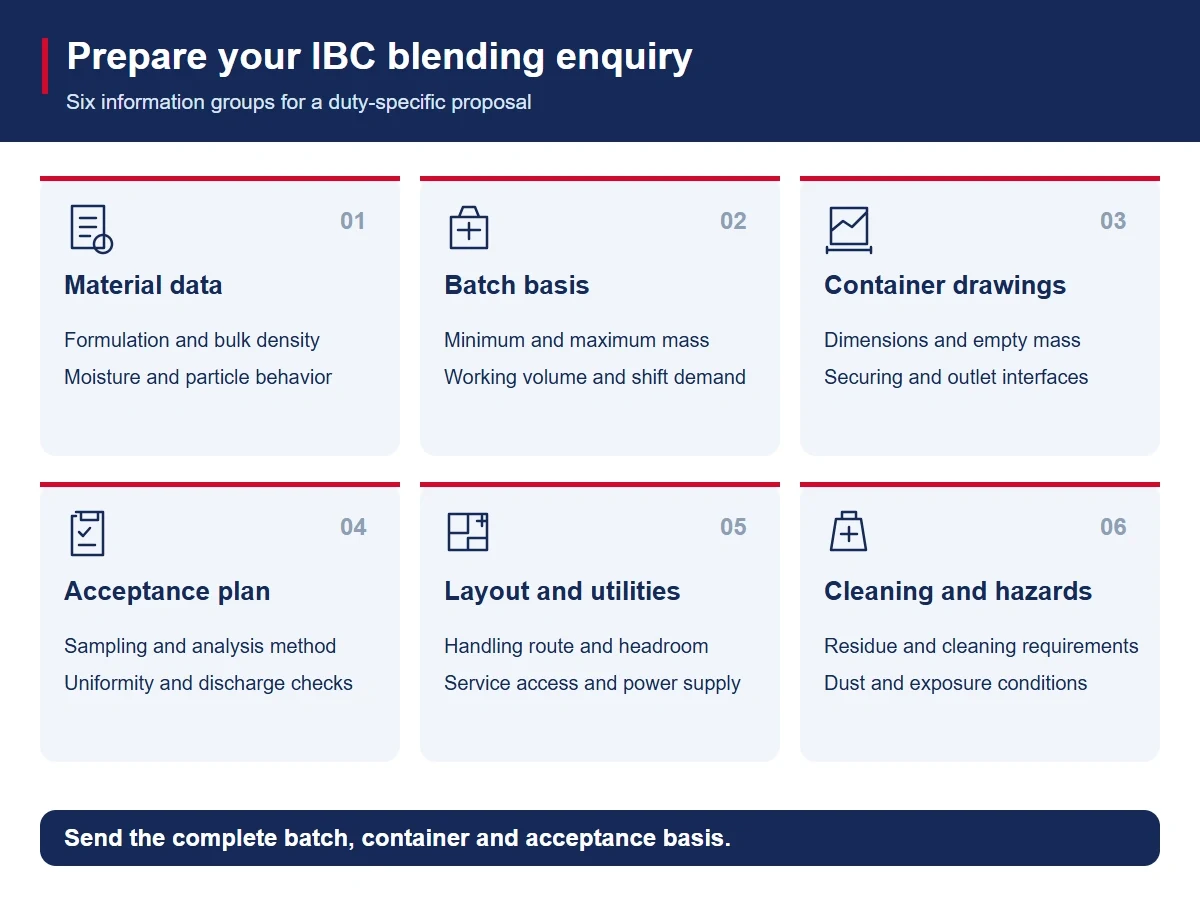
Information for an IBC bin blender quotation
- Material data: formulation, critical components, bulk density, particle behavior and moisture.
- Batch basis: minimum and maximum mass, occupied volume and required batches per shift.
- Container drawings: dimensions, empty mass, closures, securing points and outlet interface.
- Acceptance plan: sampling, analytical method, uniformity target and discharge checks.
- Layout and utilities: container route, headroom, service access and electrical supply.
- Cleaning and hazards: contact construction, residue limits, cleaning method and dust or exposure risks.
Published model reference
The existing UNITFINE model chart is retained below as a legacy catalog reference. It distinguishes maximum hopper volume, maximum charge volume and maximum charge weight. The chart does not state a bulk-density basis or a formulation-specific working range. Do not convert its liters directly into kilograms, treat its maximum charge as an approved process batch, or use its dynamic dimensions alone to design installation clearances. Confirm current values and the complete supplied configuration before purchase.
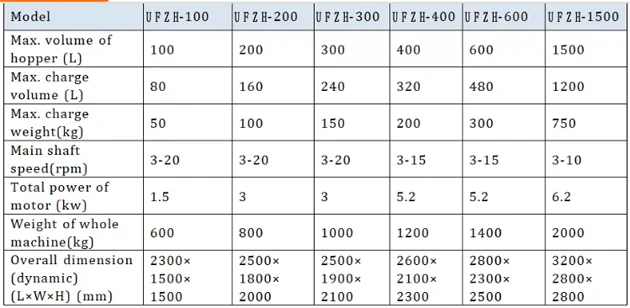
| Model | Max. hopper volume (L) | Max. charge volume (L) | Max. charge weight (kg) |
|---|---|---|---|
| UFZH-100 | 100 | 80 | 50 |
| UFZH-200 | 200 | 160 | 100 |
| UFZH-300 | 300 | 240 | 150 |
| UFZH-400 | 400 | 320 | 200 |
| UFZH-600 | 600 | 480 | 300 |
| UFZH-1500 | 1500 | 1200 | 750 |
Frequently asked questions
What does IBC mean in an IBC bin blender?
IBC means intermediate bulk container. In the bin-tumbling arrangement discussed here, the compatible container holds the batch during blending and can be removed for the agreed handling steps. Confirm the actual container and securing arrangement on the supplied drawing.
Is a larger nominal bin always a larger usable batch?
No. Review occupied volume, material behavior and the allowed working fill, then check the complete loaded assembly against the machine load limits. Nominal container capacity alone does not define the permitted batch mass or the achievable uniformity.
Can one blender use several container sizes?
Only where the offered machine and each container have been confirmed compatible. Supply drawings, dimensions, empty mass and connection details for the whole container fleet. Do not assume that containers with similar volume ratings have interchangeable supports or securing interfaces.
How long should the mixing cycle be?
Establish the cycle using representative material, the intended working batch, approved settings and an agreed sampling and analysis method. A timer setting or catalog speed range does not establish a universal mixing time or a complete shift-output rate.
Does a closed bin guarantee contamination-free production?
No. Review closures, loading and discharge interfaces, cleaning, inspection and material handling as part of the actual process. The bin arrangement alone does not prove zero exposure, absence of cross-contamination or compliance with a particular pharmaceutical requirement.
Can this blender replace a liquid agitator or high-shear mixer?
That should not be assumed. This page addresses suitable powder and granule batches in a container-tumbling arrangement. Liquid dispersion, strong deagglomeration or another mixing mechanism requires a separate formulation and equipment review.
What information is needed for a quotation?
Send material and batch data, container drawings, a proposed acceptance method, layout and utilities, plus cleaning and hazard requirements. Ask for the supplied configuration and working limits to be identified in the quotation and approved drawing.
Discuss your batch and container requirements
Send UNITFINE your IBC blending enquiry with the formulation, batch basis, container drawings, layout and trial criteria. Request a duty-specific proposal identifying the load limits, operating range, supply boundary and documentation. Confirm the offered arrangement before ordering.


