
A practical ribbon mixer selection guide should help you compare quotations on the same basis: the batch you actually need to blend, the load the drive must handle, and the time required to reach an agreed product specification. A vessel label in liters, a motor rating and a short mixing-time claim do not establish production capacity on their own.
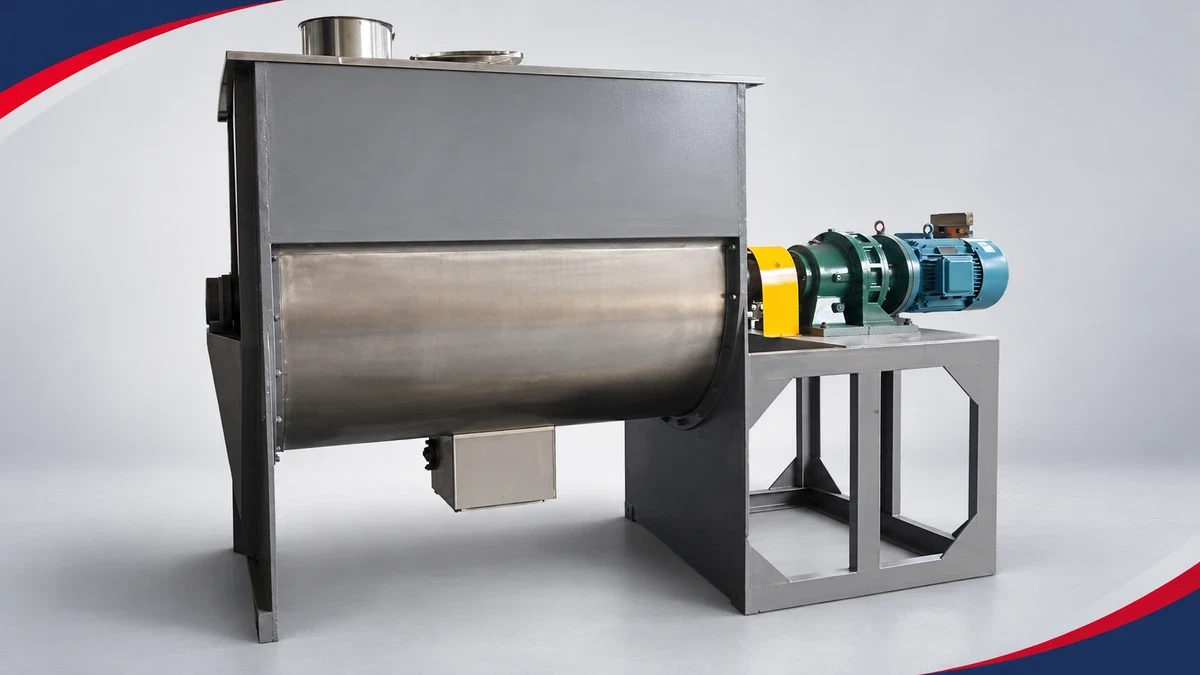
Quick answer: Calculate the required product volume from batch mass and measured bulk density, then confirm the supplier’s permitted working-volume range. Specify the worst credible material and startup conditions for drive selection. Establish mixing time through representative trials with a documented sampling and acceptance method, and include loading, discharge and cleaning when calculating output.
What information should you collect before sizing a ribbon mixer?
Define minimum, normal and maximum batches before choosing a machine. Record whether different recipes change the volume, mass, flow behavior or cleaning burden. The recipe occupying the most space is not necessarily the recipe creating the greatest mechanical load.
This article is a purchasing worksheet for horizontal batch ribbon mixers handling suitable powders and granules, not a model-rating table or a selection guide for every ribbon-mixer design. For available construction and configuration options, see the UNITFINE Ribbon Mixer product page. Use the guide below to prepare questions and compare the engineering basis behind proposals.
| Selection input | Information to provide | Decision it supports |
|---|---|---|
| Batch and density | Minimum, normal and maximum batch mass; measured bulk density range and test method. | Product volume, working-fill window and maximum batch load. |
| Powder behavior | Particle-size range, cohesion, moisture, abrasiveness, temperature and segregation tendency. | Whether ribbon blending is suitable and which construction requires review. |
| Recipe and additions | Ingredient fractions, minor components, loading order, and any liquid quantity, viscosity and addition rate. | Mixing trial, distribution strategy and possible changes in resistance. |
| Acceptance and schedule | Uniformity test, sample size, allowable damage, output target and available operating hours. | Mixing endpoint, complete batch cycle and feasible production schedule. |
| Installation | Supply voltage/frequency, feed and outlet heights, access, cleaning method and assessed hazards. | Drive/electrical configuration, layout, interfaces and documentation scope. |
How do you calculate working volume from batch weight?
Product volume is batch mass divided by bulk density: V = m / ρb. With mass in kilograms and bulk density in kilograms per cubic meter, the result is cubic meters. Use bulk density measured in a condition representative of charging; true particle density is not a substitute.
Working volume is the volume of product that can be blended under the agreed conditions. Gross trough volume is the physical vessel capacity. Suppliers may use “capacity” differently, so ask whether a quoted number means gross volume, usable product volume or a reference batch mass. Obtain both the permitted minimum and maximum working batch for your material.
Illustrative calculation—not a UNITFINE model rating
Assume a dry batch of 400 kg and a representative bulk density of 500 kg/m³. Product volume is 400 / 500 = 0.80 m³, or 800 L. If that recipe’s density falls to 400 kg/m³ at the same batch mass, product volume becomes 1.00 m³. The mixer must accommodate the actual range within its supplier-approved working limits.
Only if a supplier explicitly approves a maximum working fill of 70% of gross volume for this application would 0.80 / 0.70 ≈ 1.14 m³ be an illustrative gross-volume requirement. That assumed 70% is not a recommended universal fill ratio, and the calculation does not check torque, minimum batch size, discharge or cleaning.
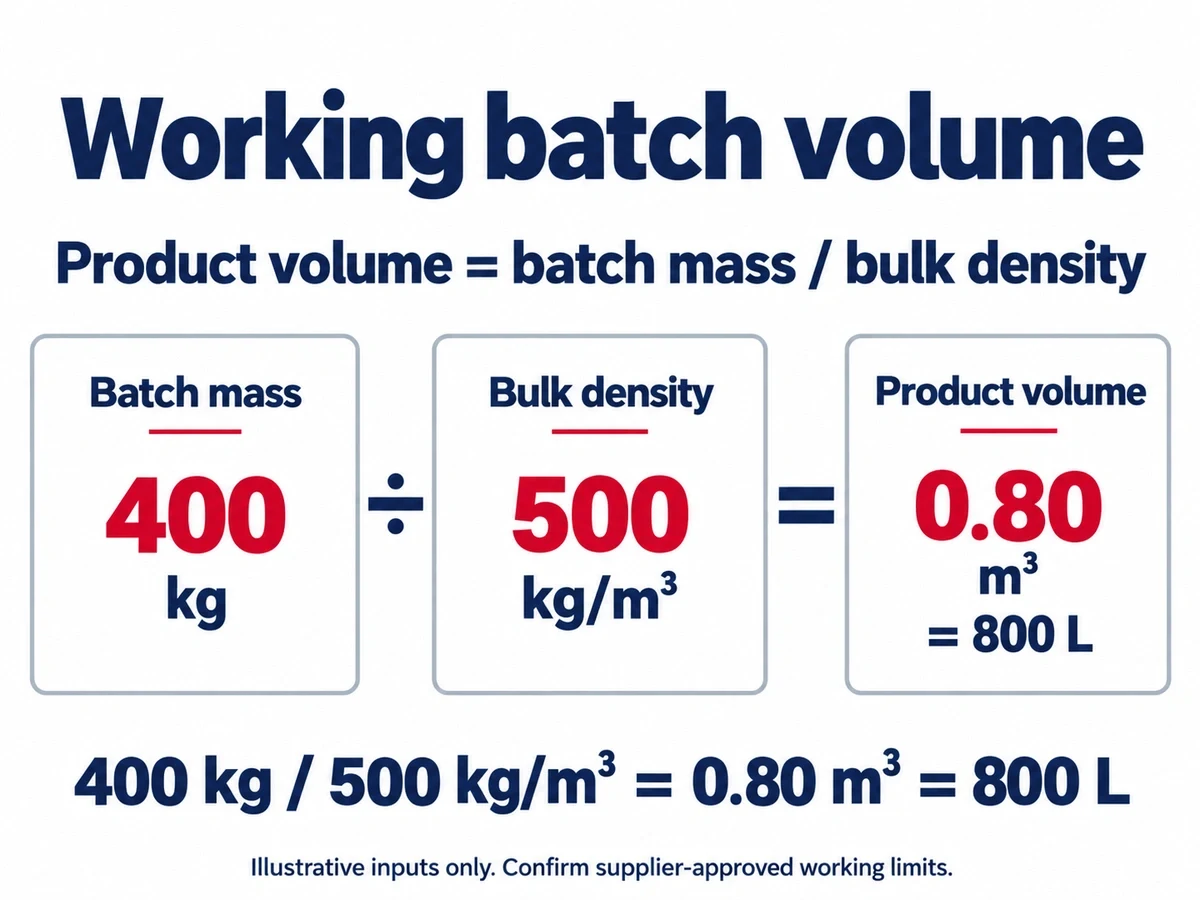
Do not apply a fill percentage twice. If a quotation already states 800 L of usable working volume, dividing that value again by a presumed fill percentage can produce a misleading comparison. Ask the supplier to identify the capacity basis on its drawing and quotation.
Check the smallest batch as carefully as the largest
A larger trough is not automatically more flexible. Too little product can change contact between the charge and agitator, while excessive filling can restrict the intended circulation. Minimum and maximum batch limits must therefore be demonstrated for the proposed geometry and recipe rather than copied from another manufacturer’s percentage range.
How should motor power and drive requirements be specified?
Ribbon mixer power cannot be selected reliably from liters alone. The supplier needs batch mass, bulk behavior, operating speed, startup requirements and duty cycle to evaluate the complete drive. Ask what conditions the proposed motor, gearbox, shaft and coupling are designed to handle, not simply whether the motor has more kilowatts than another quote.
Separate continuous running from the worst credible startup or upset condition. A recipe containing a wetting addition may behave differently from the same dry powder. Explain whether the operating procedure requires starting with material already in the trough; do not assume a mixer can restart a settled or overloaded charge.
| Question for the supplier | What a useful response identifies | What is insufficient |
|---|---|---|
| Which material and batch were used for drive selection? | Density range, maximum load, cohesion and relevant additions. | A motor rating selected only from nominal liters. |
| What startup and operating conditions are allowed? | Approved starting procedure, speed range and duty limitations. | An unexplained statement that a larger motor solves every issue. |
| How is the drive protected and maintained? | Agreed overload response, electrical requirements, access and maintenance instructions. | Only a motor nameplate with no system-level explanation. |
A variable-frequency drive can support an approved operating range, but it does not remove mechanical, thermal or product limits. Do not change gearing, speed or protection settings without the equipment supplier’s review. This guide does not provide a universal kW-per-liter sizing formula.
How do you establish mixing time and uniformity?
Mixing time is the time needed for a defined formulation and batch to meet a specified acceptance test under documented settings. It is not established by a timer alone. Compare trial results only when recipe, working fill, loading sequence, speed, sampling and analytical method are comparable.
ROSS’s ribbon-blender specification guidance describes opposing axial and radial movement from inner and outer helical ribbons and recommends testing blend quality and batch time. These principles support a trial-based approach; another supplier’s fill limits, tip speeds or customer outcomes are not UNITFINE specifications.
Agree on a trial plan before testing
- Document the representative recipe, ingredient variation, bulk density, batch and loading order.
- Select the critical component or suitable tracer, analytical method, sample size and acceptance limits with the responsible quality team.
- Compare planned mixing durations using an approved sampling procedure, without bypassing guarding or reaching into equipment.
- Evaluate variation across documented locations or discharge intervals, and record particle damage, temperature, agglomerates and residue where relevant.
- Check product after the intended discharge and transfer route; acceptable material inside the mixer does not by itself establish acceptable product at packing.
- Confirm repeatability over the agreed trial scope and record operating limits and exceptions in the acceptance report.
If coefficient of variation is used, define it as sample standard deviation divided by sample mean, multiplied by 100%. Its interpretation depends on sample count, sampling procedure, analytical uncertainty and a meaningful nonzero mean. A low value from poorly chosen samples does not prove an entire batch is uniform. No universal CV target is specified here.
What is the difference between mixing time and production capacity?
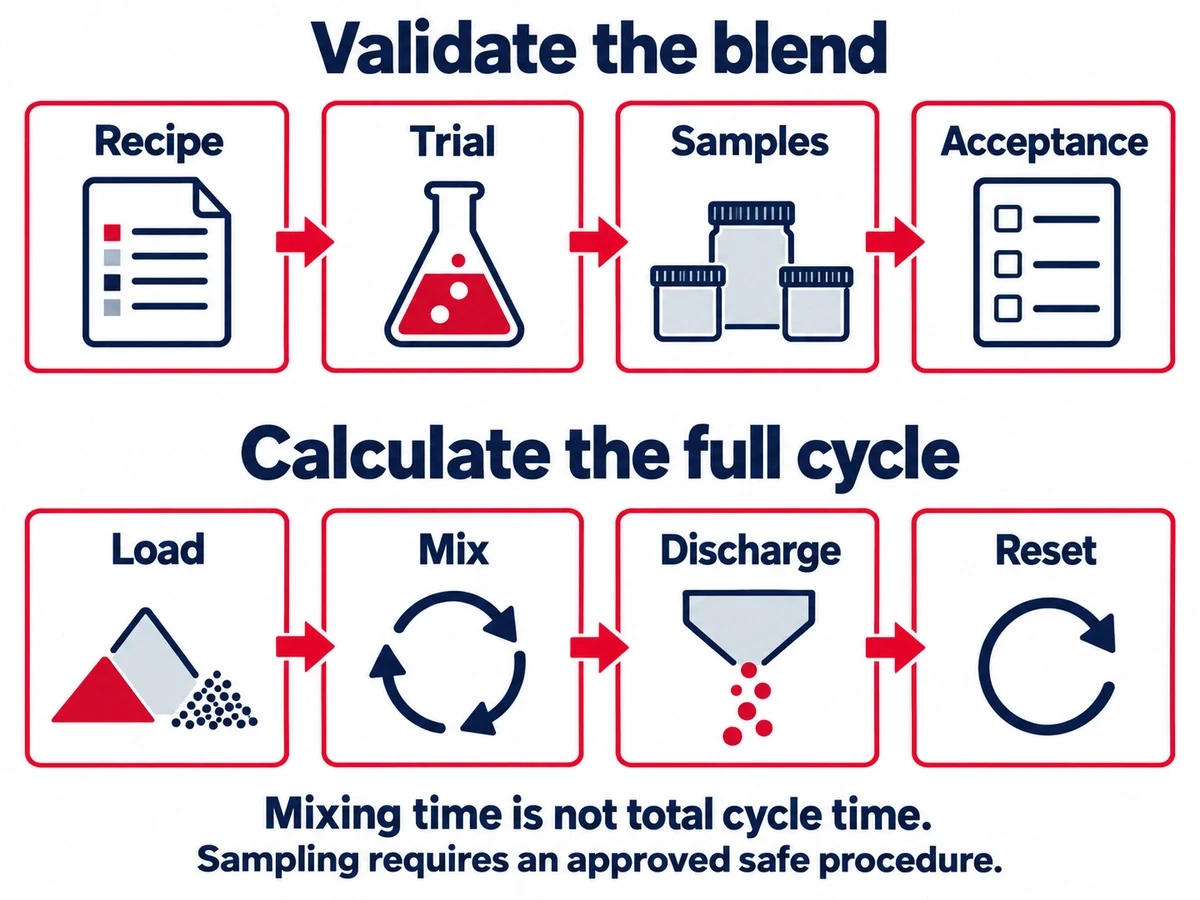
Production capacity depends on the complete cycle, including tasks that prevent the next batch from starting. Record loading, mixing, additions where not concurrent, discharge, inspection and necessary cleaning/changeover. Account separately for shift downtime and downstream restrictions.
Hypothetical schedule: A 400 kg batch takes 6 minutes to load, 8 minutes to mix, 4 minutes to discharge and 2 minutes to reset. If these stages are sequential, total cycle time is 20 minutes and theoretical output is 400 × 60 / 20 = 1,200 kg/h, before downtime, rejected product or additional changeovers. These assumed inputs demonstrate arithmetic only and do not establish the achievable throughput of any UNITFINE mixer.
Specify whether liquid addition overlaps mixing, how often cleaning is required and whether upstream equipment can prepare the next charge concurrently. Count each activity once. Use a measured or agreed schedule rather than multiplying batch mass by the number of short mixing intervals in an hour.
Which configuration and integration checks belong in the quotation?
Compare quotations for contact construction, cleanability, sealing and interfaces as well as volume and drive. Material grade alone does not establish hygiene, corrosion resistance in every service or regulatory compliance. State the product, cleaning chemistry and acceptance requirements so the supplier can propose a suitable construction.
For feeding or discharge, a UFLOW Vacuum Conveyor may be evaluated as a separate transfer step for suitable materials. Confirm transfer rate, receiving capacity, headroom, air handling and segregation with the complete line. A transfer device does not replace the mixer’s blending function.
- Recipe compatibility: check moisture, liquid addition, fragility, abrasion and whether another mixer type warrants a trial. The UNITFINE mixer and blender range is a starting point for alternatives, not proof that each machine fits the same duty.
- Discharge and residue: agree on valve arrangement, outlet height, retained product and receiving equipment.
- Cleaning and access: define dry or wet cleaning, cross-contamination criteria and authorized access procedures.
- Safety interfaces: include guarding, interlocks and safe isolation in the project review. Potential combustible dust, hazardous areas, pressure or vacuum service require qualified assessment of the complete installation; do not infer suitability from a standard enclosure or a motor option.
Use a common basis when comparing supplier proposals
Ask each supplier to return the same input sheet with assumptions and exclusions marked. A proposal is easier to assess when it states permitted batches, capacity definitions, drive duty, trial basis and the complete-cycle assumptions alongside its price. Unanswered engineering questions should remain open items, not silently become performance commitments.
Include the recipe data, density measurements, batch range, hourly requirement, test method, liquid additions, contact requirements, site drawing, utilities and safety assessment inputs. Request an approved arrangement drawing and a written acceptance scope before ordering. Final selections remain subject to application review and the agreed test basis.
Frequently Asked Questions
How do I choose ribbon mixer capacity in kilograms?
Convert batch mass to product volume using measured bulk density, then check the proposed mixer’s permitted working-volume and batch-mass limits. A capacity in liters cannot be converted into a universal kilogram rating without material data.
Is a 70% fill ratio suitable for every ribbon mixer?
No. Fill limits depend on mixer geometry and application. The 70% value in this guide is an explicitly assumed calculation input, not a general operating recommendation. Obtain minimum and maximum working limits from the supplier.
Can motor power be calculated from mixer volume alone?
No. Provide batch load, powder behavior, operating conditions, startup requirements and duty cycle so the supplier can evaluate the complete drive. A larger motor does not by itself establish safe or effective operation.
How long should a ribbon mixer run?
Use a representative trial and a defined sampling and acceptance method to establish mixing time for the recipe and working batch. Include loading, discharge and cleaning separately when assessing production output.
Will longer mixing always improve uniformity?
No. Extra time does not correct every loading, sampling or material-compatibility problem and can add unwanted heat or particle damage in susceptible products. Establish a validated endpoint and check the product after discharge and transfer.
What should I send UNITFINE for a quotation?
Send the recipe and material properties, measured bulk density, minimum and maximum batches, output schedule, liquid additions, cleaning requirements, acceptance test, utilities and layout. Identify hazards and unresolved application questions so the proposal can state its assumptions.
Prepare a Ribbon Mixer Selection Review
Send your recipe, measured bulk density, minimum and maximum batch, batch-volume calculation, production schedule and blend acceptance requirements. Ask UNITFINE to review the proposed working range, drive, construction and test basis before selecting a configuration.
Scope: this educational guide provides selection questions and clearly labeled arithmetic examples, not a certified design, operating procedure or performance guarantee. Supplier documentation, representative trials and competent site-specific engineering review govern the final installation.