
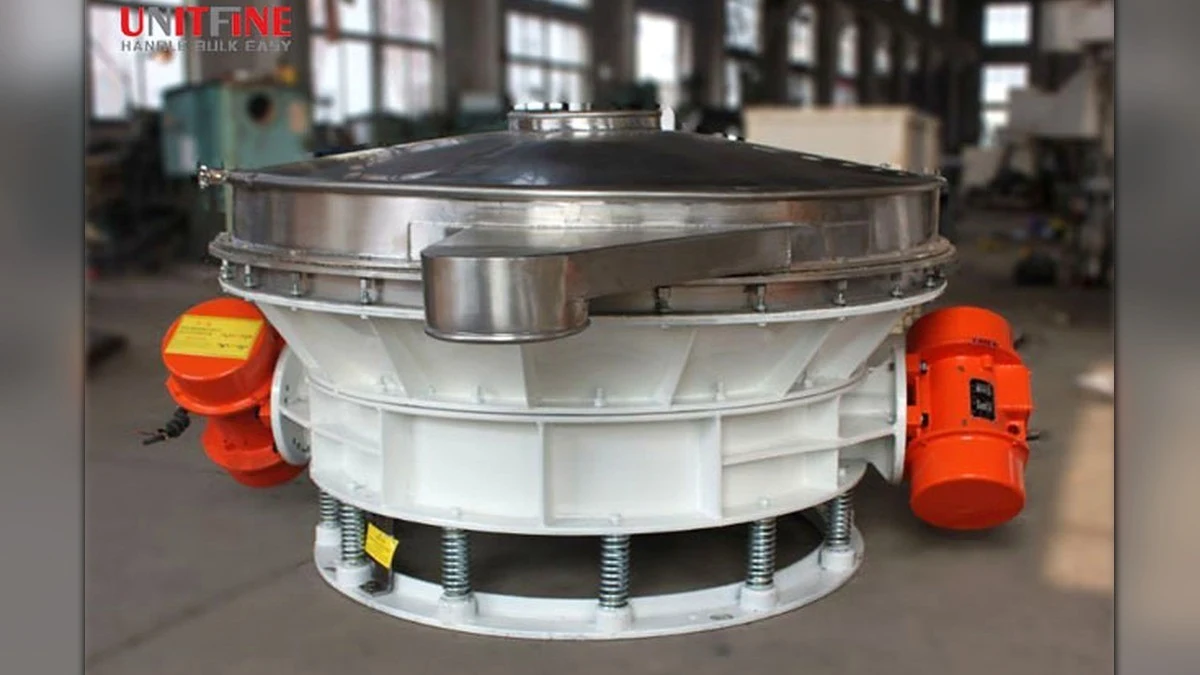
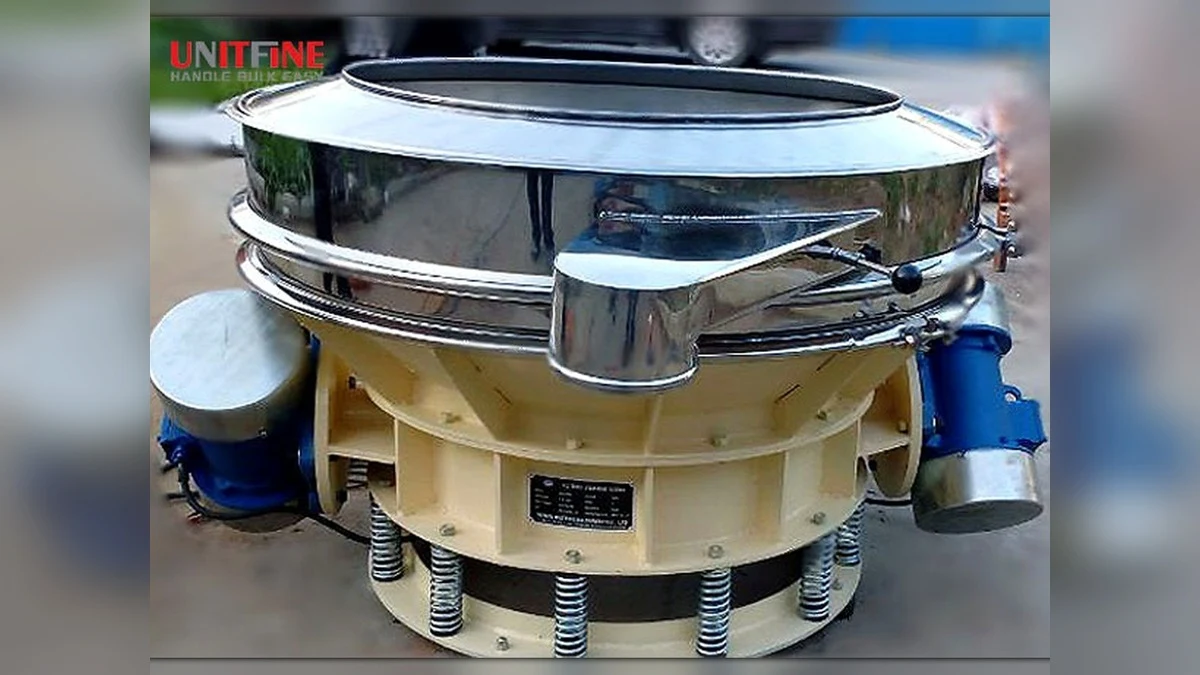
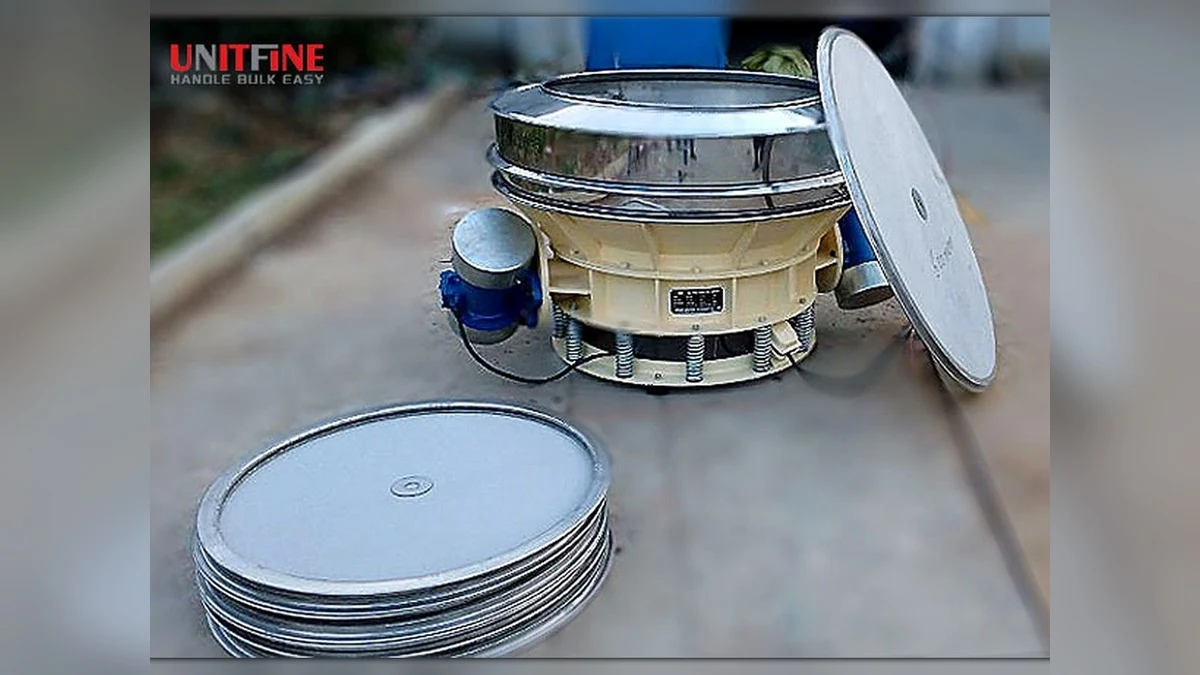
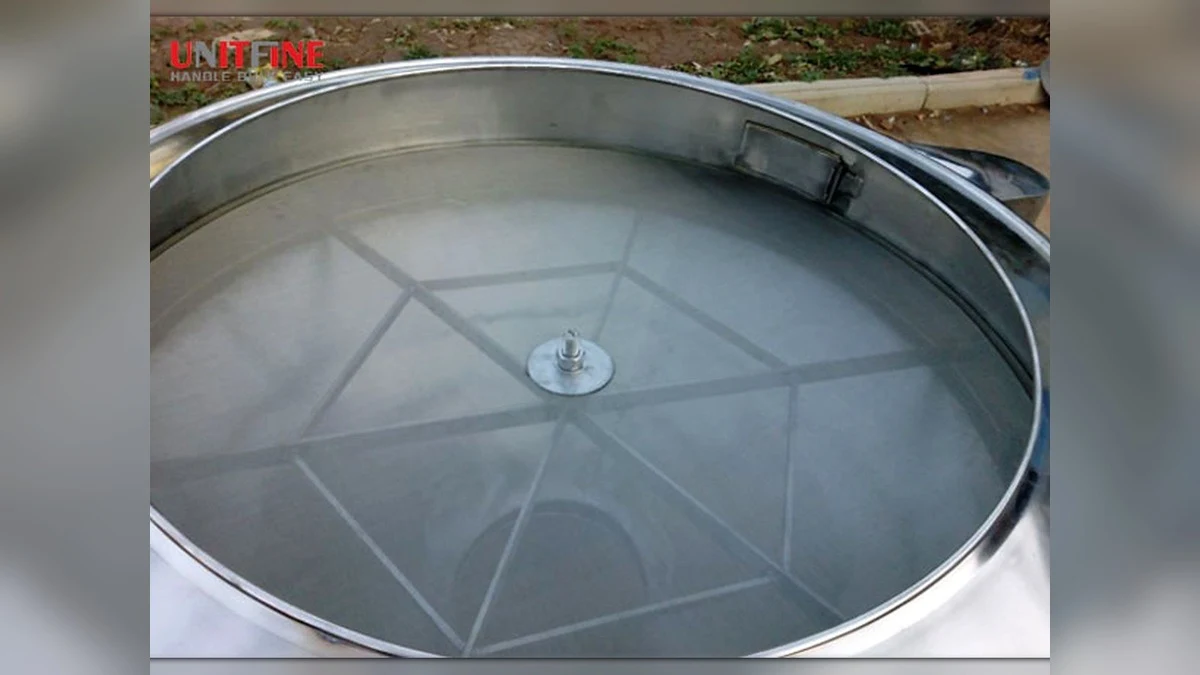

A flow-thru rotary vibrating separator is designed for compact, continuous safety screening where installation height is limited and material needs a short, direct path through the screen. UNITFINE’s low-profile configuration uses two side-mounted vibration motors and is available for dry powders, granules, and suitable liquid or slurry duties when the screen, seals, contact materials, and outlets are selected for the application.
The machine is commonly considered for pre-packaging checks, bulk-bag unloading stations, ingredient receiving, impurity removal, and other points where the main goal is to remove oversize contamination or verify product consistency without adding unnecessary equipment height. Actual capacity and separation results depend on the material, aperture, feed rate, moisture, screen condition, and machine configuration; they should be confirmed with representative samples rather than inferred from diameter alone.
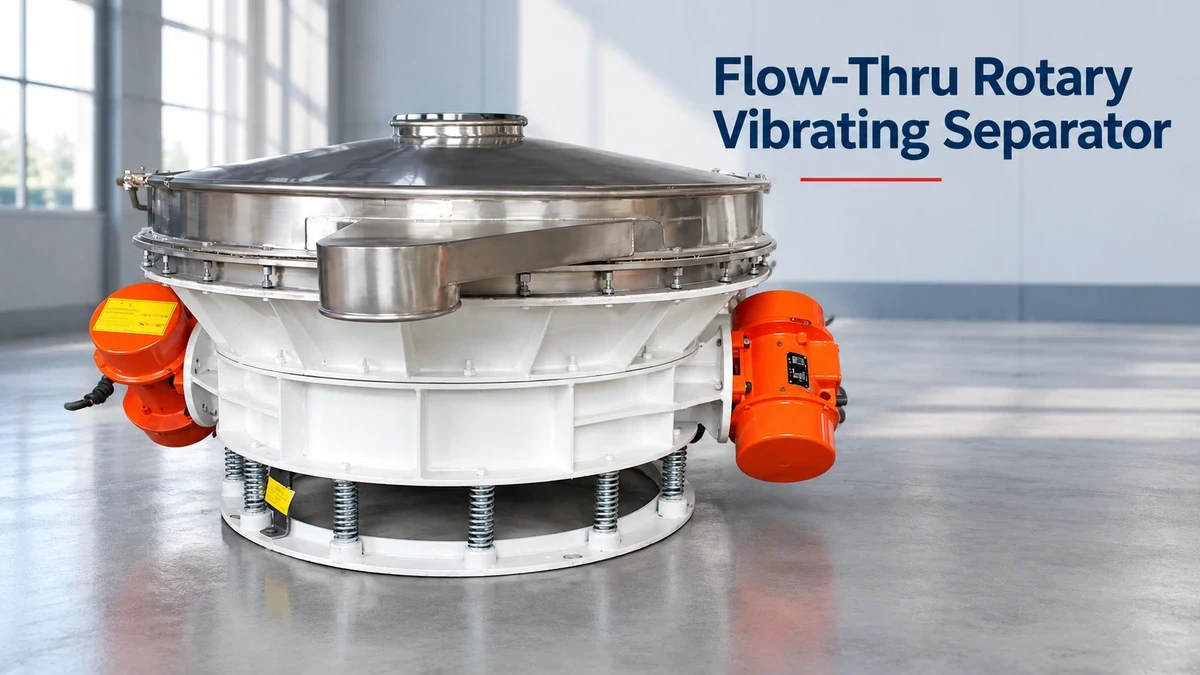
What Is a Flow-Thru Rotary Vibrating Separator?
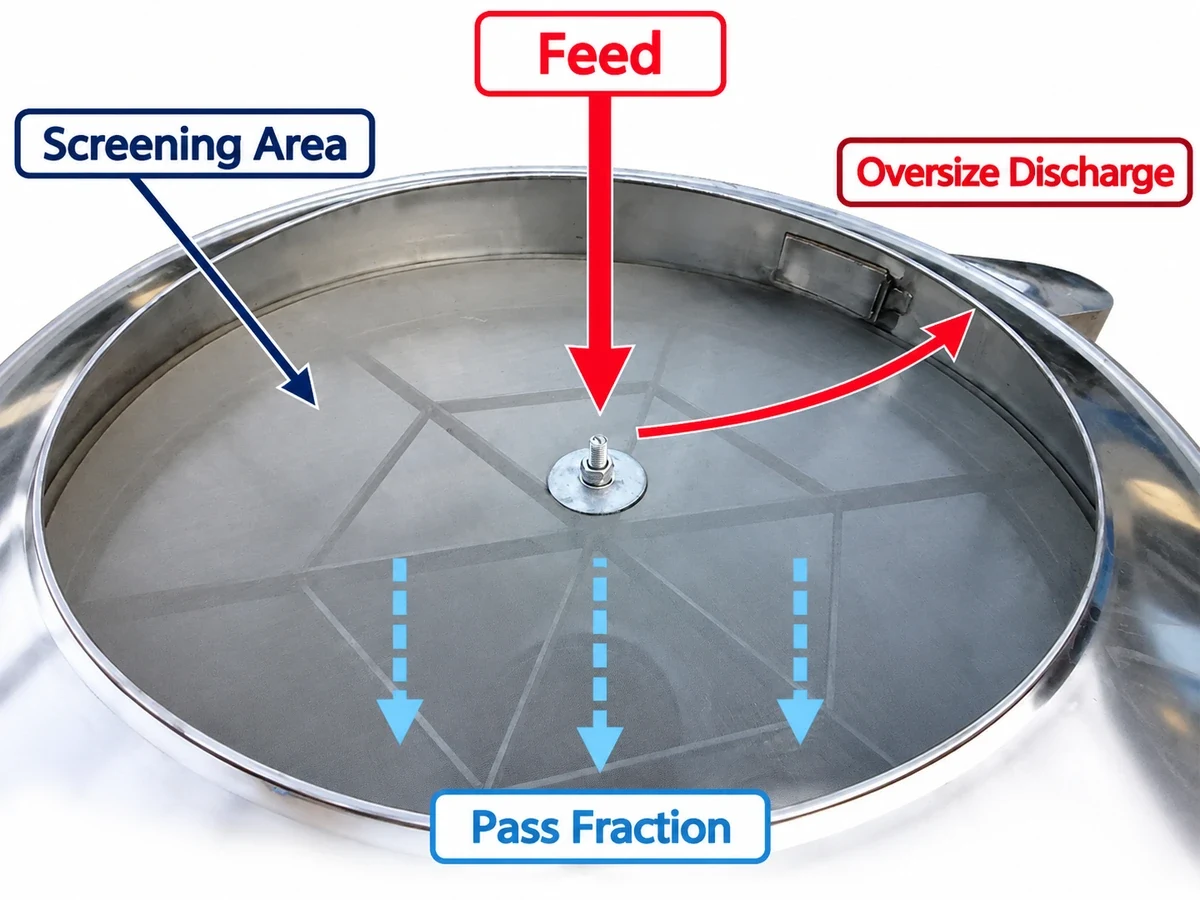
The UNITFINE flow-thru rotary vibrating separator is a circular screening machine with a low-profile body and two vibration motors mounted on opposite sides. The compact arrangement reduces headroom compared with many conventional multi-deck circular separators. Material enters the screening area, fines or liquid pass through the selected screen, and retained particles leave through the oversize discharge path provided by the machine configuration.
The two motors generate vibration that moves material across the screen while promoting passage through the openings. Their operating direction, force balance, and phase settings influence the material path and residence time. Adjustment should be made for the actual feed; more aggressive motion does not necessarily produce a cleaner separation, especially when the product is fragile, cohesive, or rich in near-size particles.
Why the Low-Profile Direct-Flow Structure Matters
Reduced Installation Height
A compact body can fit between an upstream hopper, bag-dump station, mixer, conveyor, or packaging machine where vertical space is restricted. Confirm the total installed height, flexible connectors, access clearance, and support frame—not only the nominal machine height.
Shorter Material Path
A direct-flow layout can reduce unnecessary retention inside the separator. This can be useful for safety screening and continuous transfer, but outlet size and downstream pressure conditions must still prevent backup or flooding of the screen.
Continuous Scalping
The separator can remove lumps, foreign objects, packaging debris, or other oversize material before the product reaches the next process step. The screen aperture must be chosen from the largest acceptable product particle—not from a generic mesh recommendation.
Process-Line Integration
The machine can be positioned at receiving, transfer, or packing points. Dust-tight connections, cleanability, support stiffness, outlet orientation, and the ability to inspect the screen are important parts of the installation.
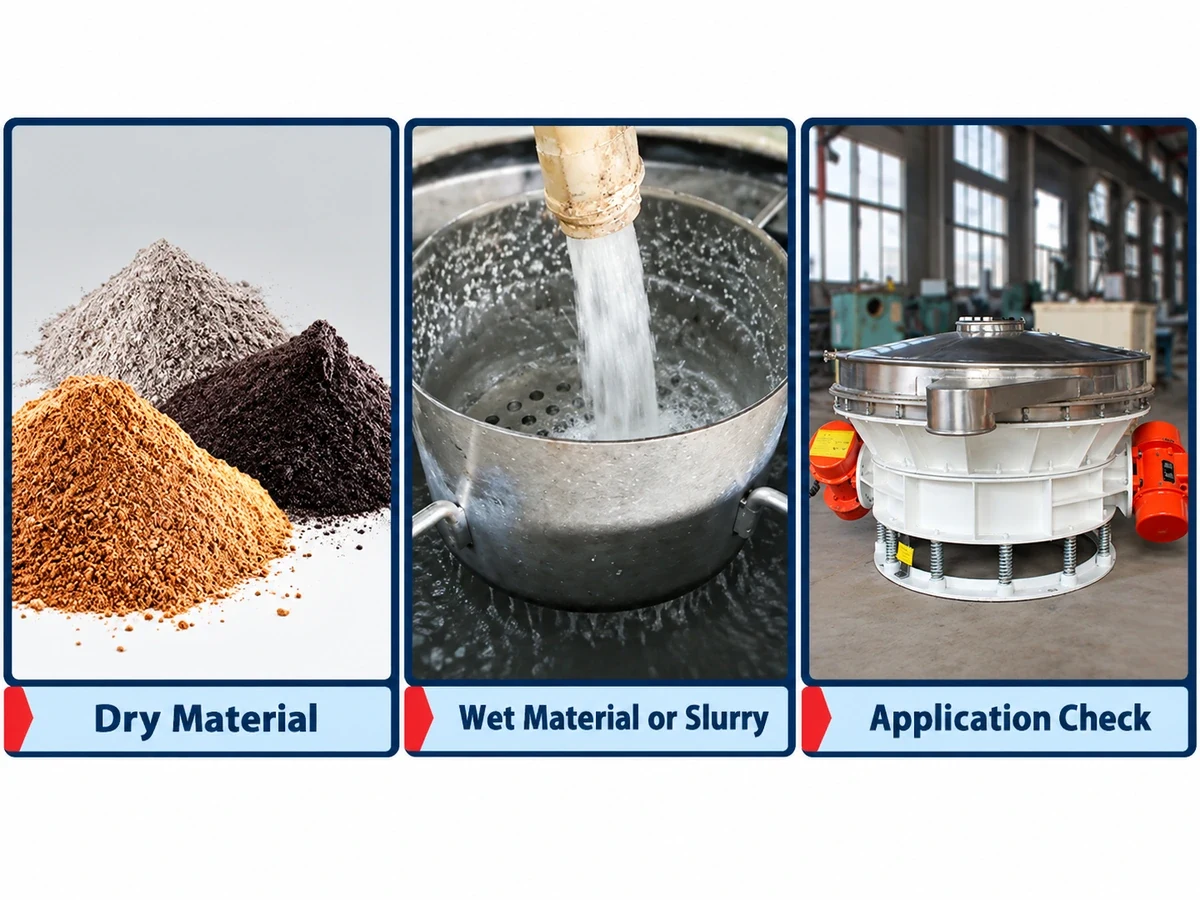
Dry and Wet Material Applications
The same machine family may be configured for dry or wet service, but these duties should not be treated as identical. Screen media, seals, contact materials, surface finish, outlet design, cleaning procedure, and feed control must match the product and the plant’s hygiene or contamination-control requirements.
| Duty | Typical Objective | Examples to Evaluate | Key Checks Before Selection |
|---|---|---|---|
| Dry powder or granules | Safety screening, scalping, de-lumping, or foreign-material removal | Flour, starch, food additives, spices, detergent powder, chemical powders, fertilizer ingredients, and plastic granules | Bulk density, moisture, flowability, dust behavior, aperture, near-size fraction, static risk, and required containment |
| Wet product or slurry | Straining, removal of coarse contamination, or solid-liquid separation within the selected opening range | Suitable liquid suspensions, process slurries, and wet food or chemical streams | Viscosity, solids loading, temperature, corrosion, drainage, splash control, seal compatibility, and cleaning method |
| Hygiene-sensitive product | Final check before packing or controlled transfer between process stages | Food ingredients and pharmaceutical-related powders where the supplied construction meets the project requirement | Contact material, surface finish, gasket material, cleanability, documentation, and site-specific regulatory requirements |
For wet duties that require a purpose-built slurry arrangement, compare the application with the UNITFINE UF Ceramic Slurry Vibrating Screen. For general fine grading or multi-deck separation, review the UNITFINE Rotary Vibrating Sieve. The best choice depends on the separation target and plant layout, not only on whether the feed is described as wet or dry.
Published Model Range and Technical Reference
The following values reproduce the model information currently published for the UNITFINE flow-thru separator range. They are reference specifications, not a performance guarantee for a particular material. Final power, electrical frequency, construction, screen media, and capacity should be confirmed in the written quotation for the supplied configuration.
| Model | Nominal Diameter | Published Mesh Range | Published Motor Power | Published Motor Speed | Published Amplitude |
|---|---|---|---|---|---|
| UFZP600 | 600 mm | 5–100 mesh | 0.1 × 2 kW | 1450 r/min | 3–5 mm |
| UFZP800 | 800 mm | 5–100 mesh | 0.2 × 2 kW | 1450 r/min | 3–5 mm |
| UFZP1000 | 1000 mm | 5–100 mesh | 0.2 × 2 kW | 1450 r/min | 3–5 mm |
| UFZP1200 | 1200 mm | 5–100 mesh | 0.4 × 2 kW | 1450 r/min | 3–5 mm |
| UFZP1500 | 1500 mm | 5–100 mesh | 0.4 × 2 kW | 1450 r/min | 3–5 mm |
How to Estimate the Required Capacity
A diameter or motor rating alone cannot establish usable capacity. Two materials processed through the same screen can produce very different results because particle-size distribution, bulk density, moisture, flowability, aperture, percentage of material passing the screen, and acceptable product loss all affect the required area and operating point.
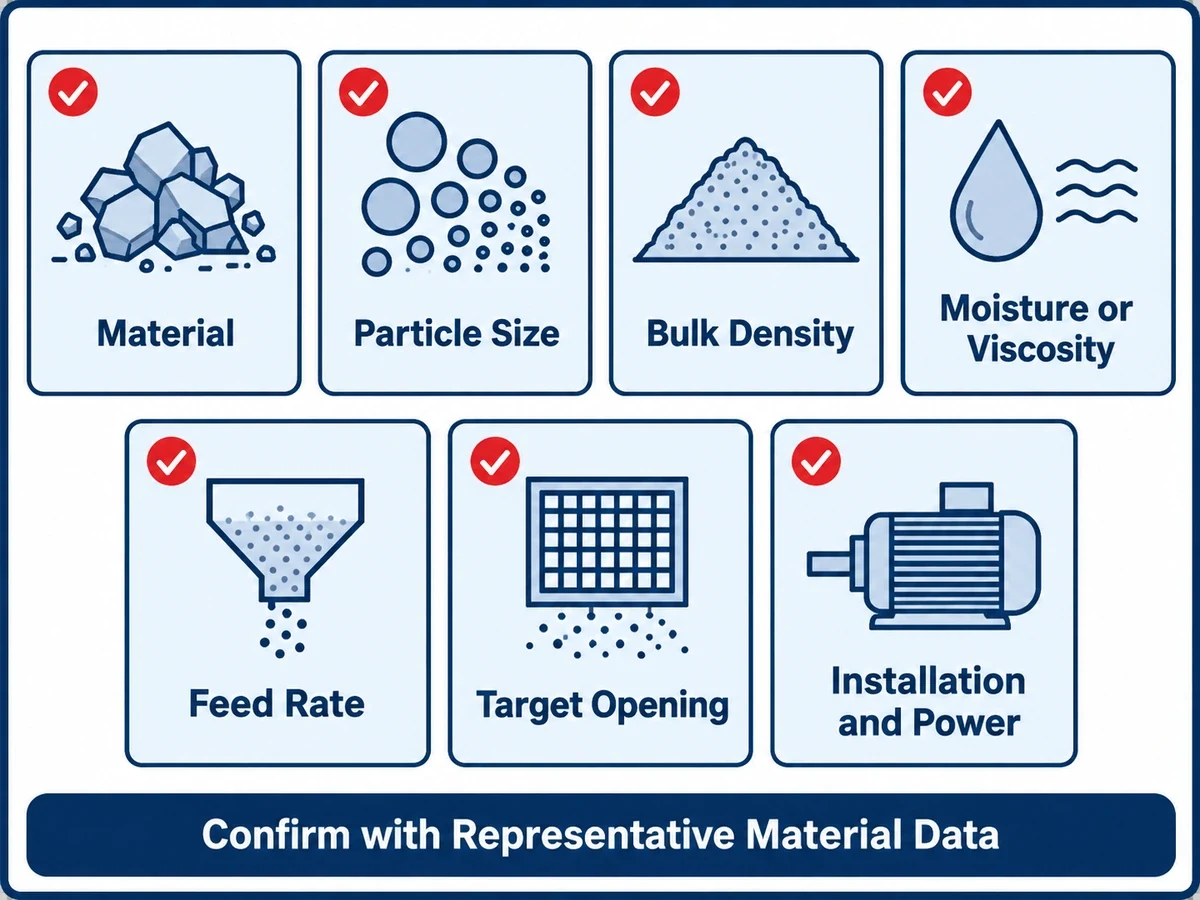
Provide These Inputs for Capacity Selection
- Material name and whether the feed is a dry powder, granule, liquid, or slurry
- Particle-size distribution, especially the percentage close to the target opening
- Bulk density, moisture, temperature, viscosity where relevant, and flow behavior
- Normal and peak feed rate, operating hours, and upstream feeding method
- Required aperture or mesh and the purpose: safety screening, scalping, grading, or straining
- Maximum acceptable oversize in the pass stream and acceptable good-product loss
- Contact material, seal requirements, cleaning method, local voltage, frequency, and available space
For a new product or a demanding cut, a representative material test is the safest way to establish a practical feed rate. Record the machine model, screen opening, motor settings, test duration, feed mass, pass mass, oversize mass, and any evidence of blinding, leakage, product damage, or unstable discharge. Results apply only to the tested material condition and configuration.
Flow-Thru Separator vs. Standard Rotary Vibrating Sieve
| Selection Point | Flow-Thru Rotary Vibrating Separator | Standard Rotary Vibrating Sieve |
|---|---|---|
| Primary layout advantage | Low-profile installation and short material path | Flexible circular-screen configuration for grading, filtering, or multiple fractions |
| Common starting duty | Continuous safety screening, scalping, and foreign-material removal | Fine screening, classification, liquid filtration, or multi-deck separation |
| Number of fractions | Typically selected for a simple pass/oversize separation | May be configured with multiple decks for several fractions |
| Selection caution | Do not assume compact size guarantees capacity or prevents blinding | Do not assume extra decks automatically deliver the required cut quality or throughput |
If very fine powder tends to blind the mesh, an ultrasonic vibrating sieve may be worth evaluating. If strong directional conveying is more important than a compact circular layout, compare the duty with the UZSF linear vibrating screen. These links represent alternative starting points, not interchangeable machines.
Configuration and Installation Checklist
Screen and Product Contact Parts
Confirm aperture, wire diameter, screen material, contact-part material, gasket compatibility, surface-finish requirement, and whether the product or cleaning chemicals create corrosion or contamination risks. Do not assume a general material grade satisfies a food or pharmaceutical project without the required documentation.
Inlet, Outlets, and Flexible Connections
The inlet should distribute the feed without overloading one area. The fines and oversize outlets must discharge freely, and flexible connectors should isolate vibration without collapsing or restricting flow. Check available headroom for assembly, screen inspection, and removal.
Feeding and Downstream Control
A stable feeder improves screening consistency. Surges can deepen the material bed and carry oversize into the pass stream. Downstream equipment must accept the screened product at the same rate; otherwise material can back up into the separator.
Cleaning, Inspection, and Maintenance
Set inspection intervals according to product abrasiveness, screen tension, operating hours, and contamination risk. Inspect the screen, clamps, seals, motor fasteners, flexible connections, and discharge paths. Lock out and isolate the equipment before opening it. Replace damaged screen media or seals before restarting.
Frequently Asked Questions
What is a flow-thru rotary vibrating separator used for?
It is commonly used for compact continuous safety screening, scalping, de-lumping, pre-packaging checks, and removal of foreign or oversize material. Suitability depends on the product, target opening, feed rate, and required separation quality.
Can it screen both wet and dry materials?
Yes, the machine family may be configured for suitable dry powders, granules, liquids, or slurries. Wet and dry duties require different consideration of screen media, seals, drainage, contact materials, corrosion, cleaning, and feed control.
What capacity can a flow-thru separator achieve?
There is no reliable universal capacity value. Usable throughput depends on particle-size distribution, bulk density, moisture or viscosity, screen opening, percentage passing, feed stability, machine diameter, and acceptable product loss. UNITFINE should evaluate representative material and operating data before confirming capacity.
How do I choose the correct mesh?
Define the largest acceptable particle in the pass stream and review the actual particle-size distribution around that cut point. Mesh count alone can be ambiguous, so confirm the required opening in millimeters or micrometers together with wire diameter and screen material.
When should I choose a standard rotary vibrating sieve instead?
A standard rotary vibrating sieve is often a better starting point when the process needs fine grading, several product fractions, longer screening opportunity, or a multi-deck arrangement. The choice should be validated against the same feed and acceptance criteria.
What information should I send for model selection?
Send the material name, dry or wet condition, particle-size distribution, bulk density, moisture or viscosity, normal and peak feed rate, target opening, separation purpose, acceptable product loss, contact material, cleaning method, available space, voltage, and frequency.
Discuss Your Flow-Thru Screening Application
Share your material properties, target screen opening, required feed rate, installation height, cleaning requirements, and local power supply. UNITFINE can review whether a flow-thru rotary vibrating separator, a standard rotary vibrating sieve, or another screening configuration is the better starting point.
Contact UNITFINE or review the complete UNITFINE equipment range.


