
A vibrating sieve mesh size chart is one of the most frequently referenced tools in industrial powder processing, yet it is also one of the most common sources of ordering mistakes. Saying you need a “100 mesh” or “200 mesh” screen is not enough on its own: mesh count only tells you how many openings fit inside one linear inch. Without stating the sieve standard (such as ASTM E11 or ISO 3310-1) and the wire diameter, two screens with the same nominal mesh number can have noticeably different clear openings and open-area percentages.
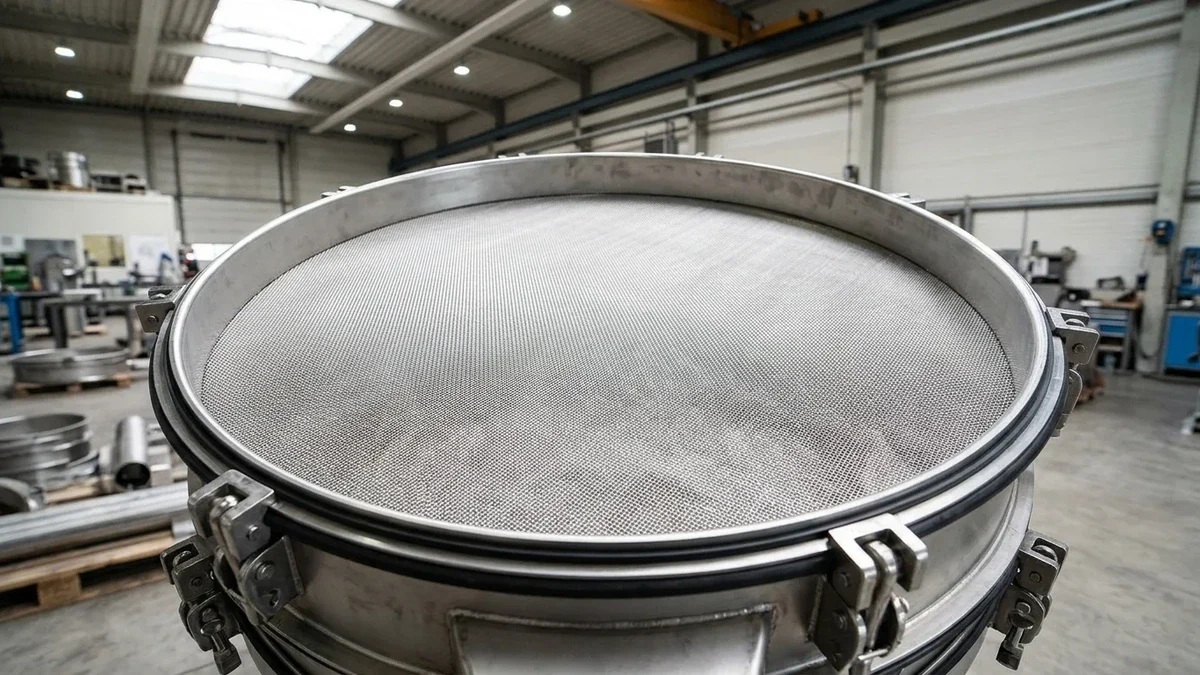
Quick Answer: How to Read a Vibrating Sieve Mesh Size Chart Correctly
Always specify screen cloth by clear aperture (mm or μm), reference standard (ASTM E11 or ISO 3310-1), and wire diameter—never by mesh number alone. In square woven wire mesh, clear aperture equals (25.4 / Mesh Count) − Wire Diameter (mm). Heavier industrial wires reduce both the clear opening and the percentage of open area compared with standard test sieves.
Why Mesh Count Alone Is Not a Unique Aperture Size
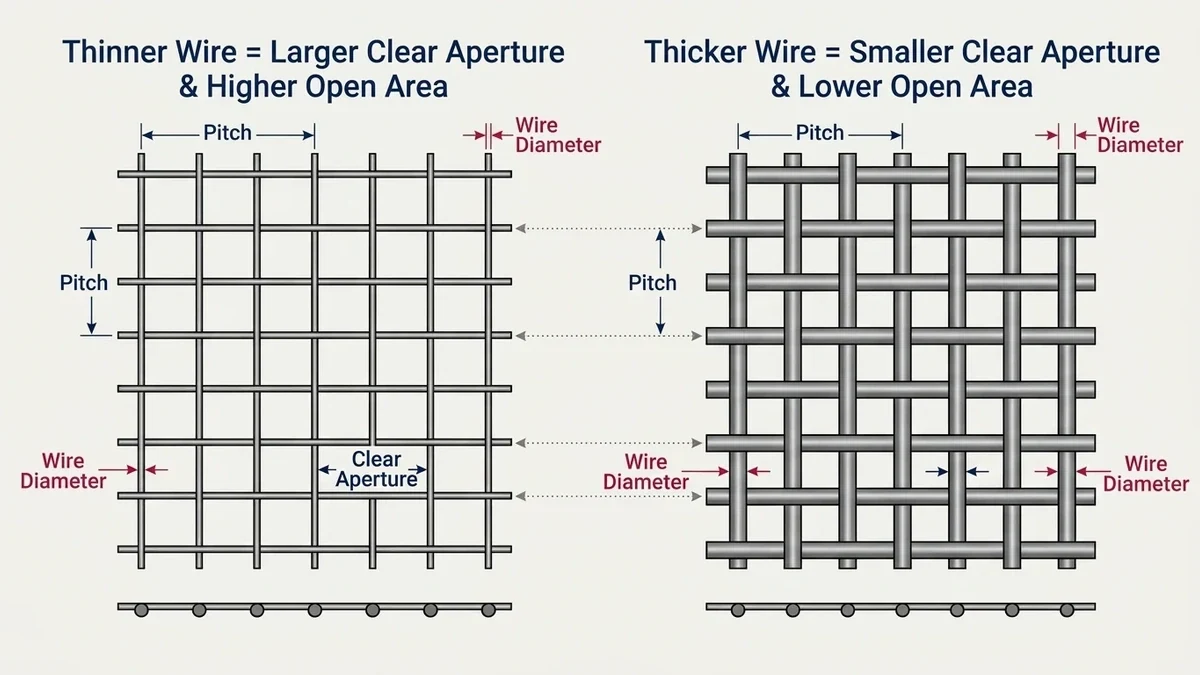
In woven wire cloth, mesh count is defined as the number of openings per linear inch (25.4 mm), measured from wire center to wire center. Because every pitch includes both one opening and one wire thickness, the actual gap that particles pass through depends directly on how thick the wire is:
Clear Aperture (mm) = (25.4 / Mesh Count) − Wire Diameter (mm)
For example, a 100-mesh screen has a center-to-center pitch of 0.254 mm (254 μm). If woven with a 0.104 mm wire, the nominal clear aperture is 150 μm (0.150 mm). If a heavier-duty 0.114 mm wire is used for abrasive service at the same 100-mesh pitch, the clear opening narrows to 140 μm and the percentage of open area drops. That difference can shift your particle-size cut point and reduce screening throughput on fine powders.
Different regional standards also complicate mesh conversions. ASTM E11 (U.S. Standard Sieve Series) and ISO 3310-1 (International Standard for metal wire cloth test sieves) align closely on nominal metric apertures, whereas older market-grade industrial woven wire cloths and legacy regional mesh tables may pair the same mesh label with different wire gauges. Stating the exact target opening in micrometers (μm) or millimeters (mm) alongside the wire diameter removes ambiguity when ordering UF woven wire mesh cloth.
Standard Vibrating Sieve Mesh Size Chart (ASTM E11 & ISO 3310-1)
The table below maps commonly used ASTM E11 sieve designations to their corresponding ISO 3310-1 nominal metric apertures in millimeters and micrometers (μm). Use this chart as an engineering reference to translate laboratory specifications into production screen cloth inquiries.
| ASTM E11 Designation | Nominal Aperture (mm) | Nominal Aperture (μm) | Typical Screening Range |
|---|---|---|---|
| No. 4 | 4.75 mm | 4,750 μm | Coarse scalping & granules |
| No. 8 | 2.36 mm | 2,360 μm | Coarse granules & pellets |
| No. 10 | 2.00 mm | 2,000 μm | Granular classification |
| No. 16 | 1.18 mm | 1,180 μm | Medium-coarse crystals & feed |
| No. 18 | 1.00 mm | 1,000 μm | 1 mm cut point & safety check |
| No. 20 | 0.850 mm | 850 μm | Medium sugar, salt & resins |
| No. 30 | 0.600 mm | 600 μm | Medium dry powder grading |
| No. 40 | 0.425 mm | 425 μm | Food, spice & chemical grading |
| No. 50 | 0.300 mm | 300 μm | General fine powder check screening |
| No. 60 | 0.250 mm | 250 μm | Fine flour, starch & minerals |
| No. 80 | 0.180 mm | 180 μm | Fine chemical & pharma powders |
| No. 100 | 0.150 mm | 150 μm | Common fine powder classification |
| No. 120 | 0.125 mm | 125 μm | Fine metal & mineral powders |
| No. 140 | 0.106 mm | 106 μm | Fine coating & pigment cuts |
| No. 200 | 0.075 mm | 75 μm | Fine powder; evaluate anti-blinding |
| No. 270 | 0.053 mm | 53 μm | Ultra-fine; often needs active cleaning |
| No. 325 | 0.045 mm | 45 μm | Ultra-fine metal, ceramic & additive |
| No. 400 | 0.038 mm | 38 μm | Ultra-fine; ultrasonic/tumbler trial |
| No. 500 | 0.025 mm | 25 μm | Specialized ultra-fine; confirm by sample |
Engineering note: The nominal apertures above reflect standard ASTM E11 / ISO 3310-1 test sieve designations. Production woven wire cloth for industrial vibrating sieves may use thicker or thinner wire diameters depending on wear resistance, tensioning method, and weave type (plain vs. twill). Always confirm actual aperture, wire diameter, and tolerance on your supplier drawing before ordering.
How Wire Diameter and Open Area Affect Capacity and Screen Life
Selecting industrial screen cloth is always a balance between open area (the percentage of total screen surface occupied by holes) and mechanical durability. For square woven wire mesh, open area percentage is calculated from aperture (A) and wire diameter (d) as [A / (A + d)]² × 100%.
1. Thin Wire (Higher Open Area)
Thinner wires leave more open space across the screening deck, which gives fine particles more opportunities to pass through. This is helpful for light, free-flowing, or ultra-fine powders where throughput per square meter is the main constraint. The trade-off is lower resistance to abrasion, heavy impact, and mechanical wear from aggressive bouncing balls.
2. Heavy-Duty Wire (Longer Mechanical Strength)
Thicker wires withstand higher bed loads, sharp mineral particles, and frequent cleaning cycles. However, because thicker wires reduce open area and narrow the opening if pitch stays fixed, switching blindly to heavier wire without adjusting mesh count can cause a drop in throughput or unexpected oversize rejection.
3. Market Grade vs. Tensile Bolting Cloth (TBC)
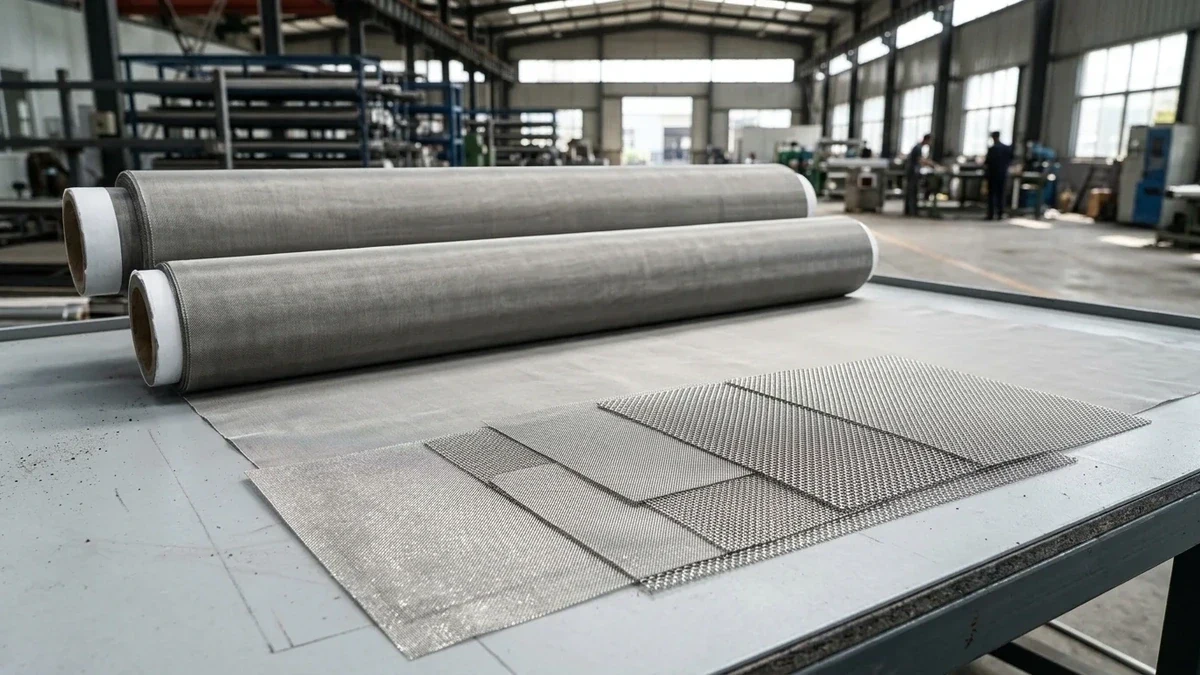
In fine powder screening, engineers often compare general-purpose market-grade wire cloth against thinner-wire tensile bolting cloth (TBC). TBC uses finer stainless-steel wires to achieve higher open area at comparable apertures, whereas market-grade cloth prioritizes heavier wire strength. Which grade fits best depends on bulk density, particle abrasiveness, deck diameter, and whether a backup support mesh is installed underneath.
Matching Mesh Size to Vibrating Sieve Type and Deblinding Method
Even the most accurate mesh conversion will underperform if the screening machine and anti-blinding accessories do not match the powder behavior around your target aperture:
- General dry or wet check screening & multi-deck grading: A standard rotary vibrating sieve handles a broad range of coarse-to-fine mesh openings when paired with appropriate tensioning and bouncing-ball cleaning decks.
- Fine, cohesive, electrostatic, or blinding-prone powders (typically 100 mesh and finer, depending on material): Near-size particles and static agglomeration can quickly plug fine openings. Adding an ultrasonic vibrating sieve applies high-frequency, low-amplitude energy directly to the mesh frame to help keep fine apertures open without relying solely on aggressive mechanical ball impacts.
- Fragile, light, or difficult fine powders requiring longer residence time: A low-frequency tumbler fine sieve simulates gentle manual hand-sieving across up to 5 decks, helping preserve fragile particles while keeping powder on the fine mesh longer.
- High-feed coarse-to-medium grading or dewatering: A linear vibrating screen provides directional conveying for heavier granular loads where coarse-to-medium woven wire or perforated decks are preferred.
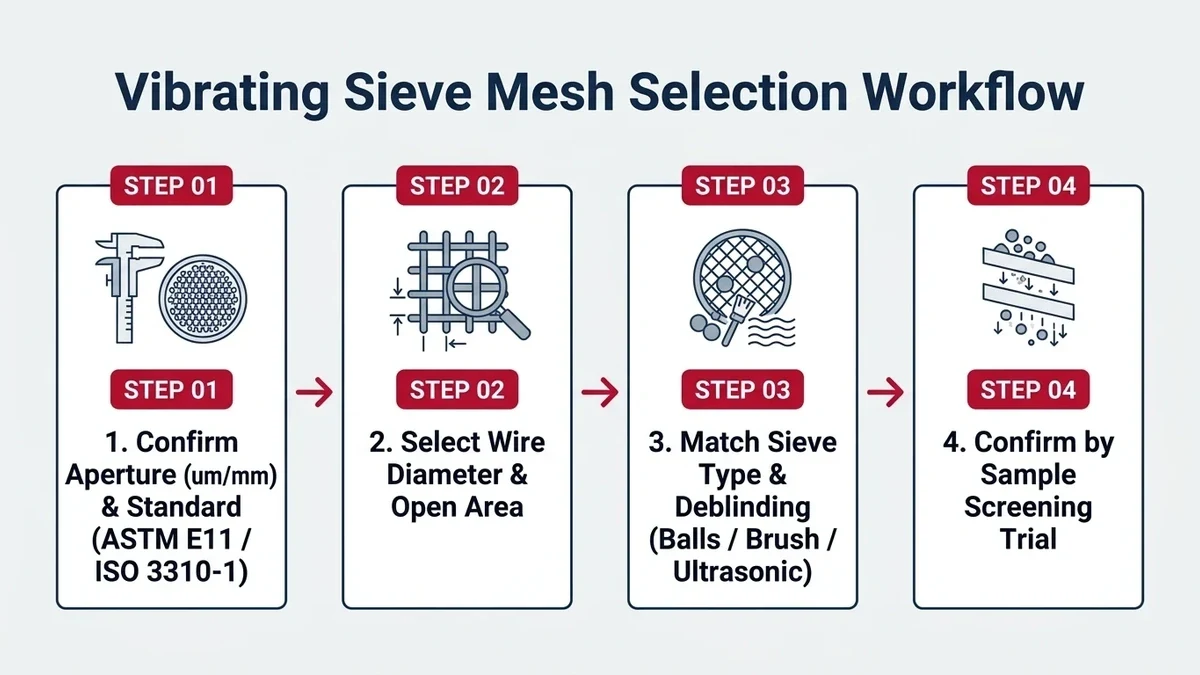
No single mesh size automatically dictates one universal machine or guaranteed throughput. Particle-size distribution (especially the share of near-size particles close to the aperture), moisture, fat or oil content, bulk density, and static behavior should be reviewed together—and confirmed by sample trial screening when cuts are fine or demanding.
Common Mesh Conversion Mistakes to Avoid
- Confusing laboratory test-sieve mesh with production screen cloth: Lab test sieves follow strict ASTM E11 or ISO 3310-1 calibration tolerances for small batch analysis, while production screens must handle continuous tension, vibration, and wear. Always verify whether your target is a lab cut point or an industrial cloth specification.
- Ignoring near-size particles: Particles whose diameter sits just above or near the mesh opening (often within roughly 0.75× to 1.5× of the aperture) tend to wedge into square holes. Selecting a screen without accounting for near-size distribution can trigger severe blinding.
- Overlooking wire material and food/chemical contact needs: Standard industrial wire cloth is commonly supplied in stainless steel (such as SUS304 or SUS316L depending on corrosion and hygiene requirements), but exact alloy grade, gasket material, and bonding/clamping construction must match your cleaning and chemical compatibility needs.
- Assuming aperture alone determines particle pass-through: Elongated, flaky, or fibrous particles can behave very differently from spherical granules on square openings, sometimes passing end-first or bridging across adjacent wires.
What to Specify When Requesting Vibrating Sieve Mesh or a New Screener
To avoid ordering the wrong aperture or screen frame, prepare the following engineering inputs before requesting a screen cloth or machine quotation from UNITFINE:
- Target cut size and standard: Desired clear opening in μm or mm (and ASTM E11 / ISO 3310-1 reference if translating from a mesh count).
- Wire diameter or duty requirement: Preferred wire thickness, weave preference, or whether abrasiveness requires heavier wire or a support mesh.
- Material profile: Material name, particle-size distribution (including oversize and near-size share), bulk density, moisture, stickiness, or static behavior.
- Machine and frame interface: Existing screener model, nominal diameter (or deck dimensions), mounting/clamping style, and number of decks needed.
- Product-contact material & cleaning method: Required stainless-steel grade (e.g., 304 or 316L), gasket elastomer, and whether bouncing balls, rotary brushes, or ultrasonic deblinding are required.
- Required capacity and operating conditions: Target hourly feed rate, continuous vs. batch duty, and local voltage/frequency if sizing a complete screener.
Need Help Confirming the Right Mesh Aperture and Sieve Configuration?
Share your target micron cut, material characteristics, and required capacity with UNITFINE engineers. We can help verify wire diameter, open area, deblinding options, and trial-screening needs before you order replacement mesh or a new screening machine.
Frequently Asked Questions
Why can two 100-mesh screens have different micron openings?
Mesh count only measures the number of openings per linear inch (center-to-center pitch). Because the clear opening equals pitch minus wire diameter, using a thicker wire for heavier industrial duty reduces the actual clear opening in micrometers compared with a thinner-wire standard test sieve.
What is the difference between ASTM E11 and ISO 3310-1 mesh charts?
ASTM E11 is the U.S. standard specification for woven wire test sieve cloth and uses both mesh numbers and metric openings, while ISO 3310-1 is the international metric standard expressed directly in millimeters and micrometers. Nominal apertures align closely across most common grades, but production screen cloth wire diameters can still vary by supplier unless specified explicitly.
Should I order replacement vibrating sieve screens by mesh number or by micron opening?
Always specify both the clear aperture (in μm or mm) and the wire diameter, along with the reference standard if you also mention a mesh number. Providing the screen frame dimensions, stainless-steel grade, and cleaning system ensures the replacement screen matches both your separation target and your machine interface.
At what mesh size should I consider ultrasonic deblinding on a vibrating sieve?
There is no single fixed mesh cutoff that applies to every powder, because blinding depends on particle shape, near-size fraction, moisture, oil content, and static charge. In practice, operators commonly evaluate ultrasonic deblinding for fine powders around 100 mesh (150 μm) and finer when bouncing balls alone cannot keep the mesh open, confirmed by sample testing.
Does a higher open-area screen always give better performance?
Higher open area generally improves potential screening throughput because more of the deck is open for particles to pass. However, achieving higher open area at the same aperture requires thinner wire, which can wear faster under abrasive or heavy loads. The right choice balances throughput against required mesh service life.