
Selecting between a rotary vibrating sieve and a linear vibrating screen is one of the most common decisions in powder and bulk-solids screening. Both machines can separate particles by size, remove oversize impurities, and improve product consistency, but they are built for different material behaviors, capacity ranges, floor layouts, and process goals.
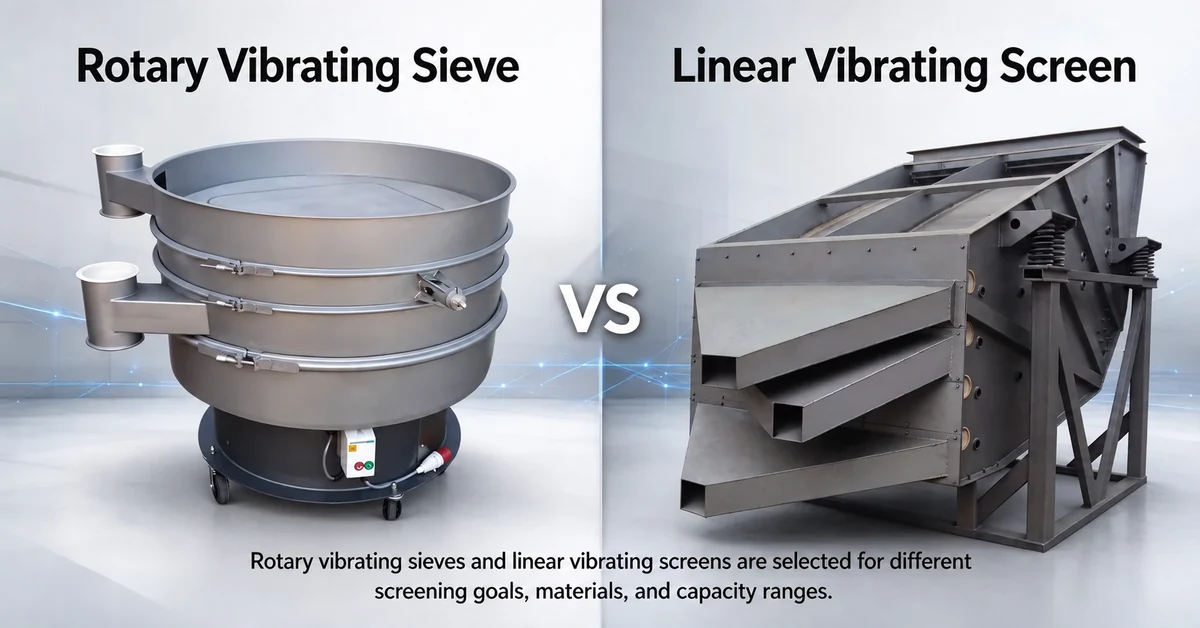
A rotary vibrating sieve is usually selected for high-precision sieving of powders, granules, and liquid-solid materials when compact layout, multi-layer separation, and fine screening accuracy are important. A linear vibrating screen is usually selected when the process requires higher throughput, longer material travel, and efficient classification of dry bulk materials.
This guide explains the practical differences between these two screening machines and gives engineers, purchasing teams, and plant managers a clearer way to choose the right equipment before sending an RFQ.
Quick Comparison: Rotary Vibrating Sieve vs Linear Vibrating Screen
| Selection Factor | Rotary Vibrating Sieve | Linear Vibrating Screen | Best Choice When… |
|---|---|---|---|
| Material motion | Three-dimensional vibration: horizontal, vertical, and inclined motion | Straight-line vibration across a longer screen surface | You need either fine circular separation or longer linear travel |
| Typical application | Fine powders, granules, liquid filtration, impurity removal, grading | Dry bulk materials, larger capacity classification, dewatering or coarse screening in some processes | The material form and capacity requirement are already known |
| Screening accuracy | Generally stronger for fine and precise separation | Strong for continuous classification where throughput matters | The buyer must balance precision and capacity |
| Capacity direction | Usually compact and efficient for fine screening | Usually better for larger feed rates and longer conveying paths | Plant output is the main decision point |
| Footprint | Compact vertical structure | Longer horizontal structure | Workshop space limits the layout |
| Layer configuration | Can use multiple decks for multi-grade separation | Can also use multiple layers, but layout and discharge arrangement differ | You need several final particle-size grades |
| Common industries | Food, pharmaceutical, chemical, metallurgy, environmental applications | Chemical, mining, metallurgy, building materials, food, fertilizer, carbon, and general bulk solids | Industry hygiene, capacity, and dust-control needs are clear |
How a Rotary Vibrating Sieve Works
A rotary vibrating sieve uses a vertical vibration motor with adjustable eccentric weights. The motor creates a combined three-dimensional motion that moves material across the screen surface in a circular or spiral pattern. This motion helps material spread evenly, pass through the mesh, and discharge from the outlet.
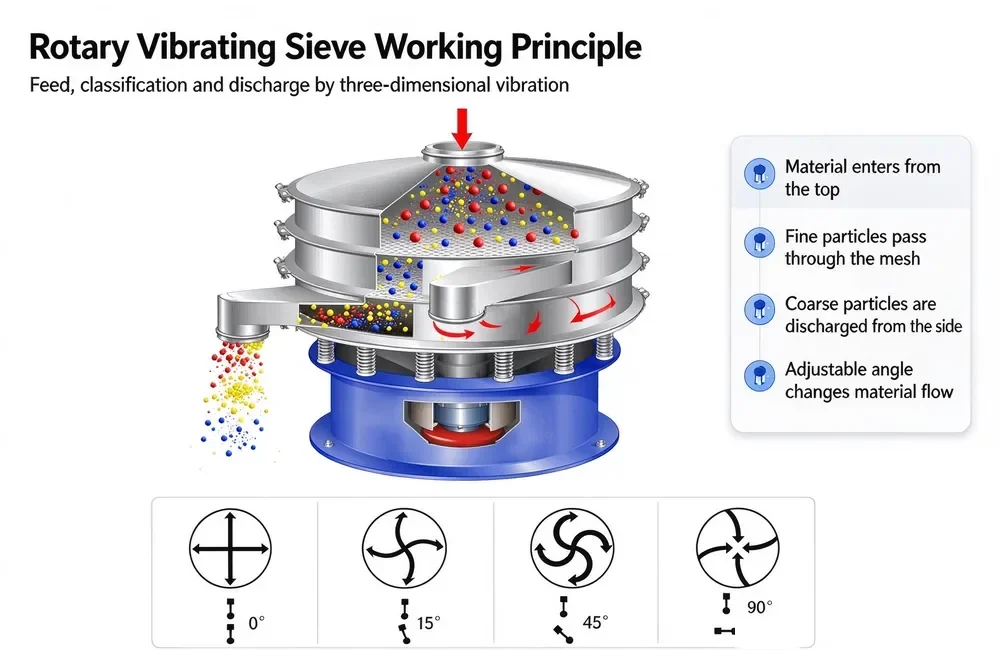
This design is especially useful when the goal is accurate sieving, impurity removal, or multi-grade separation in a limited floor area. The machine can often be configured with different screen layers, contact materials, discharge directions, and cleaning devices depending on the powder characteristics and hygiene requirements.
When a Rotary Vibrating Sieve Is Usually a Better Fit
- The material is a fine powder, granule, or slurry-like material requiring precise separation.
- The process needs compact vertical equipment instead of a long horizontal screen.
- The buyer needs several particle-size grades from one machine.
- The application involves food, pharmaceutical, chemical, or metal powder handling where clean design is important.
- The process needs optional ultrasonic or other anti-blinding assistance for difficult fine powders.
For example, if a food powder producer needs to remove oversize particles from flour, starch, milk powder, or spice powder, a rotary vibrating sieve may be a practical first option. If a metal powder or chemical powder is very fine and tends to block the mesh, an ultrasonic vibrating sieve or a rotary sieve with anti-blinding support may be considered.
How a Linear Vibrating Screen Works
A linear vibrating screen moves material in a straight-line motion across the screen deck. The vibration is commonly generated by dual vibrating motors or exciters that create a directional force. Material enters one end of the screen, travels along the screen surface, and separates through one or more screen layers before discharging.
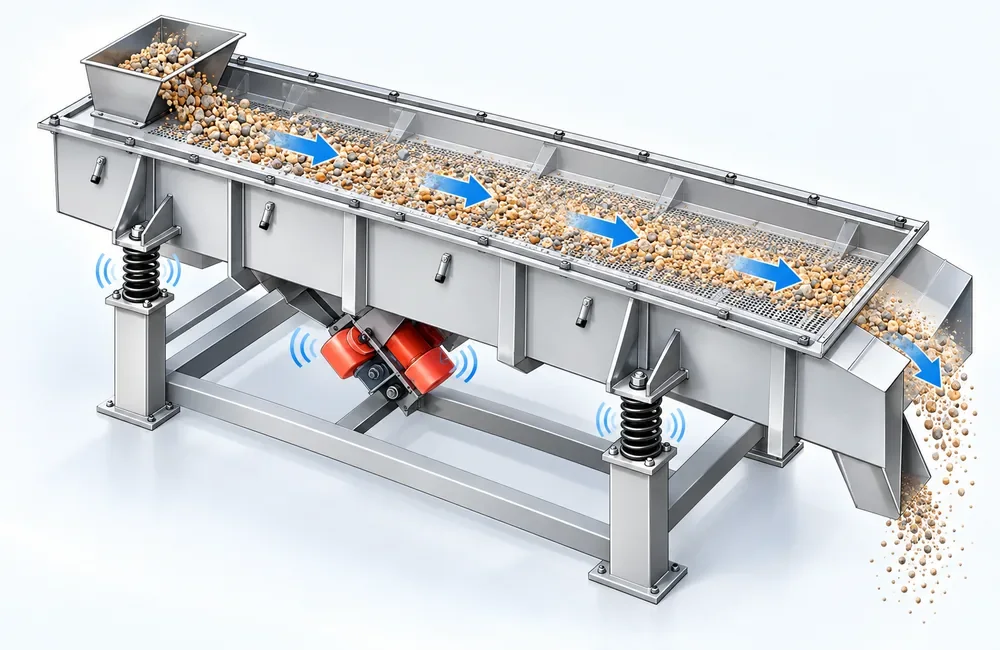
Compared with a compact round sieve, the linear design gives material a longer travel path. This can be helpful when the process needs stable throughput, larger screening area, or a more continuous flow of dry bulk solids.
When a Linear Vibrating Screen Is Usually a Better Fit
- The process requires higher throughput than a compact round sieve can comfortably handle.
- The material is dry and can travel effectively across a longer screen surface.
- The plant layout can accept a longer rectangular machine.
- The process requires continuous classification rather than small-batch fine sieving.
- The user needs a robust screening solution for chemical, food, fertilizer, carbon, mineral, or building-material applications.
If the material has a larger feed volume and the goal is continuous classification, a linear vibrating screen is often worth evaluating. If the buyer is unsure whether the material will flow well on a linear deck, material testing or a detailed RFQ with particle size, moisture, density, and capacity information is recommended.
Key Selection Factors Before Choosing a Screening Machine
1. Particle Size and Required Mesh
The target mesh size is one of the first decision points. Fine powders often need better mesh support and anti-blinding methods. Coarser or higher-volume materials may benefit from the longer path of a linear screen. If the required mesh is very fine, ask whether the material tends to stick, agglomerate, or generate static.
2. Capacity Requirement
Capacity should not be estimated from machine size alone. It depends on bulk density, particle shape, moisture content, feed uniformity, mesh opening, number of layers, and whether the screen is used for impurity removal or accurate grading. A larger machine does not automatically solve poor flow behavior.
3. Material Flowability
Free-flowing powders and granules are easier to screen. Sticky, oily, damp, flaky, or lightweight materials may require special screen cleaning, feed control, or equipment testing. A material that flows well in one machine may not perform the same way in another if the motion pattern changes.
4. Number of Grades
If the process needs several particle-size grades, the number of screen layers and discharge outlets must be planned carefully. Rotary vibrating sieves are often convenient for compact multi-layer grading. Linear vibrating screens can also be configured with multiple layers, but the equipment layout and discharge flow should be checked against the workshop layout.
5. Cleaning and Changeover
Food, pharmaceutical, and high-value chemical applications often require frequent cleaning. In these cases, equipment selection should include access doors, screen replacement method, contact material, sealing design, and whether the process has allergen, cross-contamination, or batch traceability requirements.
6. Dust Control and Sealing
Fine powder screening can create dust at feeding, screening, and discharge points. Buyers should confirm whether the screen needs a sealed cover, dust collection interface, soft connection, or enclosed upstream and downstream transfer. For powder conveying after screening, enclosed conveying options such as tube drag or vacuum conveying may also be evaluated.
Decision Guide: Which Machine Should You Shortlist?
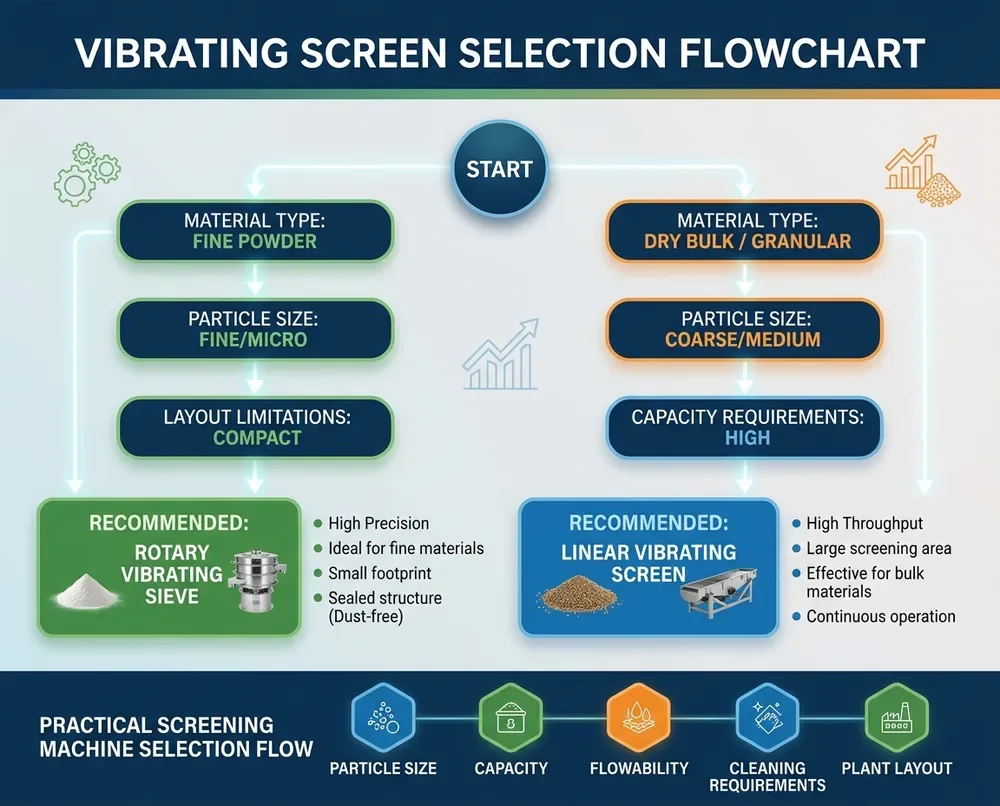
Choose a rotary vibrating sieve first if your main goals are fine screening accuracy, compact layout, multi-grade separation, and flexible cleaning options.
Choose a linear vibrating screen first if your main goals are larger dry-material throughput, continuous classification, and a longer screening path.
In many projects, the best decision is not based on machine name alone. A good RFQ should describe the material, target mesh, moisture, bulk density, feed rate, required grades, working environment, and cleaning requirements. If the buyer can provide sample material or previous equipment performance, the selection becomes more reliable.
Information to Provide Before Requesting a Quotation
To receive a more accurate recommendation, prepare the following information before contacting a supplier:
- Material name and industry application
- Feed particle size and required final mesh or particle-size range
- Bulk density and moisture content
- Required capacity per hour
- Number of grades or final outlets
- Whether the material is sticky, oily, fragile, abrasive, explosive, or hygroscopic
- Contact material requirement such as SS304 or SS316L
- Voltage, available floor space, and height restriction
- Cleaning, dust-control, and changeover requirements
If the project involves food, pharmaceutical, battery material, metal powder, or chemical powder, it is also useful to clarify whether hygiene, anti-contamination, explosion-proof, or documentation requirements apply.
Frequently Asked Questions
Is a rotary vibrating sieve more accurate than a linear vibrating screen?
A rotary vibrating sieve is often preferred for fine and precise separation because its three-dimensional motion spreads material across a compact circular screen surface. However, actual accuracy depends on mesh size, material flowability, feed rate, screen cleaning, and operating settings.
Is a linear vibrating screen better for high-capacity screening?
In many dry bulk-material applications, a linear vibrating screen is more suitable for higher throughput because material travels along a longer screen deck. The final choice still depends on material characteristics, required mesh, number of layers, and plant layout.
Can both machines be used for food and pharmaceutical powders?
Both machine types can be used in food or pharmaceutical-related processes when designed with suitable contact materials, sealing, cleaning access, and hygiene requirements. Buyers should confirm material grade, surface finish, cleaning method, and any compliance documentation before purchase.
What information should I send to choose the right screen?
Send the material name, particle size, target mesh, moisture content, bulk density, capacity, number of grades, and any hygiene or dust-control requirements. This allows the supplier to recommend a machine based on the application instead of guessing from the product name.
Need Help Choosing the Right Screening Equipment?
Unitfine can help review your material, target particle size, capacity, and plant layout to decide whether a rotary vibrating sieve, linear vibrating screen, ultrasonic sieve, or another screening solution is more suitable.
Contact Unitfine with your material information and screening requirement for a practical equipment recommendation.