Tubular chain conveyors are widely used when manufacturers need enclosed, gentle, and flexible conveying for powders, granules, pellets, flakes, seeds, or fragile bulk materials. Compared with open belt conveyors or simple screw conveyors, a tubular chain conveyor can move material through a sealed pipe layout while reducing dust leakage, product loss, and contamination risk.
For factories handling food ingredients, chemical powders, plastic pellets, coffee beans, pet food, pharmaceutical intermediates, and agricultural materials, the main value is not only “moving material from point A to point B.” The real value is stable transfer, cleaner production, flexible routing, and easier integration with upstream and downstream equipment.
What Is a Tubular Chain Conveyor?
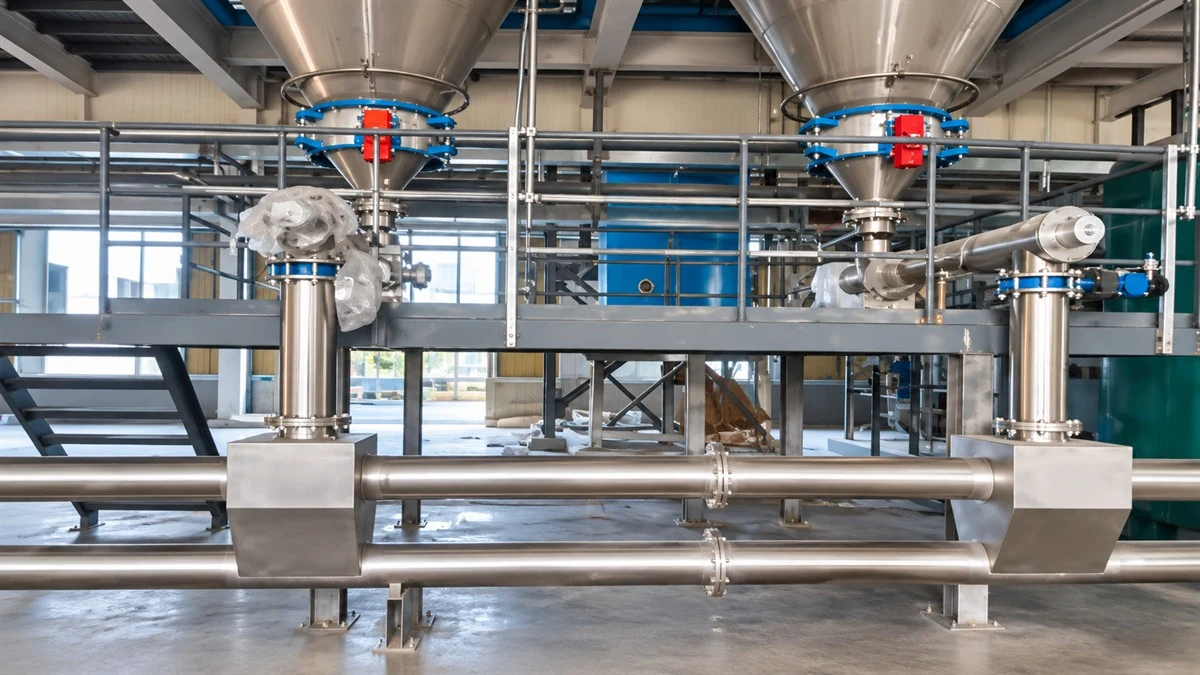
A tubular chain conveyor uses a chain with discs or flights moving inside an enclosed tube. As the chain moves, the discs push or pull bulk material through the pipe. The system can be arranged horizontally, vertically, or in a combined three-dimensional route, depending on the factory layout.
UNITFINE commonly recommends this conveying concept when customers need a cleaner and more flexible alternative to open conveyors, especially when material dust, product breakage, floor-space limits, or multiple discharge points are important concerns.
For equipment reference, see the UNITFINE Tubular Cable Drag Conveyor.
Why Tubular Chain Conveyors Are Used Across Industries
Different industries use tubular chain conveyors for different reasons, but the core advantages are similar: enclosed transfer, stable feeding, gentle movement, and layout flexibility.
| Application Need | Why Tubular Chain Conveying Helps | Typical Benefit |
|---|---|---|
| Dust-sensitive materials | Material moves inside a sealed tube instead of an open belt or open chute. | Cleaner workshop and reduced product loss. |
| Fragile granules or pellets | The conveying action is slower and gentler than high-speed pneumatic transfer. | Less breakage and more consistent finished product quality. |
| Complicated plant layout | The pipe route can combine horizontal, inclined, and vertical sections. | Better use of limited space and easier equipment integration. |
| Multiple discharge points | The system can be designed with several outlets according to process needs. | One conveying line can serve several machines or storage points. |
Food and Ingredient Processing Applications
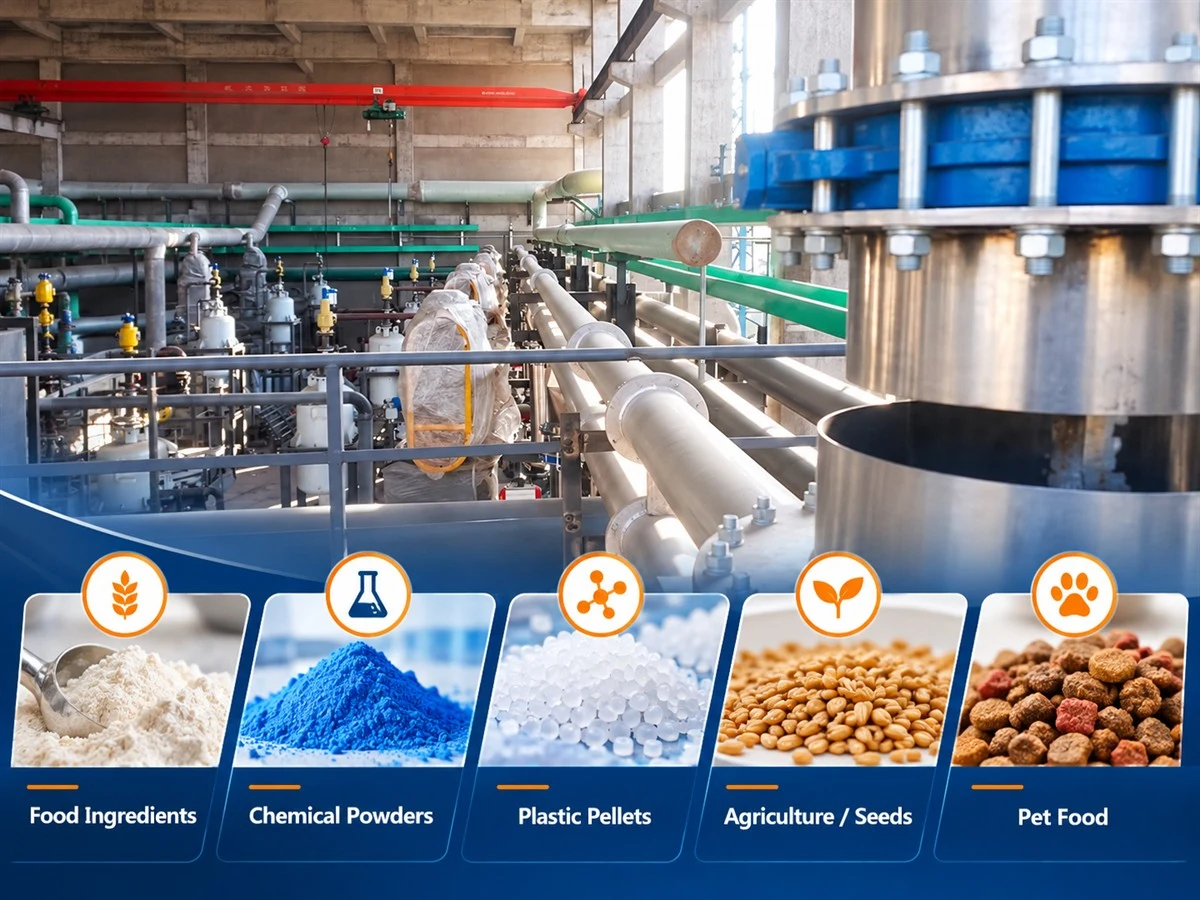
Food factories often choose tubular chain conveyors for sugar, flour blends, starch, seasonings, cereal ingredients, coffee beans, nuts, grains, seeds, and snack materials. The enclosed pipe helps keep ingredients inside the system and limits external contamination.
Common Food Industry Use Cases
- Transferring powder or granular ingredients from storage bins to mixers.
- Moving coffee beans, nuts, or grains with reduced breakage.
- Feeding packaging lines, batching systems, or screening equipment.
- Connecting silos, hoppers, mixers, and weighing systems in a compact route.
Pharmaceutical and Nutraceutical Applications
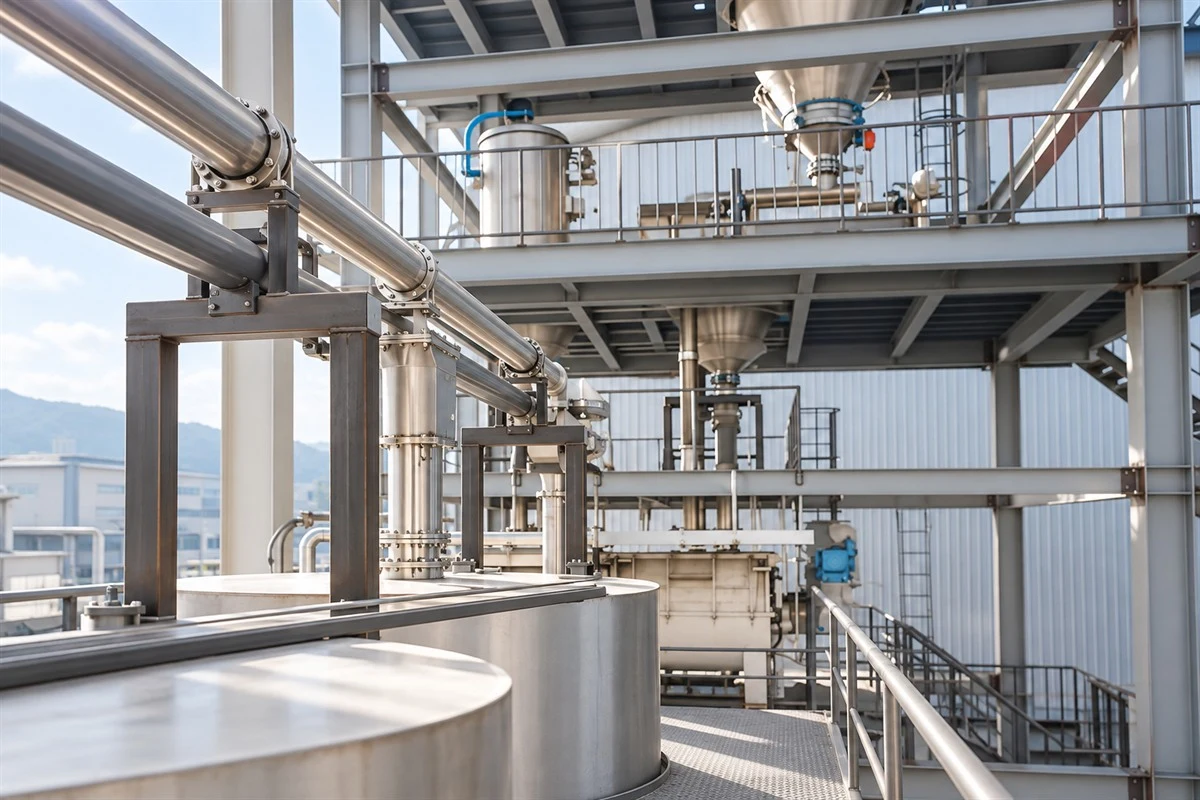
For pharmaceutical and nutraceutical production, clean transfer and controlled material handling are especially important. A tubular chain conveyor can be considered for intermediate powders, granules, excipients, capsules-related materials, and nutritional powder ingredients where dust control and gentle conveying are required.
When hygiene requirements are high, the conveyor should be designed with suitable contact materials, easy-clean structure, smooth inner surfaces, and process-specific cleaning procedures. The final selection should always consider the material characteristics and the factory’s sanitation standard.
Chemical and Fine Powder Applications
Chemical plants may use tubular chain conveyors for pigments, additives, mineral powders, detergent ingredients, catalysts, resins, and other dry bulk materials. Since many chemical powders create dust or require controlled transfer, the enclosed tube structure can reduce dust escape during conveying.
For fine powders that are very light, sticky, abrasive, or moisture-sensitive, UNITFINE normally checks bulk density, flowability, particle size distribution, moisture level, and required conveying distance before recommending a final configuration.
Plastics, Pellets, and New Material Applications
Plastic pellets, masterbatch, resin particles, recycled plastic flakes, and new material granules are common candidates for tubular chain conveying. The system can move materials between storage, drying, mixing, extrusion, and packaging processes.
Compared with pneumatic conveying, tubular chain conveying may be selected when lower speed, less material degradation, or quieter mechanical transfer is preferred. If the material is very light and the conveying distance is long, a vacuum conveyor may also be compared during selection.
Agriculture, Seeds, Coffee, and Pet Food Applications
For agricultural and pet food production, tubular chain conveyors are often used for seeds, grains, beans, feed pellets, pet food kibbles, and similar bulk materials. These materials may require gentle handling to reduce cracking, dust formation, or shape damage.
In coffee and seed handling, product appearance and integrity can be important. A slower mechanical conveying system can help reduce unnecessary impact when compared with high-velocity conveying methods.
Industry Comparison
| Industry | Typical Materials | Main Concern | Conveyor Selection Focus |
|---|---|---|---|
| Food | Flour, sugar, coffee, grains, nuts | Clean transfer and ingredient integrity | Food-contact material, enclosed routing, easy cleaning |
| Pharmaceutical / Nutraceutical | Powder ingredients, granules, excipients | Controlled handling and hygiene | Material compatibility and cleaning access |
| Chemical | Additives, pigments, minerals, resins | Dust control and material safety | Sealing, abrasion resistance, flowability check |
| Plastics | Pellets, masterbatch, recycled flakes | Stable feed and reduced degradation | Conveying speed, inlet/outlet layout, capacity |
| Agriculture / Pet Food | Seeds, grains, feed pellets, kibbles | Gentle handling | Low breakage, route flexibility, hopper integration |
When Should You Choose a Tubular Chain Conveyor?
A tubular chain conveyor is often a good choice when your production line has one or more of these needs:
- The material must be conveyed in an enclosed path.
- The plant layout requires horizontal, vertical, or three-dimensional routing.
- Dust leakage needs to be reduced.
- The material should not be exposed to strong impact or high-speed airflow.
- The process needs multiple inlets or multiple discharge points.
- The conveying line must connect silos, mixers, screeners, packaging machines, or storage bins.
When Another Conveyor May Be Better
Tubular chain conveying is not always the best answer. If the material is very sticky, extremely wet, highly cohesive, or needs short-distance simple feeding only, another conveyor type may be more practical. For example, a U Type Screw Conveyor can be suitable for certain short-distance powder feeding applications.
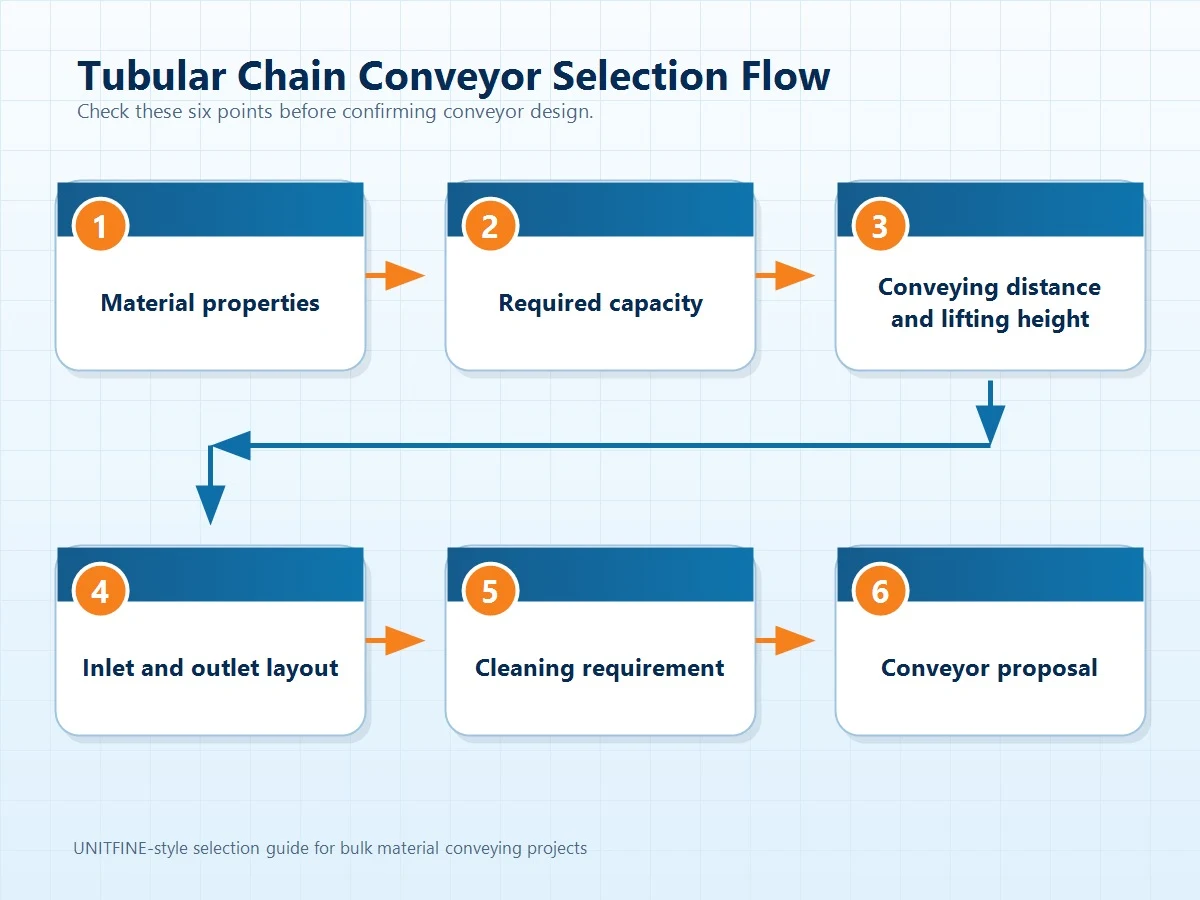
The right decision depends on the material, capacity, conveying distance, plant layout, cleaning requirement, and budget. UNITFINE normally recommends comparing several conveying methods before final design.
Key Selection Factors Before Buying
| Selection Factor | What to Confirm | Why It Matters |
|---|---|---|
| Material properties | Bulk density, particle size, moisture, abrasiveness, flowability | Determines tube size, chain type, speed, and power. |
| Capacity | Required hourly throughput and feeding stability | Prevents under-sizing or excessive conveying speed. |
| Conveying route | Horizontal distance, lifting height, number of bends | Influences layout, drive power, and system resistance. |
| Inlet and outlet design | Number, position, and discharge control requirements | Ensures smooth integration with production equipment. |
| Cleaning requirement | Food-grade, chemical-grade, or standard industrial cleaning | Affects structure, access points, and material selection. |
How UNITFINE Helps Select the Right Tubular Conveyor
UNITFINE helps customers evaluate the application before recommending a conveyor model. A useful inquiry normally includes material name, particle size, bulk density, moisture level, capacity, conveying distance, lifting height, workshop layout, and upstream/downstream equipment information.
With these details, the engineering team can recommend a suitable conveyor configuration, including tube diameter, chain and disc structure, inlet/outlet arrangement, drive position, and supporting equipment.
Need Help Choosing a Tubular Chain Conveyor?
If you are planning a powder, granule, pellet, seed, coffee, chemical, or food ingredient conveying line, UNITFINE can help review your material and layout requirements. Share your material information, required capacity, conveying distance, lifting height, and equipment layout to receive a practical conveying proposal.
FAQ
What materials can a tubular chain conveyor handle?
It can handle many dry powders, granules, pellets, flakes, seeds, beans, coffee, pet food, chemical powders, plastic pellets, and similar bulk materials. Final suitability depends on flowability, moisture, abrasiveness, and particle size.
Is a tubular chain conveyor suitable for food materials?
Yes, it can be designed for food ingredient handling when suitable contact materials, sealing, and cleaning access are used. The exact design should match the factory’s hygiene requirements.
Can one tubular chain conveyor have multiple outlets?
Yes. Depending on the process layout, the system can be designed with multiple discharge points to feed different machines, bins, or process stages.
How is it different from a screw conveyor?
A screw conveyor is often used for shorter and simpler feeding routes, while a tubular chain conveyor is usually better for enclosed, flexible, horizontal and vertical routing with longer or more complex layouts.
What information is needed before selecting a tubular chain conveyor?
You should prepare material name, bulk density, particle size, moisture, required capacity, conveying distance, lifting height, inlet and outlet positions, and any cleaning or safety requirements.