Dust leakage in powder conveying is rarely caused by one component alone. It usually develops where material feeding, air displacement, equipment sealing, transfer-point design, operating conditions, and maintenance practices do not work together. A plant may have an enclosed conveyor and still experience dust around the inlet, outlet, inspection cover, filter, flexible connection, or receiving vessel.
This guide explains how to reduce dust in powder conveying by controlling the complete material path—from pickup and feeding to transfer and discharge. It also shows when an enclosed mechanical conveyor, vacuum conveyor, or other conveying method may be appropriate.
Why Powder Escapes from a Conveying System
Powder moves with air even in systems that are primarily mechanical. When material enters a closed tube or receiver, it displaces air. If that air cannot leave through a controlled filter or vent path, pressure builds and finds the weakest opening. Fine particles then escape through worn seals, loose clamps, inspection doors, flexible sleeves, or unsealed discharge points.
Leakage can also be created by unstable feeding. A surge of material may plug a section, raise pressure, overload a drive, or force dust through a connection that remains clean during normal flow. This is why dust control begins with both material behavior and system operation—not just with adding more sealant.
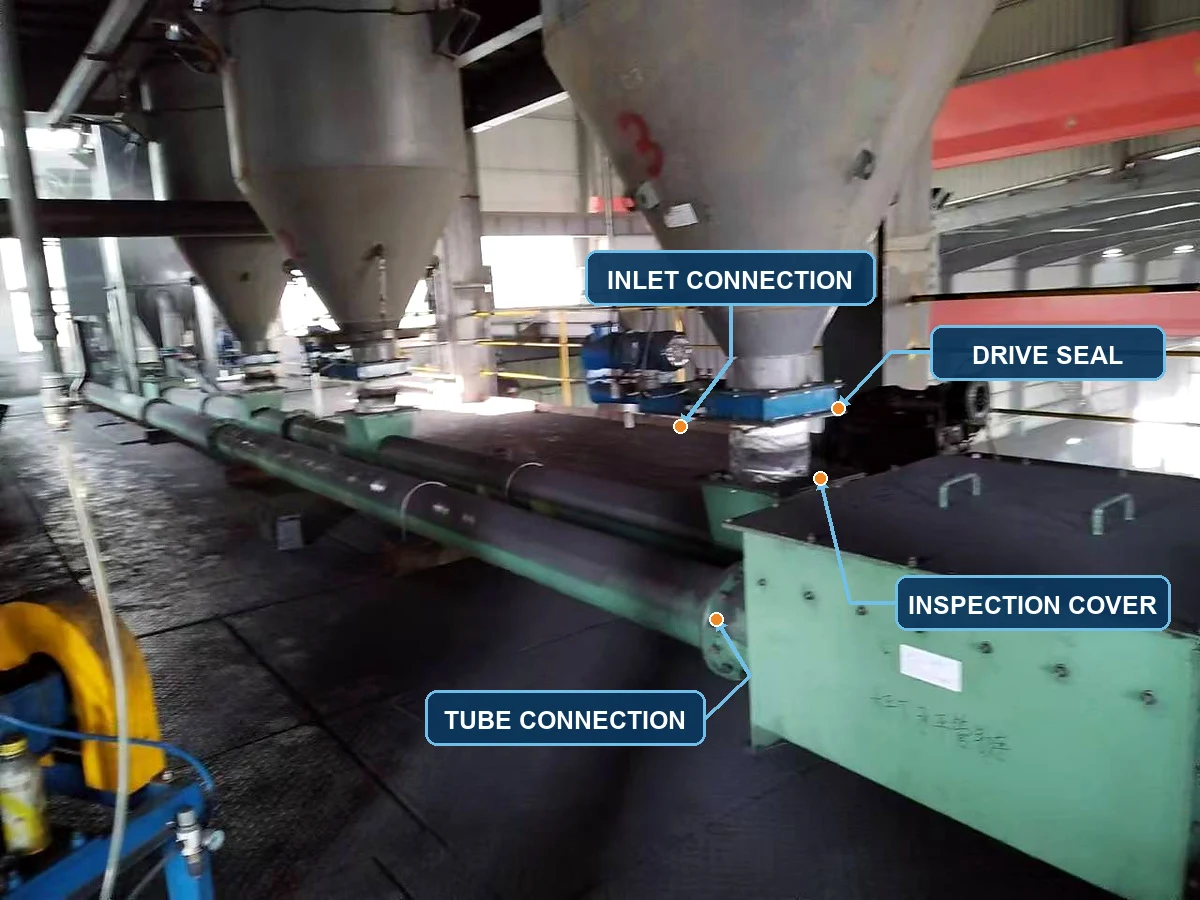
| Leakage Location | Typical Cause | Practical Check |
|---|---|---|
| Inlet or pickup point | Free-falling powder, poor hood geometry, excessive feed rate, or insufficient air capture | Observe the transfer during startup, stable production, and shutdown—not only when the line is empty. |
| Tube or duct connection | Loose clamp, damaged gasket, misalignment, vibration, or thermal movement | Inspect joint alignment, gasket compression, fastener condition, and powder trails. |
| Inspection cover | Worn seal, uneven closing pressure, product trapped on the sealing face | Clean the mating surfaces and verify the cover closes evenly. |
| Receiving hopper or outlet | Displaced air cannot escape, filter is restricted, or the airlock is not matched to the flow | Check filter differential pressure, vent area, discharge stability, and receiver level control. |
| Drive or shaft penetration | Seal wear, incorrect alignment, or product accumulation | Look for fine dust patterns, temperature rise, noise, and seal damage. |
Start with the Powder and the Process
A dust-control plan should begin with the material, not the equipment catalog. Particle size, bulk density, moisture, flowability, abrasiveness, cohesiveness, electrostatic behavior, temperature, and sensitivity to degradation all influence leakage risk and conveyor selection.
Define the operating case
Record the normal and maximum throughput, conveying distance, vertical lift, number of bends, feeding method, upstream surge behavior, receiving equipment, cleaning method, operating hours, and required containment level. A conveyor sized only for average capacity may be unstable during short feed surges.
Identify dust and explosion hazards
Combustible powders require a formal hazard assessment by qualified personnel. Grounding, bonding, ignition control, explosion protection, isolation, ventilation, and housekeeping must follow the applicable regulations and site standards. Enclosing a conveyor helps containment, but enclosure alone does not make a combustible-dust process safe.
Ten Practical Ways to Reduce Dust in Powder Conveying
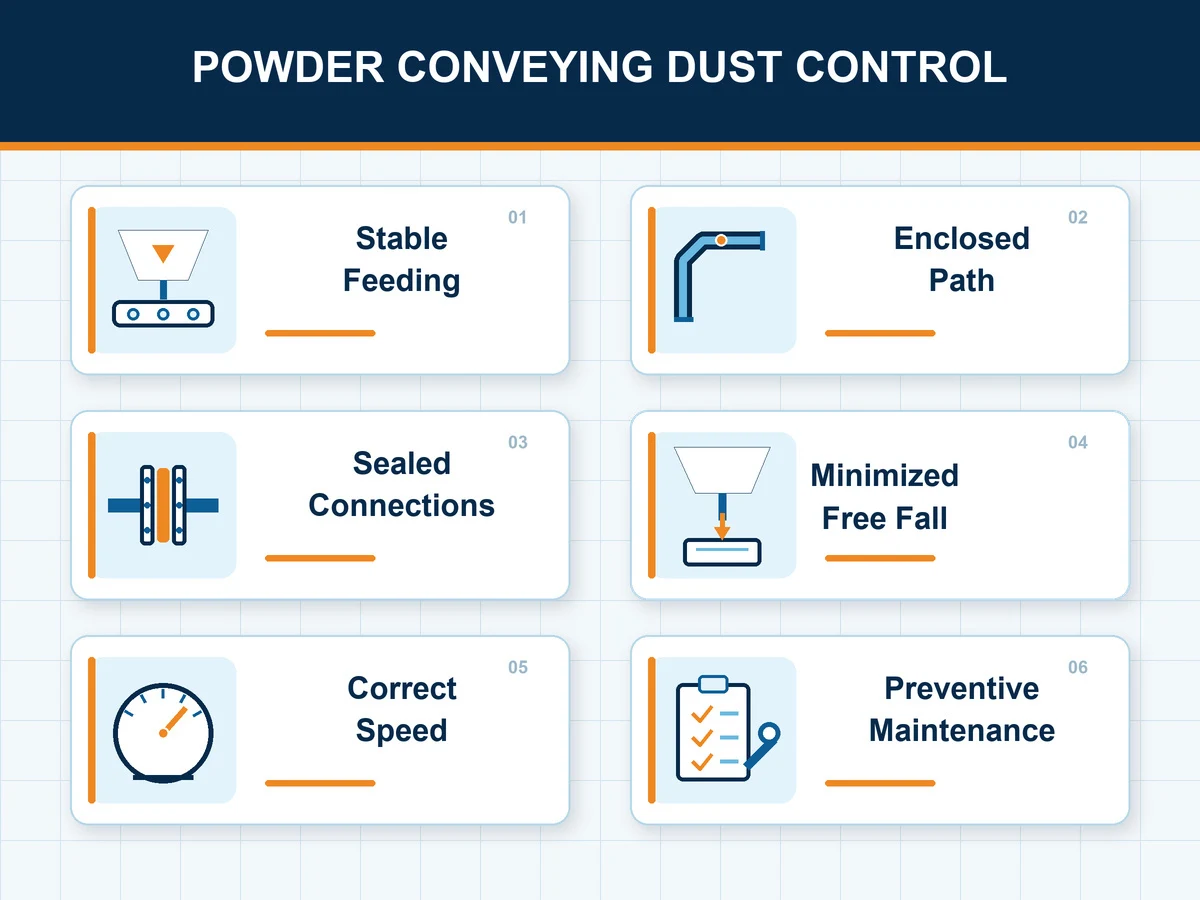
1. Use an enclosed conveying path
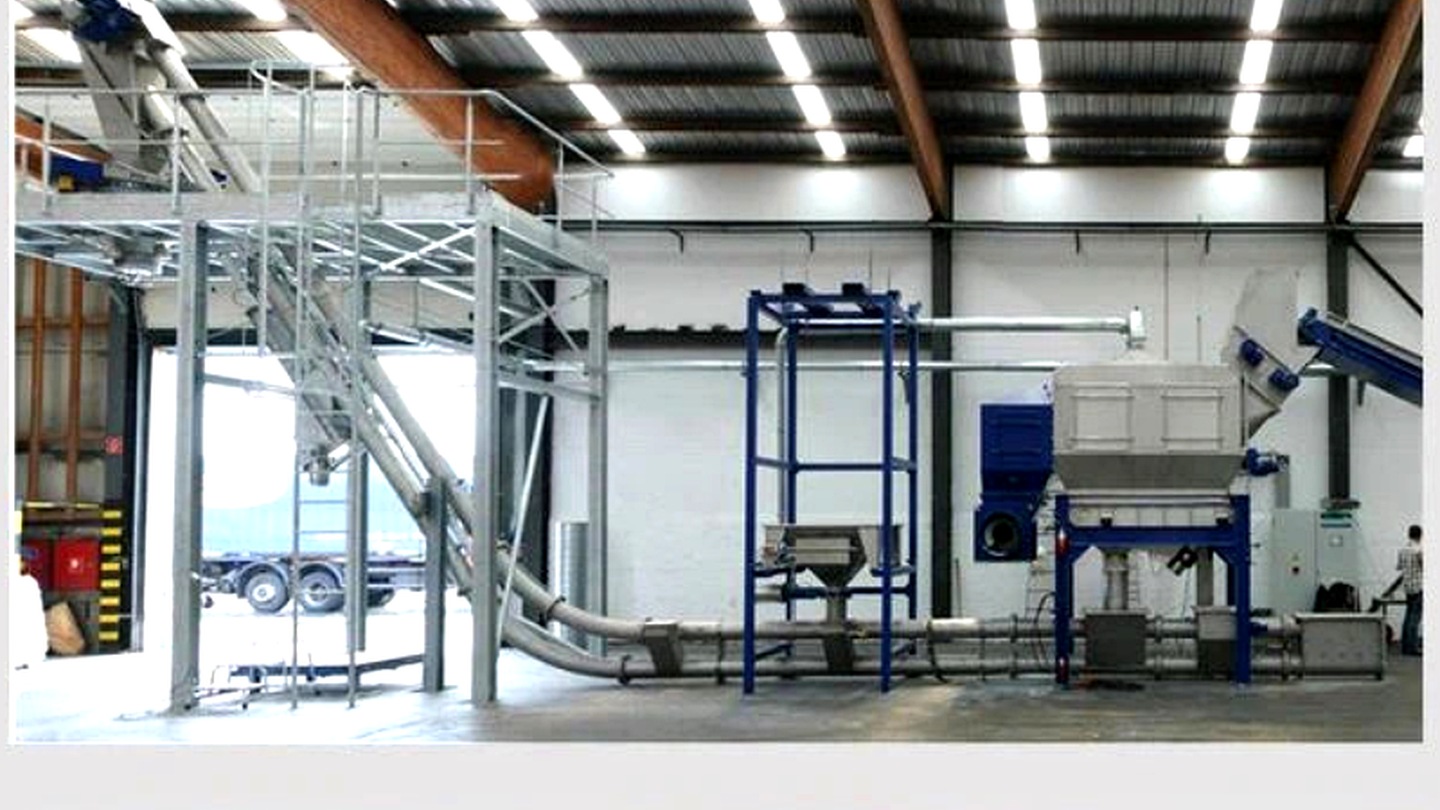
Open belts, uncovered screws, and long free-fall transfers expose powder to air movement. A sealed tubular system limits the number of release points and protects the material from external contamination. A drag tube chain conveyor moves bulk material through an enclosed pipeline and can follow horizontal, inclined, and vertical routes.
2. Control feeding instead of allowing surges
Use a feeder, rotary valve, controlled hopper outlet, or another metering device that supplies material at a rate the conveyor can accept continuously. Stable feed reduces plugging, motor load variation, receiver pressure spikes, and dust clouds at the pickup point.
3. Minimize free-fall height
Each long drop accelerates particles and entrains air. Bring the inlet, discharge chute, or telescopic connection closer to the receiving surface when practical. Maintain enough clearance for flow without creating an unnecessarily long fall.
4. Seal connections with the correct components
Gaskets, clamps, flanges, flexible connectors, inspection covers, and shaft seals must match the powder, temperature, cleaning chemicals, and movement of the system. A soft connector can isolate vibration, but it should not compensate for major mechanical misalignment.
5. Give displaced air a controlled route
When powder enters a receiver, air must leave. A correctly sized vent filter or dust collector allows air to escape while retaining particles. A blocked filter can pressurize the receiver and push dust through otherwise acceptable seals.
6. Use negative pressure where it adds control
A slight inward airflow at critical pickup points can prevent dust from migrating into the room. For suitable powders and routes, a vacuum conveyor provides enclosed transfer under negative pressure. Selection should consider filter loading, air-material separation, energy use, conveying distance, powder properties, and cleaning requirements.
7. Keep conveying speed appropriate
Higher speed is not automatically better. Excessive speed can increase particle attrition, airborne fines, wear, and impact at bends or receivers. The correct speed balances capacity, material integrity, system loading, and clean discharge.
8. Reduce unnecessary transfer points
Every inlet, outlet, chute, valve, and equipment transition is a possible leak point. A flexible route with fewer transfers can simplify containment and maintenance. UNITFINE’s conveying systems include several enclosed options that can be evaluated for different layouts and materials.
9. Inspect seals and wear parts before leakage becomes visible
Do not wait for a large dust pile. Fine powder traces around a joint often provide the first warning. Monitor gaskets, chain or cable components, conveying discs, tube bends, shaft seals, flexible sleeves, filters, clamps, and fasteners according to operating hours and material abrasiveness.
10. Record the cause, not only the cleanup
A repeated housekeeping task is evidence of an unresolved process problem. Record where dust appeared, the operating condition, material batch, feed rate, receiver level, filter condition, weather or humidity change, corrective action, and result. These records reveal patterns that visual inspection alone may miss.
Which Conveyor Type Helps with Dust Control?
The best conveyor depends on the powder and process. Dust containment is one decision factor alongside capacity, route, degradation, hygiene, cleaning, wear, energy use, and capital cost.
| Conveying Option | Dust-Control Strength | Important Engineering Questions |
|---|---|---|
| Tube drag chain conveyor | Enclosed mechanical path with flexible routing and limited transfer points | Is the chain/disc design suitable for the powder, bend layout, capacity, wear level, and cleaning method? |
| Tubular cable conveyor | Enclosed, gentle transfer for suitable fragile or sensitive materials | Does the material suit cable-and-disc conveying, and what sanitation or product-change requirements apply? |
| Vacuum conveyor | Negative-pressure transfer can contain leaks inward during operation | Can the filters handle the powder, and are the distance, capacity, air supply, and receiver cycle appropriate? |
| Screw conveyor | Can be covered and sealed for short, controlled transfer | How will shaft seals, end bearings, covers, intermediate supports, and cleaning access be managed? |
For powders that require gentle handling in a sealed tube, consider the UNITFINE tubular cable drag conveyor. For chain-driven transport of powders, granules, or small lumps through a sealed route, review the UNITFINE drag tube chain conveyor.
A Practical Dust-Leakage Inspection Routine
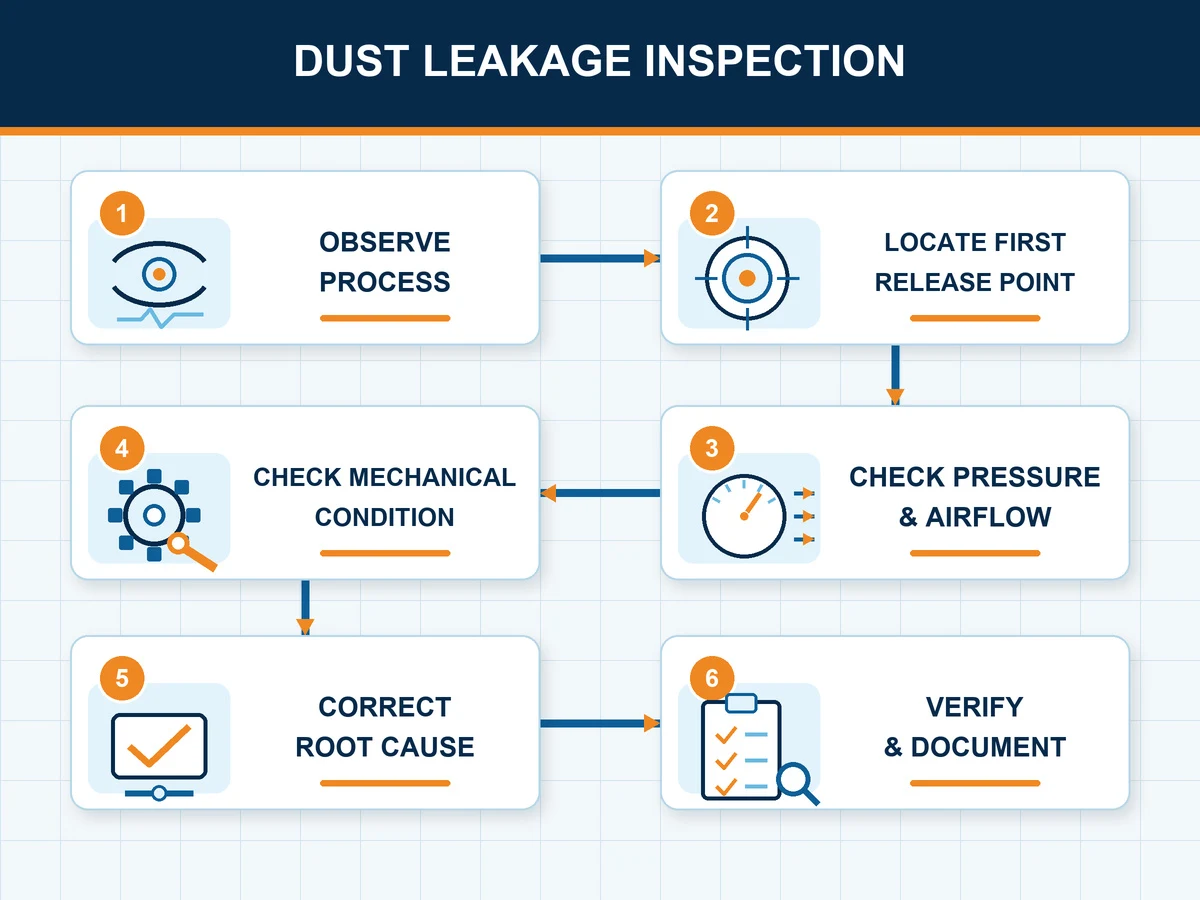
- Observe the process: Check startup, stable running, feed changes, receiver filling, and shutdown.
- Locate the first release point: Follow powder traces back to the earliest joint or transfer—not merely the floor deposit.
- Check pressure and airflow: Inspect vent filters, dust collectors, vacuum level, airlocks, and blocked outlets.
- Check mechanical condition: Inspect alignment, clamps, gaskets, seals, covers, bends, vibration, and wear.
- Correct the root cause: Adjust feed, repair sealing, restore ventilation, or change the transfer design as required.
- Verify and document: Run the system under the condition that caused the leak and record the result.
Information to Share with a Conveyor Manufacturer
A useful engineering review requires more than a required capacity. Share the powder name and safety data, particle-size range, bulk density, flow behavior, moisture, temperature, abrasiveness, conveying distance, vertical lift, bend quantity, inlet and outlet locations, upstream feeder, downstream receiver, cleaning method, operating schedule, containment target, and available utilities.
Photos or drawings of the existing line are especially helpful. Mark the locations where dust appears and note whether it occurs continuously, only during filling, only at high rate, or after filter cleaning. UNITFINE can use this information to compare enclosed conveying methods and propose a practical layout.
Need to Reduce Dust in Your Powder Conveying Line?
Send UNITFINE your powder properties, required capacity, route drawing, inlet/outlet details, and photos of the leakage points. Our team can help evaluate a tube drag chain conveyor, tubular cable conveyor, vacuum conveyor, or another suitable conveying solution.
FAQ
What is the fastest way to reduce dust at a powder transfer point?
First stabilize the feed and reduce free-fall height. Then confirm that displaced air has a filtered escape path and that the connection is properly sealed. Adding a seal without correcting pressure or unstable feeding may only move the leak elsewhere.
Does an enclosed conveyor completely prevent dust leakage?
An enclosed conveyor greatly reduces exposure points, but complete control still depends on inlet and outlet design, joint sealing, receiver venting, operating pressure, wear, cleaning, and maintenance.
When is a tube drag chain conveyor suitable for powder?
It can be suitable when the powder can be moved mechanically through a sealed tubular route and the selected chain, discs, speed, bends, capacity, wear protection, and cleaning method match the material and process.
Can negative pressure solve every powder leakage problem?
No. Negative pressure can improve containment, but filters, airflow, receiver sizing, conveying distance, product characteristics, and energy use must be engineered correctly. Mechanical defects and uncontrolled feed still require correction.
How often should seals and connections be inspected?
Inspection frequency should be based on operating hours, powder fineness, abrasiveness, temperature, vibration, cleaning cycles, and leakage history. High-risk joints may require a quick check each shift, with more detailed scheduled inspections.
What information does UNITFINE need to recommend a conveyor?
Provide material properties, capacity, route, lift, bend quantity, feeding and receiving equipment, cleaning requirements, operating schedule, containment target, and site photos or drawings.