The advantages of tubular chain conveyors become most valuable when a plant must move powders, granules, pellets, flakes, or small bulk solids through an enclosed route without creating several separate transfer stages. A properly selected system can combine horizontal, inclined, and vertical conveying, protect the product and surrounding area, and fit around existing equipment. However, these benefits are not automatic: material behavior, route geometry, cleaning standards, wear, capacity, and feeding conditions must all be checked before a conveyor is specified.
This engineering selection guide explains where a tubular chain conveyor creates practical value, where a tubular cable conveyor may be preferred for fragile products, and when a vacuum or screw conveyor may be the better choice. It is written for plant engineers, project managers, purchasing teams, and production managers comparing bulk material handling options.
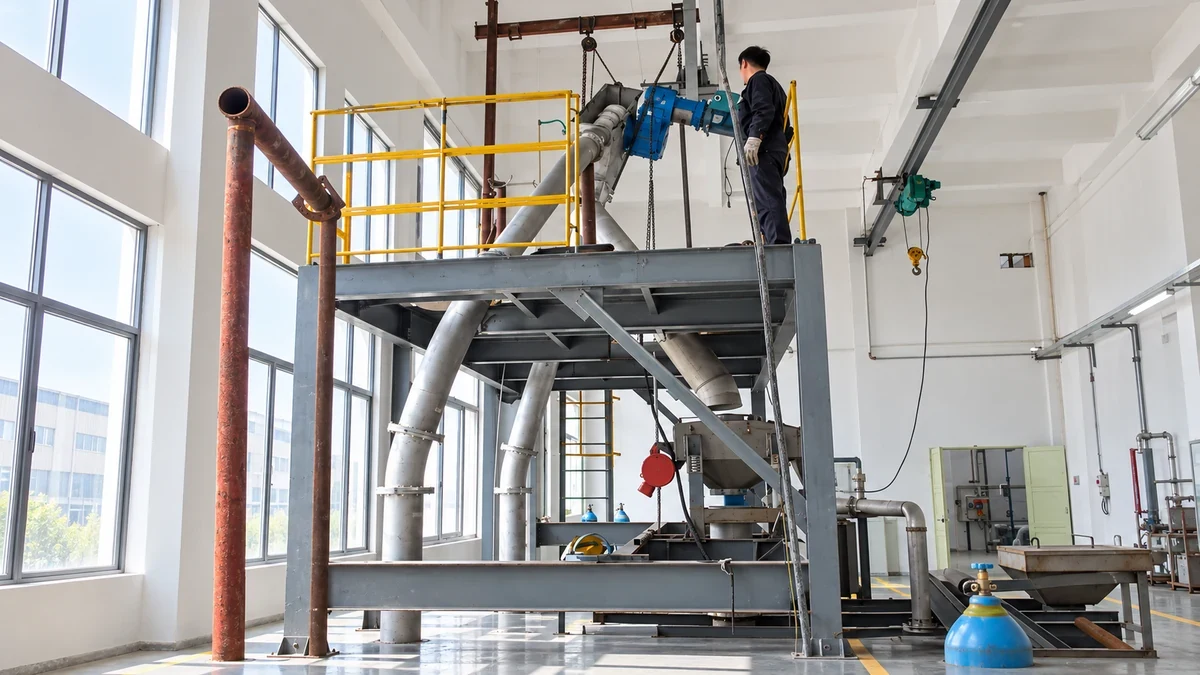
What Is a Tubular Chain Conveyor?
A tubular chain conveyor moves bulk material inside a closed pipe. A continuous chain fitted with discs travels through the tube and pulls or pushes a controlled material column from the inlet toward one or more discharge points. The route can include horizontal runs, vertical lifts, inclines, and bends.
The same broad family also includes tubular cable drag conveyors. Instead of a chain, a cable carries polymer discs through the enclosed tube. Both designs use discs to move material at controlled speed, but their mechanical construction and best-fit applications differ. The UNITFINE UTL Series tubular cable drag conveyor, for example, is designed for gentle transfer of fragile or sensitive bulk solids. UNITFINE also offers a drag tube chain conveyor for powder, granular, and small-lump materials.
Eight Practical Advantages of Tubular Chain Conveyors
1. Enclosed Transfer Helps Control Dust and Contamination
The material remains inside a sealed tube between the feeding and discharge points. Compared with an open belt, manual transfer, or exposed mechanical handling, an enclosed route can reduce product escape and limit exposure to the surrounding environment. This is useful for fine powders, food ingredients, chemicals, additives, plastic pellets, seeds, pet food, coffee, and other materials for which housekeeping or contamination control is important.
Containment still depends on correctly designed inlets, outlets, seals, inspection ports, dust collection interfaces, and feeding equipment. An enclosed conveyor should therefore be evaluated as part of the complete process rather than as an isolated machine.
2. Gentle Conveying Can Protect Product Integrity
Discs move material through the tube at controlled speed without the high air velocity of pneumatic transport or the continuous shearing action that can occur in some screw conveyor applications. For fragile granules, coffee beans, seeds, snacks, pet food, pellets, or blended products, this can help reduce breakage, attrition, segregation, and fines generation.
“Gentle” is material-dependent. Product damage should be checked with representative samples, the intended conveyor speed, bend radius, route length, number of transfers, and expected fill level. A material test is more reliable than a generic promise.
3. One Route Can Combine Horizontal and Vertical Movement
A tubular conveyor can be routed horizontally, vertically, or on an incline within one continuous circuit. This can eliminate intermediate elevators or multiple short conveyors, reduce the number of transfer points, and simplify the connection between silos, mixers, sieves, reactors, packing machines, and finished-product bins.
Fewer transfers may also mean fewer potential leakage points and less product drop. The final route must still respect the system’s allowable bend geometry, tension, drive load, access requirements, and supporting structure.
4. Flexible Routing Makes Better Use of Existing Space
Brownfield plants rarely offer a straight, empty path. A tube route can pass around columns, walls, platforms, doors, and other process equipment while using overhead or vertical space. This is often one of the strongest advantages of tubular chain conveyors in facilities where floor area is limited.
Flexible does not mean unlimited. Excessive bends, poorly located feeding points, insufficient maintenance access, or an unnecessarily long path can reduce reliability. A good layout uses the simplest route that meets the process requirement.
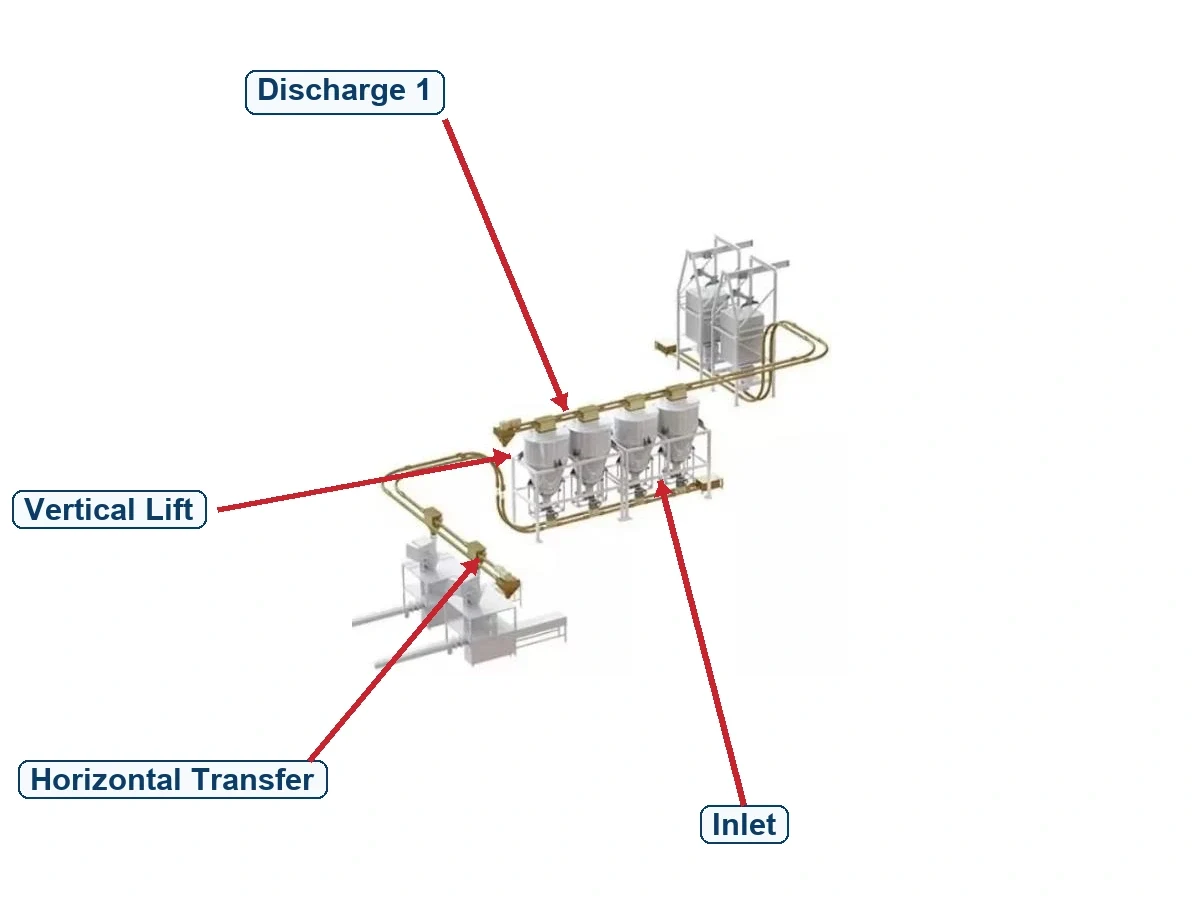
5. Multiple Inlets and Outlets Can Support Process Integration
Depending on the application and control strategy, a tubular chain conveyor may be configured with several feeding or discharge points. This can allow one system to collect material from multiple sources or deliver to selected destinations. The result may be a cleaner and more compact line than several independent conveyors.
Each additional inlet or outlet must be engineered carefully. Feed rate, discharge control, residual material, cross-contamination risk, product changeover, and the consequences of a blocked outlet should be considered before the layout is approved.
6. Low-Speed Mechanical Transfer Can Be Energy-Efficient
A tubular chain or cable conveyor moves material mechanically through a defined path. For suitable duties, it may use less energy than a pneumatic system that must continuously move a large volume of air. It may also avoid the larger dust filtration and air-material separation equipment required by some pneumatic systems.
Energy use should be compared at the required capacity, distance, lift, route, duty cycle, and material bulk density. Motor rating alone is not a complete comparison. Include auxiliaries such as blowers, filters, compressed air, dust collectors, feeding devices, and controls.
7. Modular Construction Can Support Expansion and Maintenance
Tube sections, bends, inlets, outlets, inspection points, and drive components can be configured for the plant. A modular approach can make future rerouting or capacity planning easier than a fixed one-piece installation. Correctly positioned inspection points also improve access for cleaning, disc inspection, tension checks, and wear monitoring.
Future flexibility should be designed at the beginning. If expansion is likely, tell the conveyor supplier the possible new route, capacity, and operating hours so that the original drive, tube size, support system, and controls can be evaluated accordingly.
8. A Closed System Can Improve the Working Environment
Containing material inside a tube can reduce visible dust, spillage, and frequent housekeeping around the conveyor path. Slow mechanical conveying can also avoid some of the air movement and noise associated with pneumatic conveying. These factors can support a cleaner production area and more predictable material flow.
The result depends on the entire installation. Feeding points, seals, discharge transitions, dust extraction, grounding, explosion protection, and operating procedures must all match the material hazard assessment and local requirements.
Tubular Chain vs Cable, Vacuum, and Screw Conveyors
No conveyor is best for every material. The following table provides a practical first comparison. Final selection should be based on material testing and a complete process review.
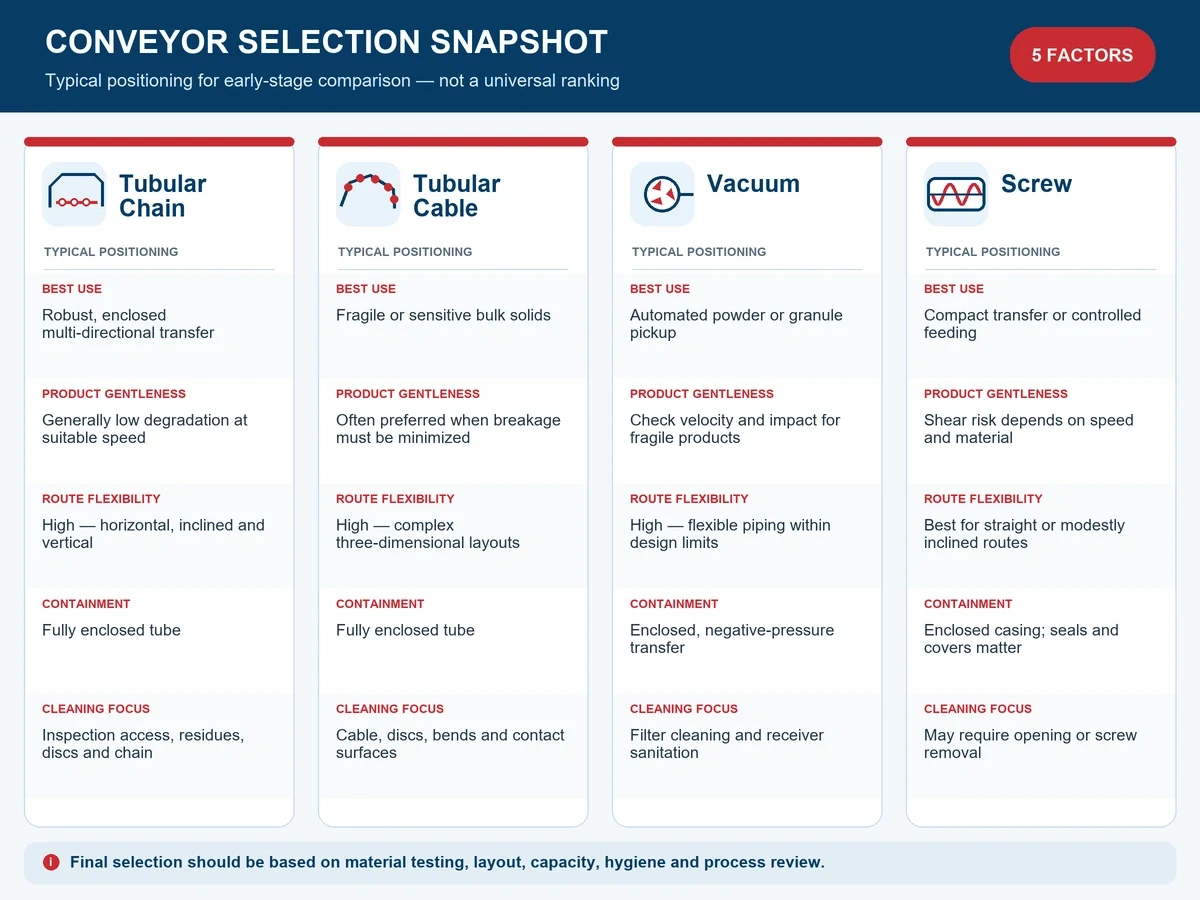
| Selection Factor | Tubular Chain Conveyor | Tubular Cable Conveyor | Vacuum Conveyor | Screw Conveyor |
|---|---|---|---|---|
| Typical strength | Robust enclosed transfer with horizontal, inclined, and vertical routing | Gentle enclosed transfer for fragile or sensitive products | Clean, flexible transfer of powders and granules using negative pressure | Simple, compact mechanical transfer and controlled feeding over shorter routes |
| Product degradation | Generally low at suitable speed and fill level | Often the preferred option when breakage must be minimized | Can be higher for fragile products because of velocity and impact | Can create shear or product damage depending on screw speed and material |
| Route flexibility | High; one route can combine directions | High; suitable for complex three-dimensional layouts | High; piping can be routed flexibly within design limits | Usually best for straight or modestly inclined routes |
| Containment | Fully enclosed tube | Fully enclosed tube | Enclosed and operated under negative pressure | Enclosed casing, but seals and covers require careful design |
| Cleaning considerations | Inspection access, residual material, disc and chain cleaning must be planned | Cable, discs, bends, and product-contact surfaces must be accessible or cleanable | Filter cleaning and receiver sanitation are key | Deep cleaning may require opening or removing the screw |
| Best-fit question | Do we need a robust enclosed multi-directional route? | Is gentle transfer of a fragile product the priority? | Do we need short, automated powder transfer with easy pickup points? | Do we need simple transfer or metered feeding on a relatively direct route? |
For a closer product review, compare UNITFINE’s UFLOW vacuum conveyor and U type screw conveyor with the tubular options. The broader UNITFINE conveying system range can help teams evaluate the alternatives within one process plan.
When Is a Tubular Chain Conveyor the Right Choice?
A tubular chain conveyor deserves serious consideration when several of the following conditions apply:
- The material must remain enclosed from pickup to discharge.
- The route needs both vertical and horizontal sections.
- The plant has limited floor space or many obstacles.
- Product breakage, segregation, or fines generation must be controlled.
- Several process machines need to be connected with fewer transfers.
- Dust, spillage, or outside contamination is a concern.
- Multiple inlets or selected discharge points may be needed.
- The product and cleaning method are compatible with the proposed chain, discs, tube, seals, and access points.
When Might Another Conveyor Be Better?
A tubular chain conveyor is not automatically the best solution. A screw conveyor may be more economical for a short, direct route or for metered feeding. A vacuum conveyor may be preferred when powder must be picked up from flexible suction points and transferred intermittently to a receiver. A bucket elevator may be more suitable for a straightforward high-capacity vertical lift. Extremely abrasive, sticky, compressible, hot, hazardous, or difficult-to-clean materials require additional testing and design controls.
The most common selection mistake is choosing a conveyor from a generic capacity number while ignoring bulk density, particle size distribution, moisture, flowability, fragility, abrasiveness, temperature, route, duty cycle, sanitation, and hazard classification.
Engineering Data to Provide Before Requesting a Quote
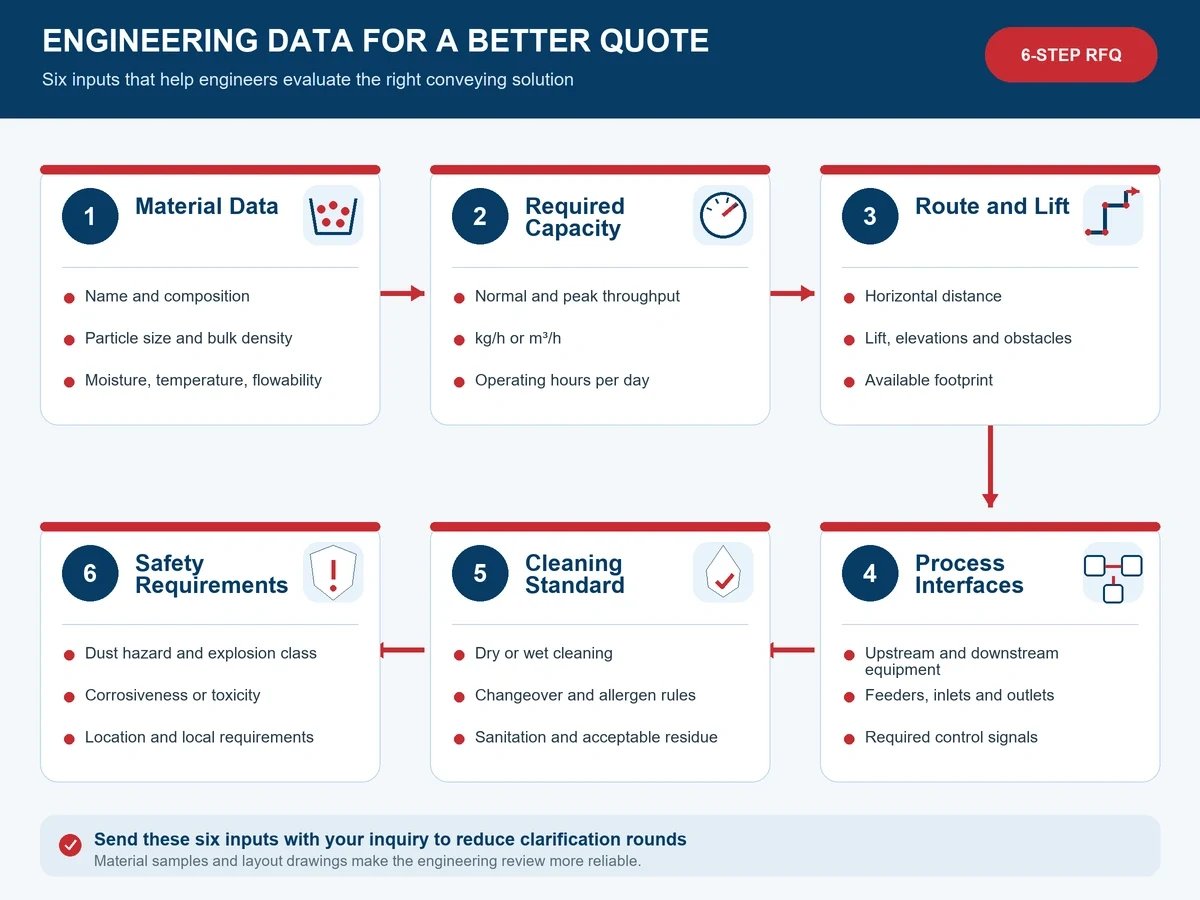
| Information | Why It Is Needed | Recommended Detail |
|---|---|---|
| Material | Determines flow, wear, cleaning, and product-contact requirements | Name, composition, particle size, bulk density, moisture, temperature, abrasiveness, fragility, and flowability |
| Capacity | Influences tube size, speed, fill level, and drive selection | Normal and peak capacity in kg/h or m³/h, plus operating hours per day |
| Route | Determines length, lift, bends, drive load, supports, and access | Horizontal distance, vertical lift, inlet/outlet elevations, obstacles, and available footprint |
| Process interfaces | Prevents unstable feeding, overfilling, or poor discharge | Upstream equipment, feeder type, downstream machine, inlet count, outlet count, and control signals |
| Cleaning and hygiene | Defines access, surface material, residual control, and validation needs | Dry or wet cleaning, changeover frequency, allergen rules, sanitation standard, and acceptable residue |
| Safety and environment | Influences containment, grounding, protection, and documentation | Dust hazard data, explosion classification, corrosiveness, toxicity, indoor/outdoor location, and local requirements |
How UNITFINE Approaches Conveyor Selection
A useful proposal should do more than name a machine. It should connect material characteristics, required capacity, route geometry, product quality, cleaning expectations, and upstream/downstream equipment. For fragile products, the comparison may favor the UTL tubular cable conveyor. For a robust enclosed transfer route, a drag tube chain conveyor may be more appropriate. For short intermittent powder transfer or direct feeding, a vacuum or screw conveyor may be the better answer.
UNITFINE’s engineering team can review the material sample, layout drawing, elevations, process connections, capacity, and cleaning requirements before recommending a configuration. This reduces the risk of selecting equipment that looks suitable in a catalog but does not fit the actual production line.
Need Help Comparing Conveyor Options?
Send UNITFINE your material name, particle size, bulk density, moisture, required capacity, horizontal distance, vertical lift, inlet and outlet locations, operating hours, and cleaning standard. We can help compare tubular chain, tubular cable, vacuum, and screw conveying options for your line.
Frequently Asked Questions
What are the main advantages of a tubular chain conveyor?
The main advantages are enclosed conveying, dust and contamination control, gentle material movement, flexible horizontal and vertical routing, efficient use of plant space, fewer transfer points, and the possibility of multiple inlets or outlets.
Is a tubular chain conveyor suitable for powders?
It can handle many powders, granules, pellets, flakes, and small bulk solids, but suitability depends on flowability, moisture, cohesiveness, abrasiveness, particle size, temperature, and cleaning requirements. Representative material testing is recommended for difficult products.
What is the difference between a tubular chain and tubular cable conveyor?
Both move discs through an enclosed tube. A tubular chain conveyor uses a chain, while a tubular cable conveyor uses a cable. Cable systems are often considered where especially gentle handling of fragile products is important; chain systems may suit robust enclosed conveying duties. The final choice depends on the material and route.
Is a tubular chain conveyor better than a vacuum conveyor?
Neither is universally better. Tubular chain conveyors are attractive for continuous, low-speed, enclosed transfer through multi-directional routes. Vacuum conveyors are useful for flexible powder pickup and automated transfer under negative pressure. Compare product damage, route, capacity, energy, filtration, cleaning, and duty cycle.
Can one tubular conveyor have several inlets and outlets?
Many systems can be configured with multiple feeding or discharge points, but the controls, feed balance, residual material, changeover risk, and outlet operation must be engineered for the specific process.
What information does UNITFINE need to select a conveyor?
Provide the material properties, normal and peak capacity, route drawing, vertical lift, operating schedule, inlet and outlet positions, upstream and downstream equipment, cleaning method, product-contact material, and any dust or safety requirements.